


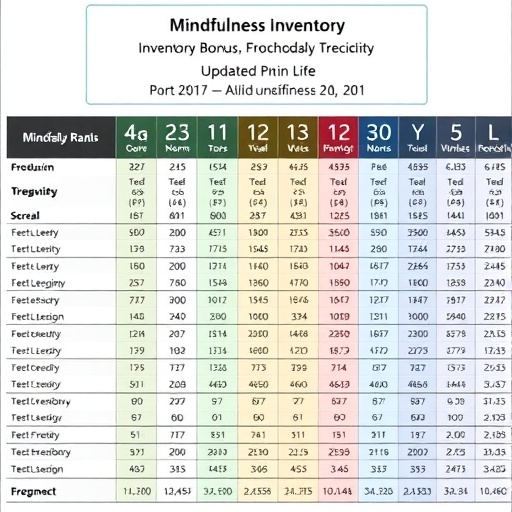
In the rapidly expanding field of mindfulness research, the Freiburg Mindfulness Inventory (FMI) has emerged as a pivotal tool for assessing mindfulness traits across diverse populations. A groundbreaking study led by Walach, Sauer, Kohls, and colleagues, soon to be published in BMC Psychology in 2025, takes a significant leap forward by presenting comprehensive norm scores and psychometric evaluations of both the FMI short form and the revised form, known as FMI-13R. This research is particularly notable for its use of a large, representative sample drawn from the German population, marking an unprecedented stride in ensuring the cultural and demographic relevance of mindfulness measurement.
Mindfulness, often characterized as the awareness that emerges through paying attention to the present moment non-judgmentally, has garnered immense interest both in clinical psychology and in broader health and wellness contexts. Yet, measuring such an inherently subjective and multifaceted construct poses substantial challenges. The FMI’s development was motivated by the need for a concise, reliable, and valid instrument suitable for diverse populations including clinical and general samples.
The study underlines the relevance of refining and validating mindfulness measurement tools, showing that the original FMI short form, while widely used, had certain limitations in capturing nuanced aspects of mindfulness. The revised FMI-13R incorporates subtle changes aimed at enhancing the scale’s psychometric robustness, including improved internal consistency and construct validity. This adjustment is not merely a technical tweak but reflects deeper insights into how mindfulness manifests behaviorally and experientially in daily life.
Data were collected via a meticulously stratified sampling method that mirrored the demographic composition of Germany, including variables such as age, gender, educational background, and socioeconomic status. This methodological rigor ensures that the derived norm scores carry strong generalizability and can serve as meaningful benchmarks for both researchers and practitioners assessing mindfulness in German-speaking contexts.
Psychometric analysis employed advanced statistical techniques, including confirmatory factor analysis (CFA), reliability testing via Cronbach’s alpha, and convergent validity assessments with related psychological constructs such as emotional regulation and psychological well-being. These rigorous evaluations confirmed that the FMI-13R outperforms the original short form in several domains, notably in factorial structure stability, reliability coefficients exceeding 0.80, and higher predictive validity in relation to stress resilience measures.
Another remarkable facet of the study is its discussion on the theoretical foundations of mindfulness and how these relate to item selection and scale construction. The researchers argue that the revised version better encapsulates core mindfulness components such as present-moment attention and acceptance, integrating contemporary philosophical and neuroscientific perspectives with psychometric science. This synthesis underscores a critical advancement in mindfulness research methodology.
The findings have wide-reaching implications for clinical psychology, especially for interventions that integrate mindfulness training, such as Mindfulness-Based Stress Reduction (MBSR) or Mindfulness-Based Cognitive Therapy (MBCT). Clinicians can now rely on the FMI-13R normative data to more accurately identify individual differences in mindfulness capacity and track changes over treatment courses with enhanced sensitivity.
Moreover, the availability of representative norm data facilitates international cross-cultural comparisons in future studies. Such comparisons can illuminate how cultural factors mediate mindfulness experiences and measurement, an area that has remained underexplored due to a paucity of reliable normative information across different populations. This German sample serves as an essential reference point for these endeavors.
The research team also acknowledges limitations and suggests directions for further exploration, including longitudinal studies to examine the stability of mindfulness traits over time and across life transitions. They also emphasize the need to investigate potential differential item functioning (DIF) related to demographic subgroups, ensuring the tool’s fairness and applicability to marginalized groups.
In the digital age, where mindfulness apps and online interventions have proliferated, having validated instruments like the FMI-13R is crucial to scientifically underpinning such technological innovations. This study thus contributes not only to academic knowledge but also to practical tools that support mental health promotion on a large scale.
As mindfulness continues to be woven into the fabric of healthcare systems worldwide, the work of Walach and colleagues offers a meticulous, evidence-based approach to a fundamental challenge: how to measure mindfulness with precision, cultural sensitivity, and scientific rigor. Their contributions will undoubtedly inspire subsequent research and enable more targeted, effective applications of mindfulness science in clinical and community settings.
The study’s publication in BMC Psychology ensures accessibility and encourages open scholarly discourse, which is vital for refining mindfulness measurement further. With its robust methodology and expansive sample, this work sets a high standard for future psychometric evaluations in the mindfulness domain.
Ultimately, the validation and norm norm-setting of the FMI short form and the FMI-13R pave the way for a more nuanced understanding of mindfulness as a psychological construct. This, in turn, may catalyze novel interventions and deepen our comprehension of the interplay between mindfulness, mental health, and human flourishing.
Cite Scienmag News
Glenn Wilkins. (November 27, 2025). Freiburg Mindfulness Inventory Norms, Psychometrics Updated. Scienmag. https://scienmag.com/freiburg-mindfulness-inventory-norms-psychometrics-updated/
Glenn Wilkins. "Freiburg Mindfulness Inventory Norms, Psychometrics Updated." Scienmag, 27 November 2025, https://scienmag.com/freiburg-mindfulness-inventory-norms-psychometrics-updated/. Accessed 9 September 2026.
Glenn Wilkins. "Freiburg Mindfulness Inventory Norms, Psychometrics Updated." Scienmag. November 27, 2025. https://scienmag.com/freiburg-mindfulness-inventory-norms-psychometrics-updated/


