


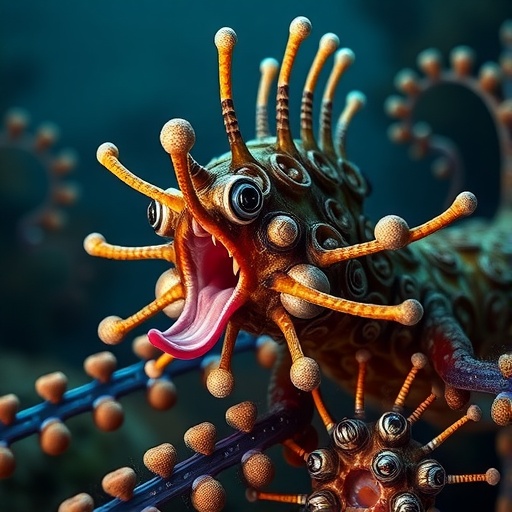
Deep-sea anglerfish, famous for the bioluminescent lure that dangles from their heads, have long captivated biologists because of one of the strangest reproductive strategies in the animal kingdom. In the crushing darkness a kilometer below the ocean surface, males are tiny compared to females, and they survive by fusing permanently to a female’s body, sharing her blood and becoming a living partner in a permanent symbiotic union. That unusual biological arrangement, in which two individuals with sharply different roles and behaviors cooperate to survive in an extreme, high-pressure environment, has now inspired a new computational method for solving some of the hardest problems in engineering design.
The method, called Deep-Sea Anglerfish Symbiosis Optimization, or DASO, was developed by Xinpeng Xu of The University of Newcastle in Australia and published in the journal Complex & Intelligent Systems. It belongs to the family of metaheuristics, the class of algorithms that underpin modern swarm intelligence. These are computational techniques that take their cues from nature, from bird flocks and fish schools to ant foraging trails and, increasingly, from less obvious biological phenomena. Rather than exhaustively searching every possible solution, metaheuristics deploy a population of candidate solutions that explore a problem space iteratively, guided by rules that balance finding entirely new regions against refining the best solutions already discovered.
The central challenge DASO was designed to tackle is a familiar one in optimization research: premature convergence and loss of population diversity. When an optimization algorithm confronts a high-dimensional, non-convex landscape, a mathematical terrain riddled with many local optima, deceptive basins of attraction, and sharp ridges, it can easily become trapped in a suboptimal region early in the search. Once the population clusters in the wrong place, the algorithm loses the diversity it needs to escape, and the search stalls. Classical remedies, such as increasing population size or injecting random mutations, help but often at the cost of slow convergence or unstable performance across different problem types.
Xu’s approach departs from most existing swarm intelligence methods by abandoning the assumption that every individual in the population should behave the same way. In the anglerfish metaphor, male and female agents occupy differentiated search roles, a concept the author describes as functional dimorphism. Female agents, modeled on the larger and more mobile fish, are primarily responsible for global exploration, probing broad regions of the search space for promising areas. Male agents, reflecting their smaller size and their dependence on locating and attaching to a female, are geared toward local refinement, intensifying the search around the most promising solutions found so far. This division of labor means exploration and exploitation are handled by distinct subpopulations with distinct movement rules, rather than by a single set of dynamics applied to everyone.
The framework integrates several further mechanisms inspired by anglerfish biology. Asymmetrical attachment governs how male agents bind themselves to high-quality solutions discovered by female agents, but in a way that is deliberately not uniform across the population, helping to preserve diversity in how the search intensifies. Local field-guided movement allows agents to exploit information from their immediate neighborhood, in the spirit of the luminous lure that attracts partners in the dark, steering nearby candidates toward promising regions without requiring global knowledge of the entire landscape. Nonlinear high-pressure adaptation serves as a scheduling mechanism, dynamically tuning the balance between exploration and exploitation as the search progresses, echoing the way organisms must adapt their behavior under the extreme pressure of the deep sea. Together, these components coordinate a heterogeneous, role-structured search in which global discovery and local polishing reinforce each other rather than compete.
To evaluate the algorithm, Xu ran an extensive experimental campaign using two widely respected benchmark suites: CEC2017 and CEC2022, competition benchmark sets drawn up by the IEEE Congress on Evolutionary Computation that are standard yardsticks for metaheuristic research. These suites contain functions specifically engineered to challenge different aspects of an optimizer, including unimodal problems with a single basin, multimodal problems dense with local optima, hybrid functions that combine different characteristics within one landscape, and composite functions that rotate and shift the terrain to defeat algorithms tuned to coordinate systems. DASO was tested in 10-, 30-, and 50-dimensional settings, with 30 independent runs conducted for every configuration. Repeating each experiment 30 times matters because metaheuristics are stochastic: their performance varies from run to run depending on random initial conditions, and robust conclusions require measuring that variability rather than relying on a single lucky trial.
The results showed that DASO achieved competitive performance in solution quality, convergence behavior, and robustness when compared with representative metaheuristic algorithms from the literature. In practical terms, competitive performance across both benchmark suites and all three dimensionalities indicates that the algorithm is not a specialist tuned to a narrow class of problems, but a general-purpose optimizer that adapts well as problem difficulty and dimensionality increase. Convergence behavior, meaning how quickly the best solution improves over the course of the run and whether the improvement curve plateaus at a high-quality value, was a particular strength associated with the role-structured division of labor, since male agents can intensify around female discoveries without dragging the entire population away from unexplored regions.
A crucial element of the evaluation was the statistical treatment of the results. Because stochastic algorithms produce different outcomes on every run, comparing a single set of figures can be misleading. Xu therefore applied the Wilcoxon rank-sum test, a non-parametric statistical test that determines whether the distribution of results from two algorithms differs significantly, at the 0.05 significance level. This analysis confirmed the consistency of DASO’s performance relative to its competitors, providing a rigorous basis for the claim that the observed advantages are genuine rather than artifacts of random variation.
Beyond abstract benchmarks, the study tested DASO on constrained engineering design problems, where algorithms must satisfy real-world requirements such as stress limits, material constraints, and manufacturing tolerances while minimizing cost or weight. Constrained problems are notoriously difficult because the optimal solutions often lie exactly on the boundary of feasibility, forcing the algorithm to walk a tightrope between improving the objective and violating a constraint. Strong performance in this arena is the most meaningful evidence that a new metaheuristic can translate into practical value, and DASO’s results there support the author’s broader thesis: that heterogeneous, role-structured populations are a promising design principle for complex optimization.
The significance of the work lies in its design philosophy as much as its benchmark numbers. The overwhelming majority of swarm intelligence algorithms, from particle swarm optimization to artificial bee colony methods, model a homogeneous population in which every agent follows the same behavioral rules, and diversity is maintained only through mechanisms like random perturbation. DASO demonstrates that explicitly assigning different roles to different agents, drawing on biological dimorphism as a template, can be an effective structural answer to the exploration-exploitation dilemma at the heart of all stochastic optimization. The deep-sea anglerfish turns out to be more than a curiosity of natural history: its radical cooperation between unlike partners offers a blueprint for coordinating unlike searchers in computational landscapes.
As engineering systems grow more complex, from aerodynamic shapes and structural frameworks to neural architectures and supply chains, the demand for robust, general-purpose optimizers continues to rise. DASO adds a biologically grounded and statistically validated entry to that toolbox, suggesting that the strangest corners of the natural world still hold unexploited lessons for computer science. The paper is open access, allowing researchers worldwide to examine, replicate, and build upon the approach, and future work will likely explore how role-structured populations scale to even higher dimensions and to dynamic, changing problem environments.
Cite Scienmag News
Denise Maddox. (September 9, 2026). Deep sea anglerfish symbiosis inspires new engineering optimization method. Scienmag. https://scienmag.com/deep-sea-anglerfish-symbiosis-inspires-new-engineering-optimization-method/
Denise Maddox. "Deep sea anglerfish symbiosis inspires new engineering optimization method." Scienmag, 9 September 2026, https://scienmag.com/deep-sea-anglerfish-symbiosis-inspires-new-engineering-optimization-method/. Accessed 9 September 2026.
Denise Maddox. "Deep sea anglerfish symbiosis inspires new engineering optimization method." Scienmag. September 9, 2026. https://scienmag.com/deep-sea-anglerfish-symbiosis-inspires-new-engineering-optimization-method/


