

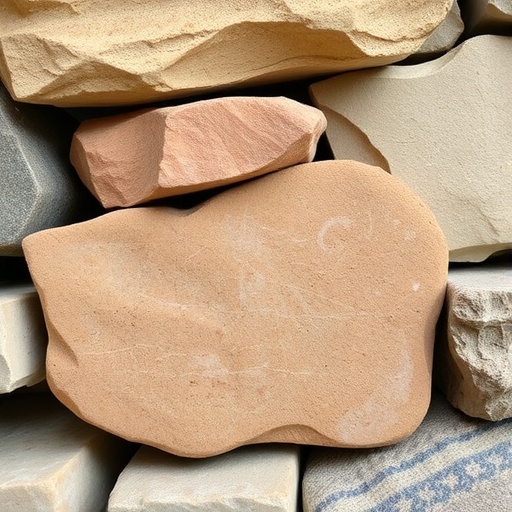
In an unprecedented dive into the interplay between freeze-thaw dynamics and sandstone degradation, recent research led by Li, Yin, Zhang, and colleagues unravels the intricacies of how cooling rates influence the mechanical and hydraulic impairments in this vital sedimentary rock. Sandstone, a crucial material in both natural and engineered settings, faces continuous exposure to environmental stresses. Among these, the freeze-thaw cycles stand out for their potential to induce profound alterations in rock integrity. This study casts a new light on the mechanisms driving sandstone’s deterioration, elucidating factors that have until now remained poorly quantified.
The methodology adopted by the researchers is not only innovative but exemplifies the meticulous approach necessary to decode freeze-thaw effects. By varying the cooling rates during laboratory simulations of freeze-thaw cycles, the team systematically evaluated the subsequent mechanical deterioration of sandstone samples. Their approach provides a novel parameter—cooling rate—as a pivotal variable influencing the extent and nature of damage incurred. Such detailed investigations allow a deeper understanding of how rapid versus gradual temperature transitions differentially impact structural resilience.
One of the key revelations of this study is the significant correlation between cooling rates and the mechanical weakening of sandstone. Faster cooling rates were found to induce more severe fracturing and microcrack propagation within the rock matrix. This phenomenon can be attributed to the rapid expansion of water upon freezing, exerting substantial internal stress that outpaces the rock’s ability to accommodate strain. These insights emphasize the critical role of temporal temperature gradients in modulating rock durability under cyclic freeze-thaw conditions.
Hydraulically, the freeze-thaw induced deterioration manifests through increased permeability and altered fluid flow pathways within the sandstone. The experiments demonstrated that rapid cooling not only compromises mechanical stability but also enhances the connectivity of pore spaces and fractures. This results in more pronounced hydraulic changes, potentially accelerating erosion processes and influencing groundwater migration. Such findings hold profound implications for hydrological models, particularly in cold-region environments where freeze-thaw cycles dominate.
Understanding these hydraulic implications is vital for infrastructure planning and ecological assessments. Areas with sandstone bedrock that undergo rapid freeze-thaw cycles may experience unexpected shifts in subsurface water movement. This can affect foundations, tunnels, and reservoirs, demanding more robust engineering considerations. The research advocates for integrating cooling rate parameters into predictive models to better forecast the long-term impact of seasonal and climate-related freeze-thaw phenomena on rock behavior.
Furthermore, the mechanical degradation linked to freeze-thaw cycles extends beyond natural systems, affecting human-built environments that rely on sandstone for construction. The observed relationship between rapid cooling and the acceleration of mechanical damage suggests that climate variations, including extreme cold events, could exacerbate infrastructure aging and failure. These insights push engineers and policymakers to reconsider maintenance schedules and material selection criteria in cold climates.
The study’s experimental design is notable for its replication of natural environmental conditions, lending practical relevance to its conclusions. Samples were subjected to controlled cooling regimes that mimic diurnal and seasonal temperature fluctuations experienced in situ. This translational approach bridges the gap between laboratory findings and field observations, reinforcing the validity of the interpretations provided.
Moreover, the microstructural analyses post freeze-thaw treatment revealed the nuanced evolution of damage patterns. Microcrack networks expanded and coalesced differently depending on the cooling rate, highlighting the complex interplay between thermal stress, water phase changes, and rock heterogeneity. These microscopic insights complement the mechanical and hydraulic assessments, delivering a comprehensive picture of freeze-thaw induced degradation.
In the realm of environmental earth sciences, such detailed characterization of freeze-thaw effects offers valuable perspectives on landscape dynamics, especially in temperate and polar regions. The freeze-thaw cycles play a pivotal role in shaping rock outcrops, soil formation, and sediment mobilization. By elucidating the specific impact of cooling rates, this research sharpens our predictive ability regarding geomorphological evolution under changing climate conditions.
Another remarkable aspect of the research lies in its potential to inform conservation strategies for historical sandstone monuments. These cultural artifacts are vulnerable to freeze-thaw damage, and understanding how varying thermal conditions accelerate deterioration may guide preservation techniques. Tailoring conservation efforts to local climatic nuances could extend the lifespan of these invaluable structures.
The interplay between mechanical deterioration and hydraulic changes also bears significance for natural hazard assessments. Rockfalls, landslides, and rockslide triggers often originate from the weakening of rock masses subjected to freeze-thaw weathering. The identification of cooling rate as a critical factor provides emergency planners with additional criteria to evaluate risk in susceptible regions, ultimately contributing to safer urban planning and disaster mitigation.
The reported findings also contribute to the broader discourse on climate change impacts. As global temperature patterns become more erratic, environments characterized by freeze-thaw action may experience shifts in intensity and frequency of cycles. This could lead to accelerated sandstone degradation, jeopardizing ecosystems and infrastructure previously considered stable. The study thus prompts reevaluation of vulnerability assessments under future climate scenarios.
Furthermore, the research methodology and discoveries open pathways for future investigations into other lithologies affected by freeze-thaw phenomena. Understanding whether similar cooling rate dependencies exist across different rock types could revolutionize general freeze-thaw weathering models. Such cross-disciplinary studies could culminate in a unified framework for predicting rock decay under varied thermal regimes.
In conclusion, the comprehensive analysis by Li and colleagues stands as a milestone in freeze-thaw research related to sedimentary rocks. Their demonstration that cooling rates profoundly influence both mechanical weakening and hydraulic alterations in sandstone challenges previous assumptions that centered predominantly on cycle count or temperature extremes. This refined understanding equips geoscientists, engineers, and environmental managers with actionable insights needed to manage and mitigate freeze-thaw related risks effectively. The implications span from fundamental earth science theories to practical applications in construction, water resource management, and heritage conservation.
This seminal work underscores the critical necessity of considering thermal kinetics in evaluating freeze-thaw damage, revolutionizing how we perceive rock weathering in cold regions. As our climate continues to evolve, integrating such detailed parameters into predictive models ensures our capacity to anticipate and respond to related geological and environmental challenges remains robust and adaptive.
Subject of Research: Effects of cooling rates during freeze-thaw cycles on mechanical deterioration and hydraulic properties of sandstone.
Article Title: Cooling rate effects on mechanical deterioration and hydraulic implications of freeze-thaw damage in sandstone.
Article References:
Li, X., Yin, K., Zhang, G. et al. Cooling rate effects on mechanical deterioration and hydraulic implications of freeze-thaw damage in sandstone. Environ Earth Sci 85, 19 (2026). https://doi.org/10.1007/s12665-025-12719-x
Image Credits: AI Generated


