


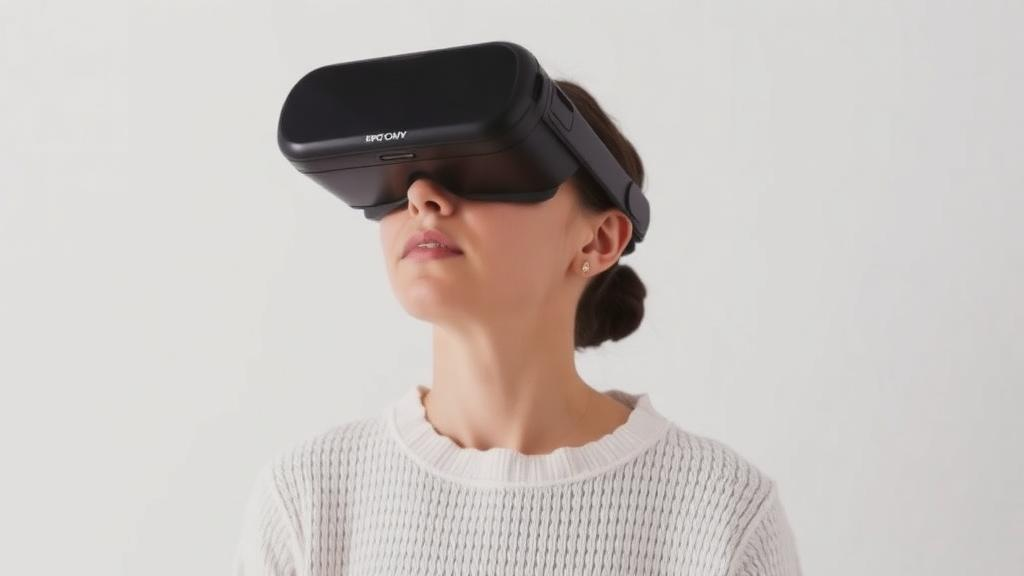
Virtual reality has spent decades perfecting the art of the eye. Headsets now render photorealistic forests, kitchens, and city streets in stunning fidelity, and spatial audio convinces the ear that a virtual campfire crackles just behind the shoulder. But the nose has remained stubbornly left out of the illusion. Now, a team of researchers from Liverpool John Moores University, the University of Liverpool, and Sony Europe has published evidence that the sense of smell may not need an endless library of scents after all. Their study, published in Frontiers in Virtual Reality, suggests that the same four physical odour blends can be perceived differently depending entirely on what a person is looking at in VR — a phenomenon the researchers call olfactory crossmodal redirection.
The technical problem the study tackles is fundamental to how olfactory displays work. Vision generates millions of colours from just three primaries — red, green, and blue — but smell has no equivalent synthesis mechanism. Current olfactory displays typically support only around four physically distinct odour channels, constrained by hardware complexity, cost, control precision, and physical space. Delivering a unique scent for every virtual object would require an impractically large and expensive device, and would increase the risk of odour contamination between channels. The researchers’ insight was to sidestep this limitation entirely: rather than trying to synthesise new odours, they asked whether a compressed physical odour palette could be stretched across many visual contexts, with the brain supplying the apparent variety.
To test this, thirty participants — twelve men and eighteen women, aged 18 to 63 — were immersed in a room-scale VR environment using an HTC VIVE Pro headset with outside-in tracking from three Lighthouse base stations. They encountered twenty distinct virtual objects, each associated with one of four essential oil blends aligned with the fragrance wheel families: citrus, woody, floral, and oriental. Three semantically related visuals were paired with each blend — lemons, limes, and oranges for citrus; campfires, pine trees, and piles of chopped wood for woody; lavender, roses, and tulips for floral; and star anise, cinnamon, and vanilla ice cream for oriental. Eight additional control objects, including books, tires, sushi, and an empty white mug, received randomly assigned blends or no odour at all, providing a baseline for incongruence effects.
The olfactory delivery system was a custom six-chamber rotary display built at the University of Liverpool’s Immersive Laboratory. Four active chambers each contained a cotton sliver saturated with approximately 0.15 millilitres of an essential oil blend, while two inactive chambers delivered clean air. Calibrated servos rotated the odour wheel so that the target chamber sat roughly five centimetres beneath the participant’s nostrils whenever their virtual nose came within ten centimetres of a smellable object. A small fan continuously pushed scented air away from the nose and into a carbon filter, minimising residue between trials. A sniffing sound cue, roughly half a second long, prompted participants to inhale whenever an odour was released, and a minimum five-second interval between cues prevented the sound from overlapping.
Participants answered five questions after each object on a nine-point Likert scale: how intense the smell was, how pleasant it was, whether it matched the object, how natural the smell was, and how natural the visual was. Each participant completed one hundred ratings across the twenty objects, with the stimulus order randomised uniquely per participant to control for order and fatigue effects. The experiment took, on average, sixteen minutes. Alongside the subjective ratings, the researchers recorded two physiological measures: heart rate variability (HRV), captured via an optical ear-clip sensor and interpreted as an index of parasympathetic engagement and positive affective appraisal, and galvanic skin response (GSR), recorded continuously at 43 Hz using a Shimmer3 GSR+ sensor and interpreted as an index of sympathetic arousal and cognitive load.
The statistical analysis relied on linear mixed-effects models (LMMs), with participant included as a random intercept and visual stimulus, odour category, age, and gender as fixed effects. Because the design was partially crossed — not every visual was paired with every odour — a fully expanded factorial specification produced rank-deficient model matrices, so the researchers used reduced numeric codings to capture broad condition-level trends. The LMMs revealed that the visual stimulus term was significantly associated with perceived visual-odour match (p = 0.005) and smell naturalness (p = 0.002), while odour intensity, pleasantness, and visual naturalness showed no reliable associations. Critically, HRV was significantly associated with both the visual stimulus term (p < 0.0001) and the odour category term (p = 0.001), whereas GSR showed no statistically significant associations with either term.
Exploratory within-blend comparisons added texture to these findings. When the same physical woody blend was paired with a campfire, a pine tree, and a pile of chopped wood, participants rated the perceived match differently across all three pairings. Similar differences emerged for the citrus blend across lemon, lime, and orange, and for the floral blend across lavender, rose, and tulips. HRV differences appeared selectively within the woody and oriental blends but not within citrus or floral. These patterns indicate that the effects were outcome-dependent rather than uniform: changing the visual stimulus while holding the physical odour constant produced selective differences in perceived intensity, subjective congruence, smell naturalness, visual naturalness, and HRV, but the specific pairings that differed varied by measure.
As a secondary, hypothesis-guided analysis, the researchers conducted stimulus-level Pearson correlations to characterise whether the condition-level evaluation profiles covaried with perceived visual-odour match. The results were striking. Perceived match was significantly associated with perceived intensity (r = 0.90), perceived pleasantness (r = −0.78, where the negative correlation reflects the pleasantness coding and indicates that higher match was associated with more pleasant ratings), and smell naturalness (r = 0.92). Perceived match was not significantly associated with visual naturalness, HRV, or GSR. This pattern suggests that perceived match was tied to a broader perceptual profile rather than being an isolated semantic judgement of fit — pairings judged as better matching were also rated as more intense, more natural in smell, and more pleasant.
The researchers are careful about what these findings do and do not establish. The correlations were descriptive and associational, not causal or mediation tests, and the pattern may be consistent with a congruence-based account of crossmodal redirection without proving it. Because visual stimulus and odour family were not fully crossed, the findings do not provide a formal comparison of their independent effects. Odour identity, categorisation, similarity, and discriminability were not directly measured, so the study does not establish that visual context generates distinct odour identities — only that the same physical blends were associated with context-dependent differences in higher-level evaluation. The authors also note limitations around potential odour contamination and carryover, the absence of odour-alone and neutral-visual baselines, and the modest sample size.
Nevertheless, the implications for VR design are considerable. In constrained hardware, a small number of physical odours could potentially be reused across visual contexts to support a broader range of context-specific experiences without increasing hardware complexity. The divergence between HRV and GSR — where HRV tracked context-dependent affective appraisal while GSR did not — suggests that visual-odour congruence is more closely associated with evaluative and affective aspects of the experience than with phasic arousal or cognitive load. Whether deliberately selecting well-matched pairings produces these outcomes remains to be tested, and future work should directly assess odour identity using forced-choice identification, category-selection tasks, and confusion matrices. But the core message is clear: the brain may be willing to accept four smells as twenty, provided the eyes are given the right things to look at.
Subject of Research: Olfactory crossmodal redirection for improving perceptual experiences in virtual reality
Article Title: Olfactory crossmodal redirection for improving perceptual experiences in virtual reality
Article References: Ward, R. J., Griffith, E., Krasteva, N., Schwalk, M., Batterley, M., & Marshall, A. (2026). Olfactory crossmodal redirection for improving perceptual experiences in virtual reality. Frontiers in Virtual Reality, 7, Article 1932945. https://doi.org/10.3389/frvir.2026.1932945
Image Credits: AI Generated
DOI: 10.3389/frvir.2026.1932945
Keywords: Olfactory, crossmodal, redirection, improving, perceptual, experiences, virtual, reality, scientific research
Cite Scienmag News
Cassandra Pierce. (October 15, 2026). Four Smells, Twenty Scenes: How Vision Redefines Scent in Virtual Reality. Scienmag. https://scienmag.com/four-smells-twenty-scenes-how-vision-redefines-scent-in-virtual-reality/
Cassandra Pierce. "Four Smells, Twenty Scenes: How Vision Redefines Scent in Virtual Reality." Scienmag, 15 October 2026, https://scienmag.com/four-smells-twenty-scenes-how-vision-redefines-scent-in-virtual-reality/. Accessed 15 October 2026.
Cassandra Pierce. "Four Smells, Twenty Scenes: How Vision Redefines Scent in Virtual Reality." Scienmag. October 15, 2026. https://scienmag.com/four-smells-twenty-scenes-how-vision-redefines-scent-in-virtual-reality/


