


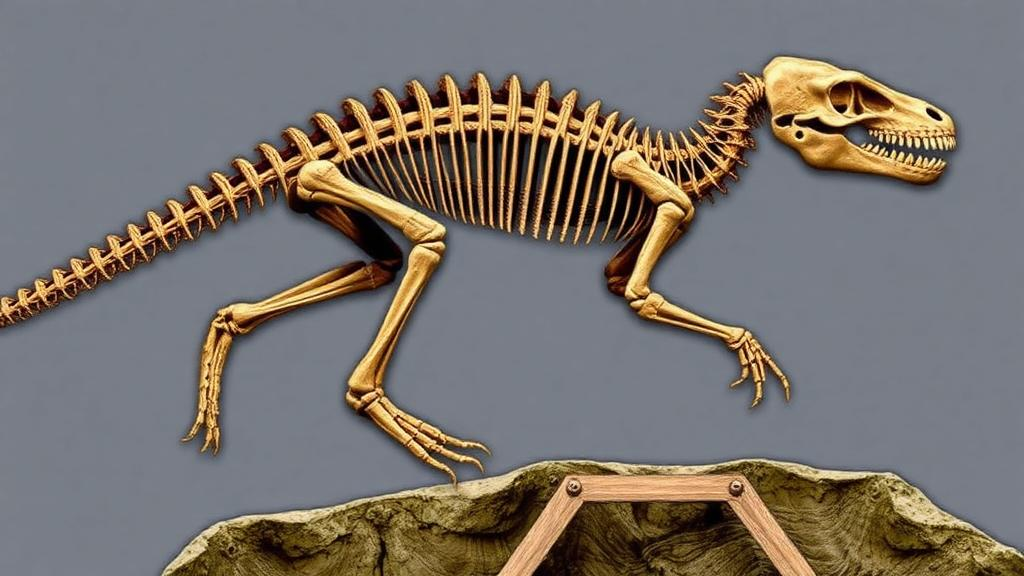
One of the most celebrated fossils in the history of life on Earth has just undergone the most thorough examination it has ever received, and the results are shaking up a story that palaeontologists thought they had largely settled. Westlothiana lizziae, affectionately known to generations of researchers and museum visitors as ‘Lizzie’, was unearthed from the Early Carboniferous rocks of East Kirkton in West Lothian, Scotland, and for more than three decades has been widely cited as the earliest known terrestrially adapted stem amniote, a creature perched at the base of the lineage that would eventually give rise to reptiles, birds and mammals. A new study published in Nature, however, argues that this tiny animal has been placed on the wrong branch of the family tree altogether, and that its true position carries profound implications for how and when the defining features of land-dwelling vertebrates first assembled.
The research team, led by Ben Igielman of the University of Oxford together with Xavier Jenkins and Roger Benson of the American Museum of Natural History, Jason Head of the University of Cambridge, Vincent Fernandez of the European Synchrotron Radiation Facility, Lucy Roberts of the Natural History Museum in London and Timothy Smithson of the University Museum of Zoology in Cambridge, subjected the holotype specimen, catalogued as NMS G.1990.72.1 and held at National Museums Scotland, to high-resolution synchrotron X-ray computed micro-tomography. The scans were performed on beamline ID19 at the European Synchrotron Radiation Facility in Grenoble, France, under proposal ls2687, and allowed the researchers to digitally segment and reconstruct individual bones of the skull roof, palate, braincase, mandible, vertebrae and limbs in three dimensions without risking damage to the fragile fossil. The resulting digital models, now openly available on MorphoSource, reveal anatomical details that could never have been extracted from the flattened, part-and-counterpart slabs in which the animal was preserved.
What the team found inside the skull came as a genuine surprise. Far from showing the suite of derived features expected of an early amniote relative, Westlothiana preserves unexpected plesiomorphies, that is, ancestral characteristics, in the skull roof, palate, braincase and lower jaw. More striking still are the traces of a thoroughly aquatic lifestyle: the scans revealed an ossified internal gill skeleton, including ceratobranchial elements of the hyobranchial apparatus, as well as extensive fields of denticles, tiny tooth-like structures, covering the palate and the mandible. An internal gill skeleton is a feature associated with breathing water rather than air, and shagreen-like denticle fields on the roof of the mouth are characteristic of suction-feeding aquatic predators among early tetrapods and their fishy relatives. Together, these traits paint a picture of an animal that was far more comfortable in water than its reputation as a pioneering land-dweller had suggested.
When the researchers fed their new anatomical observations into an expanded phylogenetic dataset and ran Bayesian analyses under a time-calibrated fossilized birth-death model, the tree returned Westlothiana not as a stem amniote but as a stem tetrapod, occupying a much deeper position on the lineage leading to all limbed vertebrates. This is a dramatic demotion in phylogenetic terms, moving the animal from the very threshold of the reptile lineage back to the broader stem of Tetrapoda itself, the branch that lies outside the crown group containing modern lissamphibians, the frogs, salamanders and caecilians, and amniotes. The result aligns with recent suggestions that the tetrapod stem lineage was taxonomically far more inclusive, and far more anatomically diverse, than traditional classifications allowed, echoing earlier work that highlighted hidden morphological diversity among early limbed vertebrates.
Yet the paradox that makes the new study so compelling is that Westlothiana simultaneously retains a set of unmistakably terrestrial adaptations. Its foot shows an amniote-like pedal formula, the pattern of bones in the digits that is associated with weight-bearing locomotion on land. Its forelimb has lost the fin-like functional anatomy seen in many earlier stem tetrapods, whose limbs were better suited to paddling than propping. And its terminal finger and toe phalanges are superficially claw-like, a feature that in living animals is often associated with traction, digging or climbing. The coexistence of these land-oriented traits with gill arches and palatal denticles in a single small-bodied animal is the clearest demonstration yet that the transition from water to land did not proceed as a neat, coordinated package of changes.
Instead, the authors argue, terrestrial anatomy evolved in a mosaic fashion, with individual traits appearing at different times, in different lineages and in different ecological contexts. Ancestral character reconstruction performed in the study, using equal-rates Mk models in the R statistical environment, suggests that traits associated with aquatic ecologies, such as sensory lateral line canals, branchial arches with grooves for the afferent gill artery, and gill arch articulation with the braincase, were present deep within the tetrapod stem, while postcranial traits such as L-shaped humeri and patterns of limb reduction and body elongation also map onto transitional, amphibious ancestors. In other words, the amniote-like foot and the claw-like phalanges of Westlothiana evolved in an animal that still breathed and fed like an aquatic predator, long before the origin of the tetrapod crown group. Terrestrial competence, on this view, was assembled piecemeal in creatures that were neither fully aquatic nor fully terrestrial, blurring the boundary that palaeontologists have long tried to draw between the two worlds.
The timing matters as much as the anatomy. Limbs first appeared in stem tetrapods by the Late Devonian, roughly 365 million years ago, and trackway evidence from Poland and Ireland shows that four-limbed animals were walking on land even earlier in the Middle Devonian. But the fossil record of the ensuing interval, particularly the poorly sampled stretch known as Romer’s gap in the earliest Carboniferous, has obscured how the first limbs were transformed into the limbs of modern-style land vertebrates. Many early taxa either retained limbs with fin-like functional anatomy or secondarily lost their limbs altogether, complicating any simple narrative of progressive adaptation to land. Westlothiana comes from the Viséan stage of the Early Carboniferous, and recent uranium-lead dating work at East Kirkton Quarry has helped pin down the age of the fauna it belongs to, a community that also included the stem amniote relative Silvanerpeton, the enigmatic mosaic form Eucritta melanolimnetes and a range of temnospondyl amphibians.
The new phylogenetic placement also feeds into a broader, ongoing recalibration of early tetrapod evolution. Recent studies of the earliest amniote tracks have pushed back the timeline of tetrapod evolution, and debates over whether recumbirostran ‘microsaurs’ sit on the amniote stem, and over the deep divergences that eventually produced lissamphibians and amniotes, continue to hinge on the anatomy of small-bodied Carboniferous and Permian fossils. The authors of the new study emphasize that their findings illuminate substantial gaps in anatomical knowledge, especially for small-bodied taxa, that have obstructed understanding of early tetrapod evolution. Many of the most evolutionarily informative early tetrapods are, like Westlothiana, tiny animals preserved as crushed slabs, and it is only with the advent of synchrotron-grade micro-tomography, phase-contrast reconstruction techniques and open digital repositories that their anatomy has become accessible in the detail phylogenetic analysis demands.
For the public imagination, the rehabilitation of ‘Lizzie’ is a reminder that even icons of palaeontology are provisional interpretations rather than settled facts. The specimen was named in 1990 by Timothy Smithson and W. D. Ian Rolfe, who at the time proclaimed it the earliest known reptile, and subsequent work in 1993 by Smithson, Robert Carroll, A. L. Panchen and S. M. Andrews cemented its status as a key to the amniote stem. Thirty-six years later, the same specimen, scanned rather than simply looked at, has told a different story: that of a small, gill-breathing, denticle-mouthed stem tetrapod that nonetheless walked on amniote-like feet with claw-like tips. The mosaic it displays suggests that the assembly of terrestrial anatomy was a long, experiment-rich process unfolding in amphibious animals across the tetrapod stem, and that the road to life on land was walked, at least partly, by creatures that never entirely left the water behind.
The study also carries a practical message for the field. The phylogenetic dataset, Nexus scripts for the Bayesian analyses and R code for ancestral state reconstruction are all stored openly on the Open Science Framework, and the computed tomography data and three-dimensional models of the specimen are freely downloadable, ensuring that future researchers can re-analyse the evidence as new fossils and methods emerge. As scanning technology spreads through museum collections worldwide, more small-bodied Carboniferous fossils are likely to receive the same treatment, and more long-held positions in the tetrapod tree may shift. What is already clear is that the origin of terrestrial vertebrates was not a single leap onto dry land but a mosaic of evolutionary experiments, and that some of the most important experiments were hiding in plain sight, inside a small Scottish fossil that has been studied for more than three decades.
Subject of Research: The mosaic evolution of terrestrial anatomy in early stem tetrapods revealed by computed tomography of Westlothiana lizziae
Article Title: Evolution of terrestrial anatomy revealed by a derived stem tetrapod
Article References: Igielman, B., Jenkins, X., Head, J., Fernandez, V., Roberts, L., Smithson, T., & Benson, R. (2026). Evolution of terrestrial anatomy revealed by a derived stem tetrapod. Nature. https://doi.org/10.1038/s41586-026-11090-6
Image Credits: AI Generated
DOI: 10.1038/s41586-026-11090-6
Keywords: Westlothiana lizziae, stem tetrapod, tetrapod evolution, Early Carboniferous, East Kirkton, amniote origins, synchrotron tomography, phylogenetics, aquatic adaptation, terrestrial anatomy, palaeontology, Romer's gap
Cite Scienmag News
Gavin Prescott. (September 30, 2026). Fossil ‘Lizzie’ Rewrites the Story of How Vertebrates First Walked on Land. Scienmag. https://scienmag.com/fossil-lizzie-rewrites-the-story-of-how-vertebrates-first-walked-on-land/
Gavin Prescott. "Fossil ‘Lizzie’ Rewrites the Story of How Vertebrates First Walked on Land." Scienmag, 30 September 2026, https://scienmag.com/fossil-lizzie-rewrites-the-story-of-how-vertebrates-first-walked-on-land/. Accessed 4 October 2026.
Gavin Prescott. "Fossil ‘Lizzie’ Rewrites the Story of How Vertebrates First Walked on Land." Scienmag. September 30, 2026. https://scienmag.com/fossil-lizzie-rewrites-the-story-of-how-vertebrates-first-walked-on-land/


