


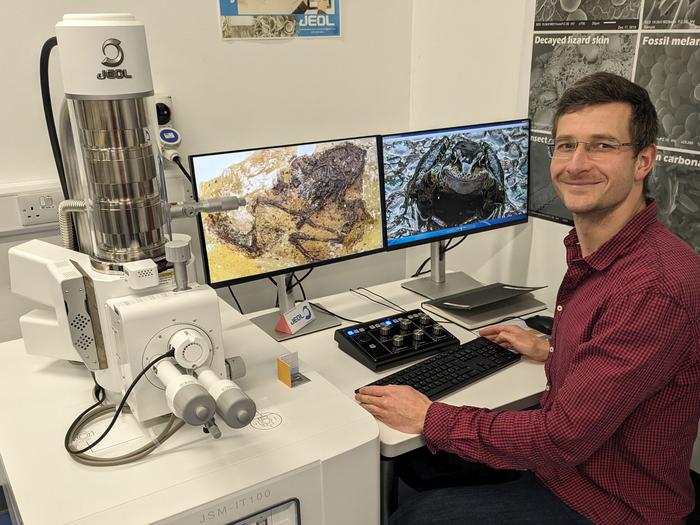
Palaeontologists at University College Cork (UCC), Ireland, have solved a hundred-year-old mystery of how some fossil frogs preserve their fleshy parts – it’s all down to their skin.

Credit: Daniel Falk
Palaeontologists at University College Cork (UCC), Ireland, have solved a hundred-year-old mystery of how some fossil frogs preserve their fleshy parts – it’s all down to their skin.
Palaeontologists Daniel Falk and Prof. Maria McNamara, together with scientists from Ireland, Germany and the UK, studied 45-million-year-old fossil frogs from the Geiseltal site in central Germany. Remarkably, the fossils show full body outlines of the soft tissues. The team discovered that the excellent condition of the fossil frogs is due to preservation of ancient skin remnants.
The team studied the fossils with high-precision techniques including scanning electron microscopy, synchrotron-X-ray analyses, and infrared spectroscopy. These techniques were not available when the fossils were first discovered in the early twentieth century.
“The quality of preservation of the fossil frog skin is amazing – even subcellular structures, such as collagen fibres, are preserved.” said study lead, PhD researcher Daniel Falk. “The skin of the frogs is replicated in the mineral calcium phosphate, which helped it survive for millions of years.”
“The preservation of the skin is so good that we can even work out the habitat of the fossil frogs,” said Daniel. “The preserved skin shows adaptations to prevent drying out, which suggests that these fossil frogs actually spent most of their time on land.”
“Fossil soft tissues often reveal hidden information about the biology of animals,” said senior author Prof. Maria McNamara. “We discovered that the fossil frog skin is preserved in the same way as fossil frogs from other sites in Europe.
“This discovery is very exciting because it overturns scientific opinion that has lasted for almost one hundred years. What’s more, the repeated pattern of fossil preservation tells us that frogs evolved special adaptations to life on dry land over 45 million years ago.”
The research highlights the usefulness of historic fossil collections and the need to re-evaluate historic specimens using modern techniques.
The study is part of a research cooperation between UCC, the Martin-Luther-University Halle-Wittenberg (Germany), the Natural History Museum Bamberg (Germany) and the University of Oxford (UK) with funding from the Irish Research Council, the European Research Council and the International Association of Sedimentologists. The study is published today in the journal Scientific Reports.
Journal
Scientific Reports
Method of Research
Imaging analysis
Subject of Research
Animal tissue samples
Article Title
Fossilized anuran soft tissues reveal a new taphonomic model for the Eocene Geiseltal Konservat-Lagerstätte, Germany
Article Publication Date
23-Apr-2024
Cite Scienmag News
Drew Townsend. (April 23, 2024). Fossil frogs share their skincare secrets. Scienmag. https://scienmag.com/fossil-frogs-share-their-skincare-secrets/
Drew Townsend. "Fossil frogs share their skincare secrets." Scienmag, 23 April 2024, https://scienmag.com/fossil-frogs-share-their-skincare-secrets/. Accessed 4 September 2026.
Drew Townsend. "Fossil frogs share their skincare secrets." Scienmag. April 23, 2024. https://scienmag.com/fossil-frogs-share-their-skincare-secrets/

