

Monday, July 27, 2026
Science
No Result
View All Result
  • Login
  • HOME
  • SCIENCE NEWS
  • CONTACT US
  • HOME
  • SCIENCE NEWS
  • CONTACT US
No Result
View All Result
Scienmag
No Result
View All Result
Home Science News Earth Science

Fossil Footprints Show Ancient Human Relative Was Bigger, Travelled in Groups 1.4 Million Years Ago

July 27, 2026
in Earth Science
Reading Time: 2 mins read
0
Fossil Footprints Show Ancient Human Relative Was Bigger, Travelled in Groups 1.4 Million Years Ago

Fossil Footprints Show Ancient Human Relative Was Bigger, Travelled in Groups 1.4 Million Years Ago

65
SHARES
587
VIEWS
Share on FacebookShare on Twitter
ADVERTISEMENT

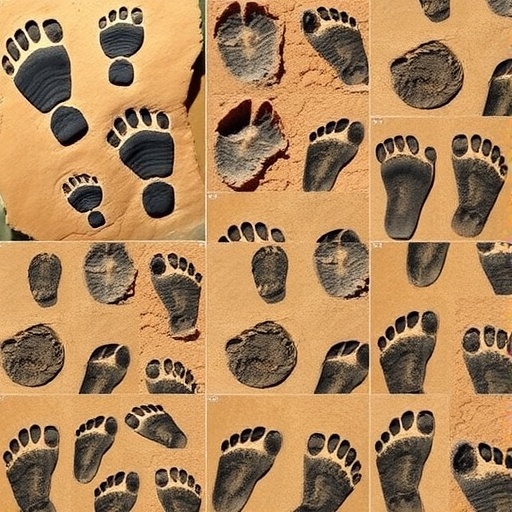
An international team has unveiled a remarkable set of fossilized footprints from northern Kenya’s Lake Turkana region, offering a rare behavioral window into hominin life more than 1.4 million years ago. Reported in Proceedings of the National Academy of Sciences, the study centers on a trackway known as GaJi10, preserved along ancient lakeshore sediments where mudflats intermittently dried and hardened—ideal conditions for retaining impressions.

Researchers analyzed footprints left by a troop of eight Paranthropus boisei individuals, originally encountered nearly 50 years ago by Smithsonian geologist Kay Behrensmeyer. During fieldwork in 1978, Behrensmeyer noticed an unexpected, hippo-sized depression in exposed rock. Careful excavation and brushing revealed two hominin tracks beneath a surface that had been silently recording movement since the Early Pleistocene.

Dating relied on volcanic ash layers embedded in the surrounding geology. By tying the trackway to an Early Pleistocene ash signature, the team estimated the prints at roughly 1.43 million years old. This places the hominins in a complex ecosystem including crocodiles and elephants, as well as multiple hominin species occupying the same landscape during that period.

The GaJi10 site is exceptionally detailed: it preserves 21 footprints attributed to eight individuals, alongside contemporaneous animal tracks. Importantly, the differing depths of impressions help distinguish deeper hippo and antelope marks from shallower hominin prints, revealing how varying trackmaker weights and substrate consistency shaped the record.

When the team compared footprint morphology and locomotion patterns, they concluded the tracks were made by Paranthropus—a surprising result because the impressions are similar in size to those expected for the larger-bodied Homo erectus. The findings suggest P. boisei individuals could have reached human-like body dimensions, up to about 6 feet tall and around 165 pounds, reshaping assumptions about relative size and niche differentiation.

Beyond body size, the trackways hint at social behavior. The simultaneous presence of mostly adult male P. boisei implies group travel without females or children, consistent with hypotheses about competition, intermittent tolerance, and movement through risky mudflat terrain.

Footprints also proved to be a “time-slice” of behavior that skeletal remains often cannot provide. As the authors note, tracks capture a fleeting moment: stance, gait, and interaction with substrate—evidence that can be directly compared across individuals and trackmakers.

The research team has since returned to Kenya, motivated by hundreds of related footprints in the broader Lake Turkana area. With better geological context, they expect to refine why these hominins repeatedly used the lakeshore and how changing conditions influenced track preservation.

Subject of Research: Not applicable
Article Title: New insights into hominin body size, locomotion, and behavior from Early Pleistocene trackways in northern Kenya
News Publication Date: Not provided in the text
Web References: https://naturalhistory.si.edu/staff/kay-behrensmeyer ; https://humanorigins.si.edu/evidence/human-fossils/species/paranthropus-boisei ; https://humanorigins.si.edu/evidence/human-fossils/species/homo-erectus
References: Proceedings of the National Academy of Sciences
Image Credits: Kay Behrensmeyer, Smithsonian.

Keywords: Early humans; Hominins; Human origins; Paleoanthropology; Fossils; Taphonomy; Paleoecology; Paleoenvironments; Paleontology; Trace fossils

Tags: Ancient human footprintsearly human ecosystem interactionsearly Pleistocene hominin behaviorfootprint analysis and dating techniquesfossil footprint preservationfossilized footprints in Kenyahominin migration and travel patternshuman group size 1.4 million years agoinsights into hominin species coexistenceLake Turkana paleoenvironmentParanthropus boiseiprehistoric social behavior
Share26Tweet16
Previous Post

Microscopic Atlas Tracks Huanglongbing Disease Progression Through Citrus Trees

Next Post

SKKU study links fragmented international aid to corruption in developing nations

Related Posts

Iceberg barriers reduce foraging links, causing sharp chick declines in Coulman Island penguins
Earth Science

Iceberg barriers reduce foraging links, causing sharp chick declines in Coulman Island penguins

July 27, 2026
Coffee creates fungal spillover from fields to forests in Costa Rica
Earth Science

Coffee creates fungal spillover from fields to forests in Costa Rica

July 27, 2026
Groundbreaking Findings Show Magma Rising Beneath Laguna del Maule, Chile
Earth Science

Groundbreaking Findings Show Magma Rising Beneath Laguna del Maule, Chile

July 27, 2026
China study assesses national plan effectiveness against antimicrobial resistance in soil
Earth Science

China study assesses national plan effectiveness against antimicrobial resistance in soil

July 27, 2026
Renewables Ease Energy, Water, and Ecological Strains in Yellow River Basin
Earth Science

Renewables Ease Energy, Water, and Ecological Strains in Yellow River Basin

July 27, 2026
Davemaoite Shows Limited Water Incorporation Under Lower-Mantle Conditions
Earth Science

Davemaoite Shows Limited Water Incorporation Under Lower-Mantle Conditions

July 27, 2026
Next Post
SKKU study links fragmented international aid to corruption in developing nations

SKKU study links fragmented international aid to corruption in developing nations

  • Mothers who receive childcare support from maternal grandparents show more

    Mothers who receive childcare support from maternal grandparents show more parental warmth, finds NTU Singapore study

    27656 shares
    Share 11059 Tweet 6912
  • University of Seville Breaks 120-Year-Old Mystery, Revises a Key Einstein Concept

    1061 shares
    Share 424 Tweet 265
  • Bee body mass, pathogens and local climate influence heat tolerance

    682 shares
    Share 273 Tweet 171
  • Researchers record first-ever images and data of a shark experiencing a boat strike

    546 shares
    Share 218 Tweet 137
  • Groundbreaking Clinical Trial Reveals Lubiprostone Enhances Kidney Function

    531 shares
    Share 212 Tweet 133
Science

Embark on a thrilling journey of discovery with Scienmag.com—your ultimate source for cutting-edge breakthroughs. Immerse yourself in a world where curiosity knows no limits and tomorrow’s possibilities become today’s reality!

RECENT NEWS

  • FGFR4-Associated APOBEC3 Mutagenesis Defines HER2-Enriched Human Breast Cancer Subtype
  • Variable Super-PeVatron in Cygnus X-3 Enables New Era of Time-Domain Astronomy
  • MIT Engineers Create Recyclable Elastic Yarn for Sustainable Textiles
  • Researchers Find Potentially Harmful Substance in Solid Waste

Categories

  • Agriculture
  • Anthropology
  • Archaeology
  • Athmospheric
  • Biology
  • Biotechnology
  • Blog
  • Bussines
  • Cancer
  • Chemistry
  • Climate
  • Earth Science
  • Editorial Policy
  • Marine
  • Mathematics
  • Medicine
  • Pediatry
  • Policy
  • Psychology & Psychiatry
  • Science Education
  • Social Science
  • Space
  • Technology and Engineering

Subscribe to Blog via Email

Success! An email was just sent to confirm your subscription. Please find the email now and click 'Confirm Follow' to start subscribing.

Join 5,146 other subscribers

© 2025 Scienmag - Science Magazine

Welcome Back!

Login to your account below

Forgotten Password?

Retrieve your password

Please enter your username or email address to reset your password.

Log In
No Result
View All Result
  • HOME
  • SCIENCE NEWS
  • CONTACT US

© 2025 Scienmag - Science Magazine
