

Tuesday, July 28, 2026
Science
No Result
View All Result
  • Login
  • HOME
  • SCIENCE NEWS
  • CONTACT US
  • HOME
  • SCIENCE NEWS
  • CONTACT US
No Result
View All Result
Scienmag
No Result
View All Result
Home Science News Archaeology

Fossil Footprints Reveal Body Size and Group Behavior of 1.4-Million-Year-Old Human Relative

July 27, 2026
in Archaeology
Reading Time: 2 mins read
0
Fossil Footprints Reveal Body Size and Group Behavior of 1.4-Million-Year-Old
65
SHARES
587
VIEWS
Share on FacebookShare on Twitter
ADVERTISEMENT

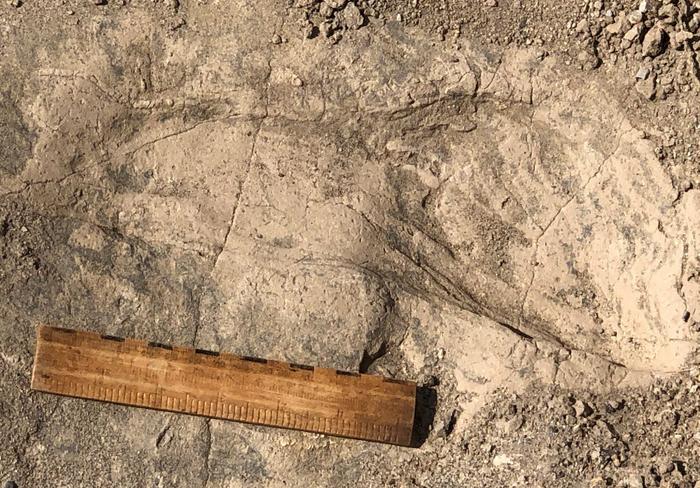
Eight fossil trackways from northern Kenya have been re-read as a rare, moment-by-moment record of how an extinct human relative moved and lived. Researchers report that the prints belong to Paranthropus boisei, a species often known from its massive jaws and teeth—leaving its lower-body anatomy largely uncharted. The new evidence comes from lakeshore deposits dating to roughly 1.4 million years ago, where ancient sediments preserved footprints with unusual clarity.

What makes the discovery stand out is the apparent synchronicity of the group. The trackways indicate that eight individuals were present in the same place and time, and—based on footprint size distributions and trackway geometry—most appear to be adults. Several of the prints are interpreted as belonging to relatively large-bodied animals, implying human-like proportions rather than the smaller stature some earlier reconstructions had suggested from scarce skeletal material.

Using analytical methods developed by the team, the researchers distinguish P. boisei tracks from other potential hominin makers by examining foot anatomy signatures and locomotion patterns. These same approaches let them translate surface traces into estimates of stature and mass. The result is surprising: some individuals may have been up to about 1.8 meters tall and around 75 kilograms, expanding the known range of body size for P. boisei.

The study also treats the trackways as behavioral data. The pattern of overlapping routes suggests the group traveled together rather than as isolated walkers. In particular, the absence of footprints interpreted as smaller individuals leads the authors to propose a group composition dominated by adult males. Such a social arrangement would fit scenarios in which males compete for mates while still tolerating one another in a risky lakeshore environment.

Lakes themselves emerge as more than scenery. Across the East Turkana region, multiple sites preserve hundreds of footprints in similar lake margin settings, separated by tens of kilometers but dated to comparable ages. The recurrence of these depositional environments implies that hominins repeatedly returned to the same kinds of habitats over periods exceeding 100,000 years.

The authors argue that the key is understanding why these particular conditions allowed tracks to last. Rapid fossilization at the margin of ancient water bodies can lock in behavior before erosion wipes it away. With enough sites, researchers can begin to reconstruct not just how hominins walked, but where and why they clustered.

A broader “photo album” of the past is now underway. The team plans further fieldwork in Kenya to expand sample sizes and refine locomotion and anatomy reconstructions from footprint morphology. By integrating new analytical pipelines with exceptional trackway preservation, the work turns the ichnological record into a high-resolution window on Early Pleistocene life.

Ultimately, the findings add a missing dimension to the fossil story of Paranthropus boisei: group dynamics. Instead of a species seen only through skulls, P. boisei appears here as a participant in complex social movement—returning again and again to the lake edge, leaving traces that still speak across deep time.

Subject of Research: Fossil footprints (Early Pleistocene) from northern Kenya; Paranthropus boisei body size, locomotion, and behavior

Article Title: Insights into hominin body size, locomotion, and behavior from Early Pleistocene trackways in northern Kenya

News Publication Date: 27-Jul-2026

Web References: http://dx.doi.org/10.1073/pnas.2530996123

References: 10.1073/pnas.2530996123

Image Credits: © Kay Behrensmeyer

Keywords: Paranthropus boisei, fossil footprints, trackways, Early Pleistocene, Kenya, Lake Turkana, hominin behavior, locomotion, body size, paleoanthropology

Tags: 1.4 million-year-old footprintsancient footprint preservationancient human ancestor locomotionbody size estimation from footprintsearly human social activityfossil footprintsfossil trackway analysisgroup behavior of extinct homininshominin foot morphologyinsights into extinct human relativepaleoanthropology of early humansParanthropus boiseiprehistoric lake shore deposits
Share26Tweet16
Previous Post

New multidisciplinary program aims to train next-generation engineering business leaders

Next Post

Industrial Poultry Farming Speeds Spread of Major Foodborne Disease

Related Posts

Australian Cave Finds Evidence of 25,000-Year Grass Burning for Rituals
Archaeology

Australian Cave Finds Evidence of 25,000-Year Grass Burning for Rituals

July 27, 2026
Mapping Project Helps Shield Coastal World Heritage Sites From Climate
Archaeology

Mapping Project Helps Shield Coastal World Heritage Sites From Climate Risks

July 27, 2026
Genetically distinct Nicaraguan avocados reveal South American transport thousands of
Archaeology

Genetically distinct Nicaraguan avocados reveal South American transport thousands of years ago

July 26, 2026
Ceramic Vessels Show Social Inequality Was Baked into 19th-Century Brazil
Archaeology

Ceramic Vessels Show Social Inequality Was Baked into 19th-Century Brazil

July 26, 2026
Study Quantifies Damage to Historic Sites Across Syria
Archaeology

Study Quantifies Damage to Historic Sites Across Syria

July 26, 2026
Silkworm Farming in Southern Central Asia Preceded the Silk Road
Archaeology

Silkworm Farming in Southern Central Asia Preceded the Silk Road

July 26, 2026
Next Post
Industrial Poultry Farming Speeds Spread of Major Foodborne Disease

Industrial Poultry Farming Speeds Spread of Major Foodborne Disease

  • Mothers who receive childcare support from maternal grandparents show more

    Mothers who receive childcare support from maternal grandparents show more parental warmth, finds NTU Singapore study

    27656 shares
    Share 11059 Tweet 6912
  • University of Seville Breaks 120-Year-Old Mystery, Revises a Key Einstein Concept

    1061 shares
    Share 424 Tweet 265
  • Bee body mass, pathogens and local climate influence heat tolerance

    682 shares
    Share 273 Tweet 171
  • Researchers record first-ever images and data of a shark experiencing a boat strike

    546 shares
    Share 218 Tweet 137
  • Groundbreaking Clinical Trial Reveals Lubiprostone Enhances Kidney Function

    531 shares
    Share 212 Tweet 133
Science

Embark on a thrilling journey of discovery with Scienmag.com—your ultimate source for cutting-edge breakthroughs. Immerse yourself in a world where curiosity knows no limits and tomorrow’s possibilities become today’s reality!

RECENT NEWS

  • Pre-Transfusion Platelet Levels Predict Bleeding in Very Low Birth Weight Infants
  • Microbial Carbon Metabolism Tied to Organic Matter Chemistry in Soils
  • Cavity-Assisted Nonlocal Metasurfaces Enable Efficient Broadband Optical Vortex Generation
  • Terrain diversity shapes carbon storage in Brazil’s Atlantic Forest

Categories

  • Agriculture
  • Anthropology
  • Archaeology
  • Athmospheric
  • Biology
  • Biotechnology
  • Blog
  • Bussines
  • Cancer
  • Chemistry
  • Climate
  • Earth Science
  • Editorial Policy
  • Marine
  • Mathematics
  • Medicine
  • Pediatry
  • Policy
  • Psychology & Psychiatry
  • Science Education
  • Social Science
  • Space
  • Technology and Engineering

Subscribe to Blog via Email

Enter your email address to subscribe to this blog and receive notifications of new posts by email.

Join 5,146 other subscribers

© 2025 Scienmag - Science Magazine

Welcome Back!

Login to your account below

Forgotten Password?

Retrieve your password

Please enter your username or email address to reset your password.

Log In
No Result
View All Result
  • HOME
  • SCIENCE NEWS
  • CONTACT US

© 2025 Scienmag - Science Magazine

Discover more from Science

Subscribe now to keep reading and get access to the full archive.

Continue reading
