


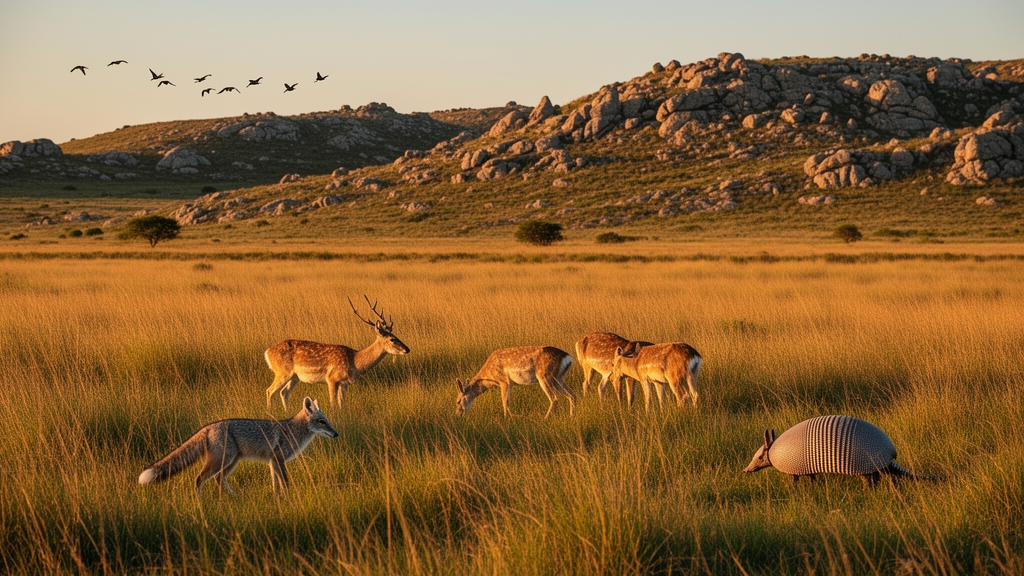
Deep in the southeast of Buenos Aires province, a chain of low mountains holds one of the last surviving stretches of Argentina’s Pampean highland grassland, and a new inventory now documents exactly which mammals live there. Researchers compiled records from museum collections, citizen science platforms, published literature and years of fieldwork, and arrived at a list of 40 mammal species inhabiting the highland grassland remnants of the Tandilia Mountains. Thirty-two of these are native to the region and eight are exotic.
The Tandilia Mountains rise from the plains in a northwest-southeast axis roughly 350 kilometres long and up to 50 to 60 kilometres wide, with hills and mountains standing between 50 and 500 metres above the surrounding Pampas and reaching a maximum height of approximately 524 metres. In this system, native highland grassland survives mainly on the hills themselves, where rocky outcrops and shallow soils make cultivation impossible. That accident of agricultural geography has preserved fragments of grassland that act as a refuge for native, endemic and endangered species, and which were earlier proposed as Valuable Pasture Areas on account of their importance.
Compiling the species list required an unusually broad sweep of evidence. The researchers reviewed the database of the Museo de La Plata and visited the collection to examine 44 specimens whose information was not available online, and also gathered records deposited in other museums, including the Bernardino Rivadavia Natural Sciences Museum, the Michigan State University Museum, the Museum of Texas Tech University and the Museum of Vertebrate Zoology, alongside data from the Global Biodiversity Information Facility, filtered to the Tandilia range and excluding fossils. Three citizen science platforms contributed photographic records: iNaturalist, where only research-grade observations were accepted; EcoRegistros; and the Argentinian Network for Monitoring Run-Over Fauna. Published bibliography on mammals of the range was also reviewed.
The researchers' own fieldwork also contributed to the inventory. Between September 2016 and June 2021, they surveyed 27 highland grassland remnants across the Tandilia system using 192 camera stations, accumulating a sampling effort of 3,719 camera trap days that yielded 3,069 mammal observations. Verified records from the local community, including photographs and videos from rural inhabitants and rescue centres, were also incorporated. Camera traps confirmed the presence of species such as capybara, Geoffroy’s cat, Pampas fox and puma within the grassland remnants, including melanic individuals of Geoffroy’s cat, while exotic species such as European hare, wild boar and fallow deer were also photographed.
The resulting inventory of 40 species spans seven orders, 18 families and 35 genera. Among the native species are endemic species of the Pampas ecoregion, species whose populations are declining globally, and threatened species. Two native species currently carry a threat categorisation: the Southern Long-Nosed Armadillo, Dasypus hybridus, listed as Near Threatened both globally and in Argentina, and the Dark Bolo Mouse, Necromys obscurus, Near Threatened in Argentina and one of only four mammal species endemic to the Pampas ecoregion.
The comparison with the wider ecoregion is sobering. Of the 85 mammal species reported for the Pampas, 75 are native, and 42.7% of those native species are represented in the Tandilia system. Meanwhile, 80% of the ten invasive mammal species found in the ecoregion are present in the grassland remnants. The exotic species recorded include chital, red deer, fallow deer, wild boar, house mouse, brown rat, house rat and European hare. The authors note that most of these invaders are categorised as generating high environmental risk, and that some could be threatening native species through intertrophic or intratrophic interactions. They call for future studies to evaluate the population sizes, trends and impacts of these invasive mammals on native biodiversity.
Not every species in the historical record made the final list, and the exclusions are themselves informative. Three bat species, Dasypterus ega, Molossus molossus and Eumops patagonicus, appear within the Tandilia range on existing distribution maps, but no specific records from the mountains could be found, so the researchers excluded them while noting that records exist in nearby localities and their presence is considered highly probable. Three collected specimens were also excluded: an ocelot, Leopardus pardalis, from Balcarce whose origin may relate to the illegal pet trade, a jaguarundi, Herpailurus yagouaroundi, collected in Tandil in 1924 and treated as a possible accidental or extralimital record, and a specimen of Myotis chilensis re-identified as Myotis levis. In contrast, the inclusion of the Pallid Fat-tailed Opossum, Thylamys pallidior, rests on several Tandilia records, including individuals in barn owl pellets and specimens and photographs from Sierra de Los Padres, despite the species being absent from recent range maps.
The inventory also captures a quiet recovery underway in the grasslands. Pumas, which had been considered extinct in most parts of the Pampas during the 20th century, have shown increasing records over recent decades across the ecoregion, and in the Tandilia Mountains records have become more frequent since 2011, with the new camera trap studies confirming their presence in several highland grassland remnants. Capybaras, meanwhile, have recently been reported breeding in the southern Tandilia Mountains. The authors suggest that the grassland remnants could function as corridors and refuges, facilitating the recolonisation of these species across the Pampas ecoregion. Yet the picture for other mammals is less encouraging: at least six species present in the mountains are reported to be experiencing population declines. Beyond the two Near Threatened species, these include Molina’s Hog-nosed Skunk, the Hairy-tailed Bolo mouse Oxymycterus rufus, the coypu and the puma itself. In Argentina, populations of Dasypus hybridus are estimated to have decreased by 25 to 30% over the last 12 years.
The methods behind the inventory differed sharply in their yields, a point the authors examine in detail. Camera traps recorded the smallest number of species, 16, compared with the other approaches, a limitation the researchers attribute to the technique’s suitability for detecting medium and large mammals rather than rodents or bats, and to the fact that camera trap sampling is designed according to target species, which shapes detection capacity. Citizen science projects, by contrast, contributed 22 species, with 19 found in EcoRegistros, 18 in iNaturalist and two in the run-over fauna network, demonstrating how community participation can make reliable contributions to biodiversity data collection at large geographic and temporal scales. Museum collections yielded 33 species, including 33 records in the GBIF database totalling 2,728 records and nine species found directly in the Museo de La Plata collection, and remain a reliable source of records arising from numerous and diverse studies. Occasional observations, from the researchers themselves and from local people, contributed 20 species.
Perhaps the most urgent finding concerns protection. Only 0.15% of the Tandilia Mountains range is currently protected, and the protected areas that do exist are few and small, including the Laguna de Los Padres, Paititi, Sierra del Tigre and Boca de la Sierra reserves. The authors argue there is an urgent need to increase the number and range of protected areas and to pursue other conservation actions, such as habitat restoration, aimed at preserving the last remnants of the highland grassland and its biodiversity. As a baseline for developing management and conservation strategies, the inventory’s value lies in making explicit what still survives on these hills: a mammal community that includes endemic and threatened species, newly reported species for the region, and recovering populations of puma and capybara, all concentrated in fragments of grassland that agriculture has so far been unable to plough.
Subject of Research: An updated inventory of mammal species inhabiting the highland grassland remnants of the Tandilia Mountains in the Pampas ecoregion of Argentina.
Article Title: Mammals of the Tandilia Mountain system, current species inhabiting Pampean highland grasslands
Article References: Aranguren, M. F., Velasco, M. A., Trofino-Falasco, C., Pizzarello, M. G., Vera, D. G., & Berkunsky, I. (2023). Mammals of the Tandilia Mountain system, current species inhabiting Pampean highland grasslands. Neotropical Biology and Conservation, 18(1), 13-29. https://doi.org/10.3897/neotropical.18.e98374
Image Credits: AI Generated
DOI: 10.3897/neotropical.18.e98374
Keywords: Tandilia Mountains, Pampas ecoregion, highland grasslands, mammal inventory, biodiversity, camera trapping, citizen science, invasive species, conservation, Argentina, protected areas, endangered species
Cite Scienmag News
Margaret Porter. (October 27, 2026). Forty mammal species revealed in last refuges of Argentina’s Tandilia grasslands. Scienmag. https://scienmag.com/forty-mammal-species-revealed-in-last-refuges-of-argentinas-tandilia-grasslands/
Margaret Porter. "Forty mammal species revealed in last refuges of Argentina’s Tandilia grasslands." Scienmag, 27 October 2026, https://scienmag.com/forty-mammal-species-revealed-in-last-refuges-of-argentinas-tandilia-grasslands/. Accessed 27 October 2026.
Margaret Porter. "Forty mammal species revealed in last refuges of Argentina’s Tandilia grasslands." Scienmag. October 27, 2026. https://scienmag.com/forty-mammal-species-revealed-in-last-refuges-of-argentinas-tandilia-grasslands/


