


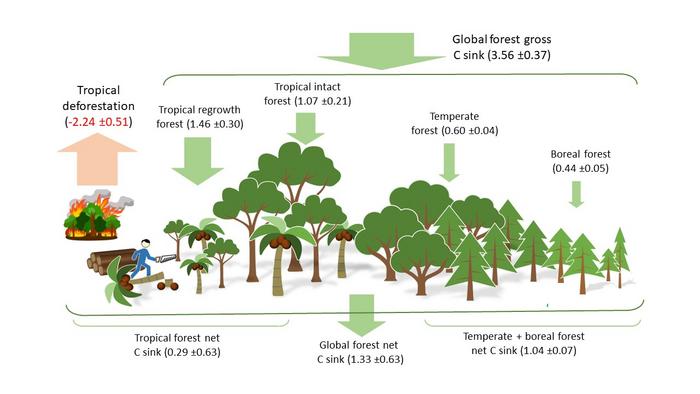
Despite facing regional threats like deforestation and wildfires, the world’s forests continue to be a powerful weapon in the fight against climate change. A new study reveals these vital ecosystems have consistently absorbed carbon dioxide for the past three decades, even as disruptions chip away at their capacity. The study, based on long-term ground measurements combined with remote sensing data, found that forests take up an average of 3.5 ± 0.4 billion metric tons of carbon per year, which is nearly half of the carbon dioxide emissions from burning fossil fuels between 1990 and 2019.

Credit: USDA Forest Service image by Yude Pan.
Despite facing regional threats like deforestation and wildfires, the world’s forests continue to be a powerful weapon in the fight against climate change. A new study reveals these vital ecosystems have consistently absorbed carbon dioxide for the past three decades, even as disruptions chip away at their capacity. The study, based on long-term ground measurements combined with remote sensing data, found that forests take up an average of 3.5 ± 0.4 billion metric tons of carbon per year, which is nearly half of the carbon dioxide emissions from burning fossil fuels between 1990 and 2019.
The study titled “The enduring world forest carbon sink”, published in the 18-July-2024 issue of the journal Nature, highlights the critical role of forests in mitigating climate change. The study further shows that deforestation and disturbances like wildfires are threatening this vital carbon sink.
The research is co-led by USDA Forest Service Northern Research Station Senior Research Scientist Yude Pan and Senior Scientist Richard Birdsey from Woodwell Climate Research Center, and includes 15 additional coauthors from 11 countries.
Key Findings:
- Boreal forests in the Northern Hemisphere, spanning regions like Alaska, Canada, and Russia, have experienced a significant decline in their carbon sink capacity, dropping by 36%. This decrease is attributed to factors including increased disturbances from wildfires, insect outbreaks, and soil warming.
- Tropical forests have also seen a decline, with deforestation causing a 31% decrease in their ability to absorb carbon. However, regrowth in previously abandoned agricultural lands and logged areas has partially offset these losses, keeping the net carbon flux in the tropics close to neutral.
- Temperate forests, on the other hand, have shown a 30% increase in their carbon sink capacity. This rise is largely due to extensive reforestation efforts, particularly in China.
“Our research team analyzed data from millions of forest plots around the globe,” Dr. Pan explained. “What sets this study apart is its foundation in extensive ground measurements – essentially, a tree-by-tree assessment of size, species, and biomass. While the study also incorporates remote sensing data, a common tool in national forest inventories and land surveys, our unique strength lies in the detailed on-the-ground data collection.”
“The persistence of the global forest carbon sink was a surprise given global increases in wildfire, drought, logging, and other stressors”, according to Dr. Birdsey. “But it turns out that increasing emissions in some regions were balanced by increasing accumulation in other regions, mainly re-growing tropical forests and reforestation of temperate forests. These findings support the potential for improving protection and management of forests as effective natural climate solutions”.
The study describes how certain land management policies and practices can help preserve this global carbon sink. Findings support a focus on curtailing deforestation across all forest biomes, for example, promoting forest restoration on lands that may be unsuitable for agriculture, and improving timber harvesting practices to minimize emissions from logging and related activities.
The research also highlights the limitations in data collection, particularly in tropical regions. The study calls for increased research and establishment of more ground sampling plots in these areas to reduce uncertainties in carbon estimates and improve understanding of the global carbon budget.
Forests play a critical role in combating climate change. Protecting and restoring these ecosystems is essential to mitigate climate impacts and achieve greenhouse gas reduction targets.
###
USDA is an equal opportunity provider, employer and lender.
Journal
Nature
Method of Research
Data/statistical analysis
Subject of Research
Not applicable
Article Title
The enduring world forest carbon sink
Article Publication Date
17-Jul-2024
Cite Scienmag News
Sloane Callahan. (July 17, 2024). Forests endure as carbon sink despite regional pressures. Scienmag. https://scienmag.com/forests-endure-as-carbon-sink-despite-regional-pressures/
Sloane Callahan. "Forests endure as carbon sink despite regional pressures." Scienmag, 17 July 2024, https://scienmag.com/forests-endure-as-carbon-sink-despite-regional-pressures/. Accessed 7 September 2026.
Sloane Callahan. "Forests endure as carbon sink despite regional pressures." Scienmag. July 17, 2024. https://scienmag.com/forests-endure-as-carbon-sink-despite-regional-pressures/

