


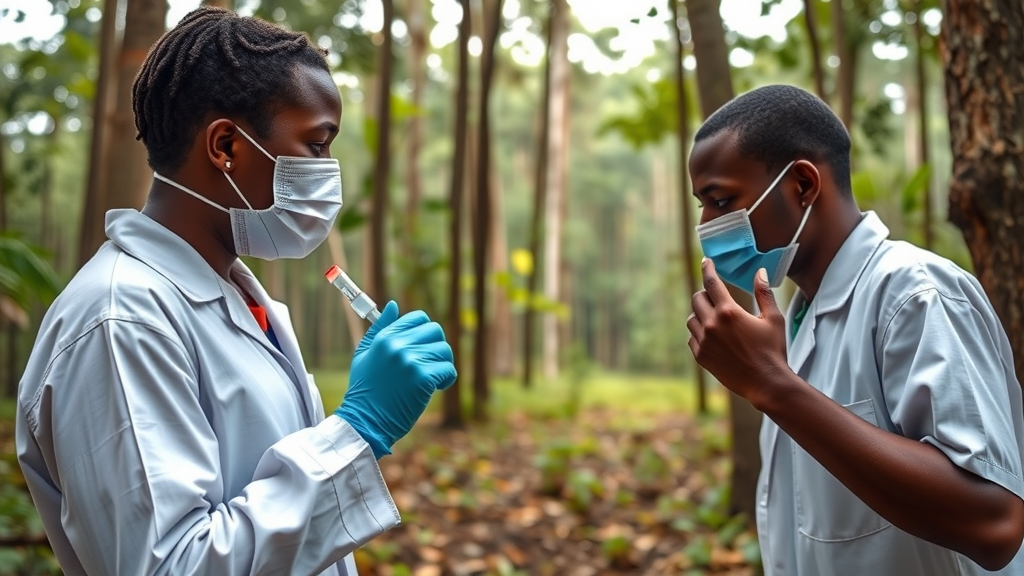
The forested region of Guinea has long been recognized as an important epicenter for Lassa fever, an acute viral hemorrhagic illness caused by Lassa virus, an Old World arenavirus maintained in nature by the multimammate mouse (Mastomys natalensis). Despite decades of sporadic outbreaks and endemic transmission across West Africa, the capacity to confirm cases rapidly and reliably in the very places where the virus circulates has remained limited. A recent study published in npj Viruses examines how diagnostic capacity for viral hemorrhagic fevers has been strengthened in Forest Guinea, documenting measurable advances in the detection of Lassa fever cases and offering a model for other endemic settings.
Lassa fever presents a formidable diagnostic challenge. Early symptoms, including fever, malaise, headache, and muscle pain, overlap substantially with malaria, typhoid fever, and other common febrile illnesses that dominate the clinical landscape of the region. As a result, many infections are treated empirically as malaria and never confirmed as Lassa, obscuring the true burden of disease and delaying interventions such as isolation, contact tracing, and timely administration of ribavirin, the antiviral most often used in management. Case fatality is highest among patients hospitalized late in illness, which makes early laboratory confirmation not merely an academic exercise but a direct determinant of survival.
Historically, suspected cases in Forest Guinea had to be referred to distant reference laboratories, often outside the country, for confirmatory testing. Transport of samples over long distances on poor roads introduced delays of days or weeks, degraded sample quality, and severed the connection between laboratory results and the clinical decisions that needed to inform them. During that interval, patients could deteriorate, contacts could be exposed, and outbreak signals could be missed entirely. Strengthening in-country and, ultimately, in-region diagnostic capacity has therefore been a central pillar of Guinea’s post-epidemic health security agenda, accelerated by the hard lessons of the 2014–2016 Ebola virus disease epidemic in West Africa.
The advances described in the study center on the establishment and progressive improvement of laboratory platforms capable of detecting Lassa virus and other hemorrhagic fever pathogens at or near the point of patient care. Molecular assays based on reverse transcription polymerase chain reaction (RT-PCR) remain the reference standard for acute case confirmation, targeting conserved regions of the viral S segment genome. Deploying these assays in Guinea required not only equipment and reagents but also reliable cold chains, uninterrupted power supply, quality management systems, and, critically, trained personnel able to perform testing to internationally recognized standards.
Serological methods complement molecular detection in the diagnostic arsenal. Indirect immunofluorescent antibody tests and enzyme-linked immunosorbent assays detecting Lassa-specific IgM and IgG antibodies extend the window of detection beyond the viremic phase and support seroprevalence studies that map the footprint of past transmission. Because antibody responses in Lassa fever can be variable and cross-reactivity with other arenaviruses complicates interpretation, the combination of molecular and serological approaches, applied with careful clinical context, provides the most complete picture of who is infected, who has been exposed, and where the virus is actively circulating.
A decisive element of the capacity-building effort has been the training of Guinean laboratory scientists and technicians in biosafe specimen handling, nucleic acid extraction, assay execution, and result interpretation. Working with Lassa virus requires appropriate biosafety precautions, since the virus can be transmitted through contact with infectious blood, tissues, or bodily fluids, and laboratory-acquired infections are a recognized occupational risk. Building a cadre of locally based experts reduces dependence on external missions, sustains testing throughput between outbreaks, and anchors diagnostic capability within the national public health system rather than in temporary emergency structures.
The study documents how these investments translated into operational gains: more suspected cases tested, shorter turnaround times between sample collection and result reporting, and a higher proportion of Lassa fever cases confirmed within the country. Each of these metrics matters. Faster confirmation enables clinicians to initiate appropriate treatment earlier, triggers more rapid deployment of outbreak response teams, and improves the accuracy of surveillance data used to allocate scarce resources. Improved detection also feeds back into research, since confirmed cases provide the samples and epidemiological context needed to study viral diversity, disease severity, and transmission dynamics.
Genomic surveillance is an increasingly important downstream benefit of strengthened diagnostics. Sequencing Lassa virus genomes from confirmed cases allows researchers to track viral lineages, identify introductions from rodent reservoirs into human populations, and reconstruct transmission chains. In Forest Guinea, where multiple Lassa virus lineages are known to circulate and where the ecological interface between humans and reservoir rodents is intimate, genomic data can distinguish persistent local transmission from repeated spillover events, information that shapes whether interventions should prioritize rodent control, food storage hygiene, community education, or vaccination once candidate vaccines advance through the pipeline.
The Guinea experience also carries lessons for regional health security more broadly. The same laboratory infrastructure, trained workforce, and specimen referral networks that support Lassa fever detection can be adapted for other viral hemorrhagic fevers, including Ebola, Dengue, and yellow fever, as well as for emerging pathogens of unknown origin. Integrated diagnostic platforms that can pivot between pathogens represent a more resilient investment than single-disease silos, a principle reinforced by the COVID-19 pandemic, which tested and in many places benefited from hemorrhagic fever diagnostic networks established in the preceding decade.
Challenges remain. Sustaining funding beyond donor-supported emergency cycles, maintaining reagent supply chains, retaining skilled staff, and expanding testing to peripheral health facilities all require continued commitment. Yet the trajectory documented in Forest Guinea demonstrates that endemic countries can move from being sample-shippers to being diagnostic leaders in the fight against viral hemorrhagic fevers. Every Lassa fever case confirmed quickly and accurately is a patient treated sooner, a contact list initiated earlier, and a piece of evidence added to the regional understanding of one of West Africa’s most persistent viral threats.
Subject of Research: Strengthening diagnostic capacity for Lassa fever and viral hemorrhagic fevers in Forest Guinea
Article Title: Strengthening diagnostic capacity for viral hemorrhagic fevers in Forest Guinea: advances in Lassa fever case detection
Article References: Koundouno, F. R., Sidibe, Y., Millimono, S. L., Ifono, K., Hinzmann, J., Soubrier, H., Kourouma, K., Millimouno, T. E., Tolno, F. M., Kamano, F. M., Barry, M. D., Koulemou, S., Sonomy, B., Traore, M., Keïta, K., Hinrichs, M., Ryter, S., van Gelder, C., Becker-Ziaja, B., … Annibaldis, G. (2026). Strengthening diagnostic capacity for viral hemorrhagic fevers in Forest Guinea: advances in Lassa fever case detection. npj Viruses, 4(1), Article 42. https://doi.org/10.1038/s44298-026-00239-9
Image Credits: AI Generated
DOI: 10.1038/s44298-026-00239-9
Keywords: Lassa fever, viral hemorrhagic fevers, diagnostic capacity, Forest Guinea, RT-PCR, serology, genomic surveillance, biosafety, public health laboratory, case detection, outbreak response, Strengthening
Cite Scienmag News
Kristina Jarvis. (September 20, 2026). Forest Guinea Expands Lassa Fever Diagnostics to Close Viral Hemorrhagic Fever Detection Gaps. Scienmag. https://scienmag.com/forest-guinea-expands-lassa-fever-diagnostics-to-close-viral-hemorrhagic-fever-detection-gaps/
Kristina Jarvis. "Forest Guinea Expands Lassa Fever Diagnostics to Close Viral Hemorrhagic Fever Detection Gaps." Scienmag, 20 September 2026, https://scienmag.com/forest-guinea-expands-lassa-fever-diagnostics-to-close-viral-hemorrhagic-fever-detection-gaps/. Accessed 4 October 2026.
Kristina Jarvis. "Forest Guinea Expands Lassa Fever Diagnostics to Close Viral Hemorrhagic Fever Detection Gaps." Scienmag. September 20, 2026. https://scienmag.com/forest-guinea-expands-lassa-fever-diagnostics-to-close-viral-hemorrhagic-fever-detection-gaps/


