


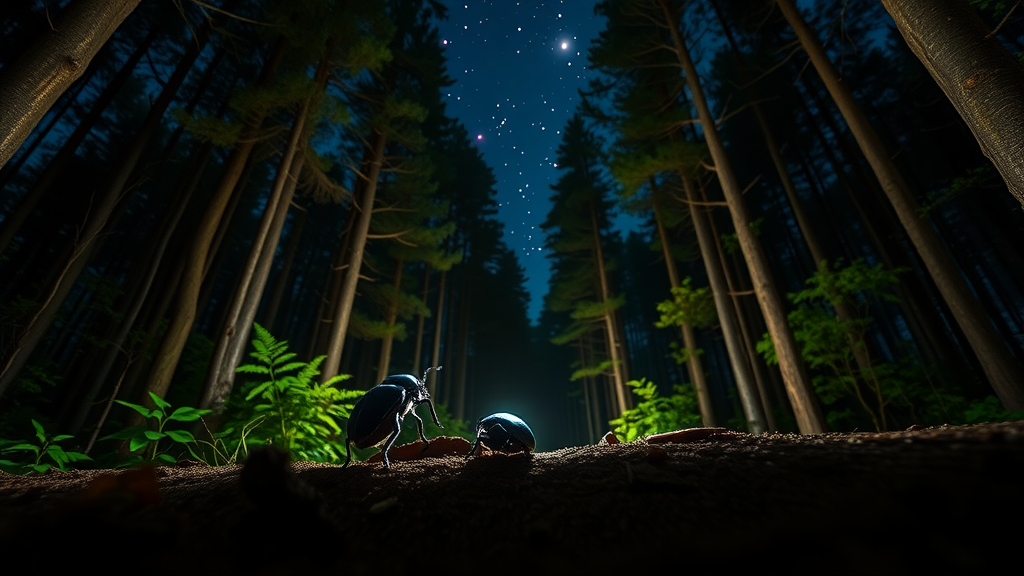
Deep in the forests around Potsdam, Germany, a small, shiny beetle crawls out of the leaf litter after dark and takes flight in search of fresh dung and carrion. For decades, scientists assumed that a creature evolved to live in the perpetual gloom of a forest floor, often tunnelling underground, would have little use for the stars overhead. A new study challenges that assumption. Researchers from the University of Potsdam, the GFZ Helmholtz Centre for Geosciences and Ruhr-Universität Bochum report that the European dung beetle, Anoplotrupes stercorosus, appears to optimise its movement when celestial or artificial light cues are available, becoming faster and far less convoluted in its paths than when left in total darkness. The work, published in BMC Environmental Science, adds a European forest dweller to the growing roster of insects that seem to exploit the night sky for navigation.
The experiment took its inspiration from a celebrated 2013 study in which researchers showed that the African ball-rolling dung beetle Scarabaeus satyrus uses the Milky Way to keep its dung ball rolling in a straight line. That finding, made famous partly because African beetles roll their prized balls directly away from the dung pile in a race against competitors, raised an obvious evolutionary question: is celestial orientation a special adaptation of exposed, ball-rolling beetles in open habitats, or a far more ancient capacity shared across the scarab beetle family? Vera Kaunath, Tony Werner, Christopher Kyba and Jana Eccard decided to test a species with a very different lifestyle. The European dung beetle does not roll balls to unknown destinations. Instead, it flies from dung pile to dung pile, locates its resource largely by smell, and digs its breeding tunnels directly beneath the find. Yet even a beetle that stays put once it has found food must still travel efficiently between resources, and for that, a compass could help.
During October 2015, the team captured beetles with cheese-baited pitfall traps in dense forest around the lake Teufelssee, roughly 36 kilometres southwest of Berlin. The site is genuinely dark by human standards, with no detectable surface glow in satellite imagery, although scattered light from Potsdam and Berlin brightens the zenith sky to roughly four times its natural brightness on clear nights. The beetles were housed in semi-opaque boxes filled with soil, leaves and horse dung, and each animal was used only once before being released near its point of capture. The stage for the actual experiment was provided by the URANIA Planetarium in Potsdam, whose dome can project up to 6,000 stars, allowing the researchers to assemble night skies of precisely controlled brightness and content, something no field site can offer.
The design was elegantly simple. A one-metre wooden arena, painted black with a white starting circle and grid, was placed on the planetarium floor. Each beetle was acclimatised for ten minutes in a glass tube, then released at the centre of the arena facing north. The test ended when the animal crossed a circle 50 centimetres from the release point, or after five minutes if it never got that far. A night-shot video camera with infrared illumination filmed every run from above, and the arena was cleaned with ethanol between trials. The beetles faced four treatments: complete darkness, a projection of roughly 2,500 stars, stars together with the Milky Way projected in a north-south orientation, and finally a single artificial lamp positioned three metres away, standing in for a real-world point source of light pollution. Light levels were measured with a Sky Quality Meter, confirming that the stars treatment matched a realistic starry sky with airglow, while the stars-and-Milky-Way projection was about 50 percent brighter than a natural sky.
Of 181 beetles tested, 77 produced analysable paths, with between 12 and 25 animals per treatment. Some beetles simply stopped moving, and some tracking attempts failed because the infrared footage did not provide enough contrast. Importantly, the proportion of excluded animals did not differ significantly across treatments, so the exclusions were unlikely to bias the comparison. The recorded paths were converted into coordinate sequences, one location every two seconds, and characterised by total walking distance, time to the arena edge and mean turning angle, a standard measure of how tortuous a route is. Direction of exit was analysed with circular statistics, including Rayleigh tests for non-random heading and Watson’s large-sample test for comparisons among treatments, and the movement variables were evaluated together with a multivariate analysis of variance.
The results were striking. Under the lamp, beetles walked the shortest distances, took the straightest routes and reached the arena edge faster than under any other condition. In complete darkness and under stars alone, their paths were the longest, slowest and most winding, with no statistical difference between the two dark treatments. The stars-and-Milky-Way treatment fell in between: total distance was shorter than in the darker conditions, and time and turning angle were intermediate. Because all three measures come from the same path, the team used a multivariate framework, which showed a highly significant overall difference among treatments, and follow-up analyses pinned the differences down for each individual variable. In plain terms, the more the beetles had to look at, the better they seemed to move, and that was as true for a projected galaxy as for an ordinary electric lamp.
Direction added a further puzzle. Across all treatments, roughly 74 percent of beetles left the arena heading west, a concentration that held even in the dark treatment, where it appeared only as a tendency. Rayleigh tests confirmed non-random, westward movement in the three illuminated treatments. Intriguingly, in the two brightest treatments, stars-and-Milky-Way and lamp, about 30 percent of the remaining animals exited in the exact opposite direction, and the median exit direction did not differ significantly among treatments. Because the Milky Way and the lamp sat roughly 90 degrees apart from the beetle’s perspective, yet the beetles’ exits clustered in a common direction regardless of treatment, the authors argue that the animals were probably not using the experimental light cues to set their heading. Instead, the shared direction may have come from some other feature of the hall, such as the silhouette of equipment, an olfactory cue or a draft near the door. Alternatively, the researchers speculate, beetles released facing north may follow self-referenced, idiothetic spiralling paths; a consistent leftward spiral would carry most animals across the perimeter at a similar spot, while a rightward spiral would produce the opposite exit, and brighter conditions might simply allow more precise execution of these stereotyped movements.
The conservation implications are deliberately cautious. On the one hand, the findings support the hypothesis that celestial bodies help optimise movement, an ability that may be ancestral among insects and that persists even in a species adapted to dark forest interiors and partly subterranean life. On the other hand, the authors explicitly note that this species’ navigation may not be disrupted by artificial light at night, because the beetles moved most efficiently under the lamp. That efficiency could, however, come at a hidden cost. African dung beetles have been shown to accept artificial light sources as substitute celestial cues when no natural ones are present, and the researchers suggest the European beetles may have misinterpreted the lamp as the moon. Whether such attraction escalates into the fatal attraction documented for flying insects, in which the dorsal light response causes moths and other aerial species to circle lamps until they die of exhaustion or predation, remains untested here.
What is not in doubt is the ecological weight these beetles carry. By burying dung and carrion, they accelerate the decomposition of organic matter and reduce the spread of flies and parasites, a service that could erode if artificial lighting chronically alters their activity. Insects exposed to constant light can show stress and exhaustion that steal time from foraging, dung transfer and mate searching. The authors conclude that pairing the avoidance of artificial lighting in natural and semi-natural areas with carefully tailored lighting concepts offers a practical window to limit the impact of light pollution before its effects become drastic. For now, the image that lingers is a small forest beetle, descendants of animals that have crawled through leaf litter for millions of years, apparently still reading the sky, and perhaps mistaking a streetlamp for the Milky Way when the real one fades from view.
Subject of Research: Celestial and artificial light cue use in the movement behaviour of the European dung beetle Anoplotrupes stercorosus
Article Title: Do dung beetles use the Milky Way to optimise their movement?
Article References: Kaunath, V., Werner, T., Kyba, C. C. M., & Eccard, J. A. (2025). Do dung beetles use the Milky Way to optimise their movement?. BMC Environmental Science, 2(1), Article 25. https://doi.org/10.1186/s44329-025-00039-1
Image Credits: AI Generated
DOI: 10.1186/s44329-025-00039-1
Keywords: dung beetle, celestial navigation, Milky Way, light pollution, artificial light at night, insect orientation, planetarium experiment, movement ecology, entomology, conservation, scarab beetles, night sky
Cite Scienmag News
Gavin Prescott. (September 27, 2026). Forest Dung Beetles Steer Straighter When the Night Sky Shines Above. Scienmag. https://scienmag.com/forest-dung-beetles-steer-straighter-when-the-night-sky-shines-above/
Gavin Prescott. "Forest Dung Beetles Steer Straighter When the Night Sky Shines Above." Scienmag, 27 September 2026, https://scienmag.com/forest-dung-beetles-steer-straighter-when-the-night-sky-shines-above/. Accessed 4 October 2026.
Gavin Prescott. "Forest Dung Beetles Steer Straighter When the Night Sky Shines Above." Scienmag. September 27, 2026. https://scienmag.com/forest-dung-beetles-steer-straighter-when-the-night-sky-shines-above/


