


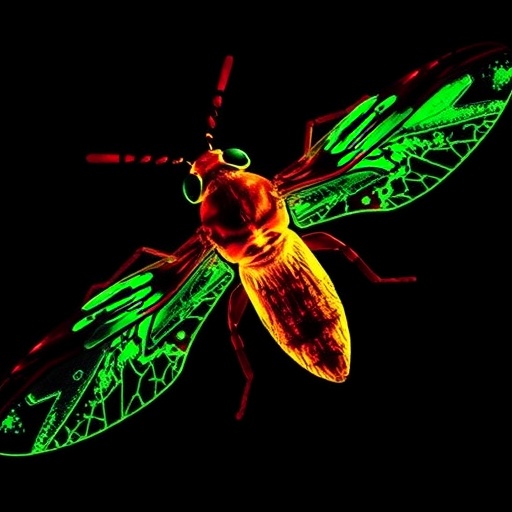
A groundbreaking advancement from Texas A&M AgriLife Research is poised to reshape forensic death investigations by introducing a novel technique that enhances the precision and timeliness of establishing postmortem intervals. The interdisciplinary collaboration between the Department of Entomology and the Department of Biochemistry and Biophysics has yielded a cutting-edge method centered on the use of infrared spectroscopy coupled with sophisticated machine learning algorithms to identify the sex of blow fly larvae directly from human remains. This innovation holds promise for improving forensic timelines, a critical factor in criminal investigations where every hour can alter the course of justice.
Blow flies, belonging to the family Calliphoridae, are renowned for their ecological role as primary colonizers of decomposing remains. The specific species studied, Chrysomya rufifacies, represents an important forensic indicator allowing entomologists to estimate time since death based on larval development stages. However, conventional approaches to sex determination in larvae have been plagued by substantial limitations, chiefly because male and female larvae are morphologically indistinguishable at early stages, and current methods require destructive molecular testing. Such approaches often delay analysis and reduce the amount of forensic material available for subsequent examinations.
The innovative research, led by doctoral candidate Aidan Holman under the supervision of Dr. Dmitry Kurouski, applies near-infrared spectroscopy (NIRS) to live larvae, noninvasively capturing the unique molecular signatures of their biological composition. NIRS leverages the interaction of light with molecular bonds—specifically vibrations among proteins, lipids, and other constituents—to produce spectral fingerprints characteristic of biological samples. By analyzing variations in light absorption and scattering patterns, researchers can detect subtle biochemical differences correlated with sex, a feat previously unachievable without sample destruction.
Implementing handheld infrared spectrometers, the research team scanned individual larvae to generate extensive spectral datasets. These datasets, characterized by intricate patterns in the near-infrared region, provided a rich source of information for computational analysis. The team employed machine learning models—advanced algorithms designed to recognize complex patterns within data—to classify larvae by sex. Out of several tested models, two demonstrated stellar performance with classification accuracy exceeding 90%, and one achieving over 95%, indicating high reliability suitable for forensic applications.
This novel technique offers numerous advantages over traditional sexing methodologies. Its noninvasive nature preserves specimens, a vital consideration in forensic casework, where sample integrity is paramount. Moreover, the speed and portability of the method, facilitated by compact handheld devices, empowers investigators to conduct on-site analyses at crime scenes. Practitioners may rapidly obtain critical data that refine postmortem interval estimates by incorporating sex-specific developmental rates into their calculations, mitigating inaccuracies that arise from treating larval populations as uniform.
In forensic entomology, the distinction between male and female blow flies is particularly consequential because their respective developmental timelines can differ by a significant margin—studies indicate disparities of at least nine hours under varying temperature conditions. Accounting for such differences enhances the precision of time-of-death estimations, which traditionally rely heavily on environmental conditions and generalized growth data. Holman’s application of vibrational spectroscopy thus introduces a refined lens through which forensic timelines can be reconstructed with heightened accuracy.
Beyond forensic science, the implications of this technique extend to broader scientific and practical realms. In agricultural pest management, understanding the sex ratio and dynamics within larval populations is crucial for sterile insect technique (SIT) programs, which release sterilized males to suppress pest propagation. The ability to rapidly and accurately sort larvae by sex can significantly optimize such biocontrol strategies, improving their efficacy while reducing costs and labor.
The spectroscopic profiling leveraged in this research capitalizes on the biochemical differentiation present even in early larval stages. Differences in cuticular hydrocarbon composition, protein expression, and lipid metabolism between male and female larvae manifest as distinct spectral signatures in the near-infrared region. This optical biochemical fingerprinting represents a frontier in non-destructive biological classification, with machine learning algorithms serving as interpreters of complex data imperceptible to human analysis.
Underpinning this interdisciplinary breakthrough is the Kurouski laboratory’s extensive expertise in vibrational spectroscopy, a versatile field that interrogates molecular vibrations across biological and environmental samples. Their approach exemplifies how fundamental analytical chemistry can be innovatively applied to solve real-world challenges in public service domains. By bridging molecular biochemistry with forensic entomology, the team has crafted a solution that integrates chemistry, biology, and computer science to advance investigative protocols.
The recognition of molecular heterogeneity within blow fly larvae as a discriminative feature underscores a paradigm shift in forensic methodology, moving away from purely morphological or genetic assays towards rapid spectroscopic diagnostics. This approach momentously reduces the time required to acquire actionable forensic data, heralding a new era where machine learning augmented spectroscopic devices become standard tools in the forensic investigator’s arsenal.
Moreover, with evolving concerns about invasive species and their ecological impacts, tools that mass-classify insect larvae without destruction could aid surveillance and management programs. The renewed focus on species like the New World screwworm fly, which has garnered increased attention due to expanding geographical activity, demonstrates the broader relevance of accurate entomological sexing in biosecurity and agricultural health.
This research exemplifies the synergy achievable when advanced technological platforms are adeptly tailored to address nuanced forensic questions. It reflects the promise of harnessing machine intelligence to augment human expertise, providing forensic entomologists with powerful, objective analytical methods previously unimaginable. As these technologies undergo further validation and integration into standard operational protocols, they stand to drastically improve the speed, accuracy, and reliability of forensic investigations worldwide.
In summation, the integration of infrared spectroscopy and machine learning for the sex determination of forensic blow fly larvae marks a significant scientific milestone. It enhances forensic entomology by refining time-of-death approximations, facilitating practical field applications, and extending utility into pest management frameworks. By noninvasively decoding the molecular signatures of larvae and capitalizing on computational power, researchers have opened new vistas for forensic science and allied disciplines, paving the way for faster, smarter, and more precise biological analyses in complex investigative environments.
Web References:
- Texas A&M AgriLife Research
- Texas A&M College of Agriculture and Life Sciences Department of Entomology
- Department of Biochemistry and Biophysics
- Journal of Forensic Sciences article
- National Institute of Justice
Cite Scienmag News
Gavin Prescott. (September 8, 2025). Forensic Timelines Enhanced by Light-Based Insect Analysis. Scienmag. https://scienmag.com/forensic-timelines-enhanced-by-light-based-insect-analysis/
Gavin Prescott. "Forensic Timelines Enhanced by Light-Based Insect Analysis." Scienmag, 8 September 2025, https://scienmag.com/forensic-timelines-enhanced-by-light-based-insect-analysis/. Accessed 4 September 2026.
Gavin Prescott. "Forensic Timelines Enhanced by Light-Based Insect Analysis." Scienmag. September 8, 2025. https://scienmag.com/forensic-timelines-enhanced-by-light-based-insect-analysis/


