


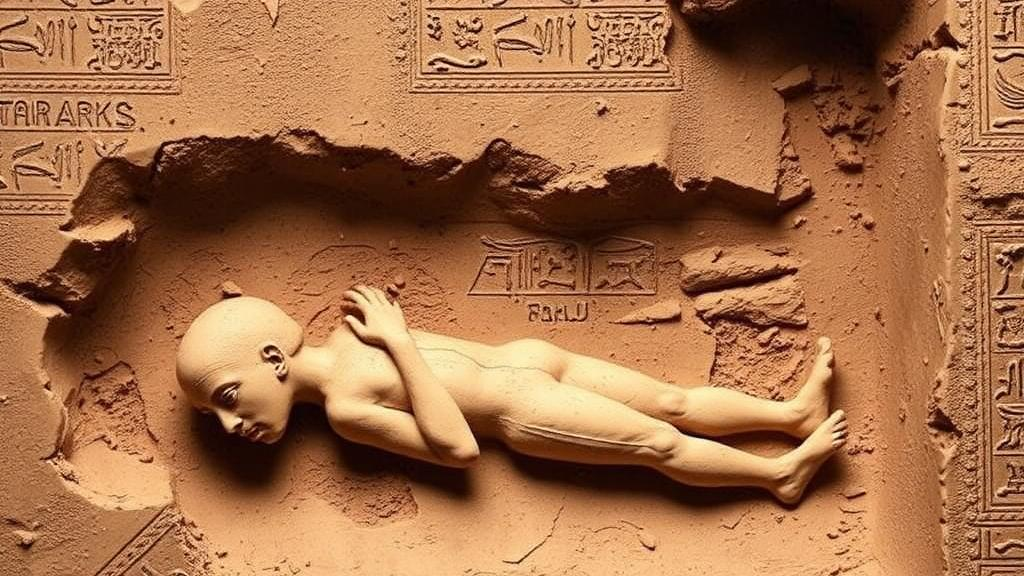
More than a century after archaeologists first unearthed rows of mysterious graves around Egypt’s earliest royal tombs, modern forensic science has delivered a verdict that ancient historians have debated for generations: many of these people were almost certainly killed on purpose. A new study published in Frontiers in Environmental Archaeology reports that at least 39 percent of a sample of skulls recovered from the First Dynasty funerary complexes at Abydos bear the unmistakable signatures of fatal blunt force trauma. The finding transforms what was once an unsettling hypothesis into a well-supported reconstruction of state-sanctioned violence at the very dawn of ancient Egyptian civilization, around 3000 BCE, when the first kings of a unified Egypt were laid to rest surrounded by members of their own households.
The story begins in the 1920s, when the pioneering British archaeologist Flinders Petrie excavated the funerary complexes at Abydos, a site in Upper Egypt that served as a burial ground for Egypt’s earliest pharaohs. Petrie documented subsidiary burials surrounding the royal tombs and their associated enclosures, which were probably used for funerary rituals. Each subsidiary burial consisted of a simple chamber arranged in rows of dozens of others. Some of the dead were given simple coffins, and most were accompanied by a modest set of grave goods, including ceramic vessels. Many graves also contained small objects such as copper tools, projectile points, and small ivory figurines. A few grave markers bore names and official titles, and those titles appear to refer mostly to lower- and mid-level officials as well as artisans, suggesting that the people buried there were not elite nobles but working members of the royal establishment.
The sheer scale of these burials raised immediate suspicions. Some individual burials were surrounded by hundreds of others, and Petrie found it difficult to believe that so many people could have died of natural causes at the same time, in close succession, and in circumstances that led them all to be interred around royal tombs. He suspected that the graves reflected the practice now known as retainer sacrifice, in which people close to a ruler are killed when the ruler dies. Yet when Petrie examined the skeletal remains, he found no evidence of lethal injuries, and the absence of corroborating trauma cast doubt on his own hypothesis for decades. Without physical evidence of violence, the retainer sacrifice interpretation remained an intriguing but unproven possibility, relegated largely to footnotes in the grand narrative of early Egyptian state formation.
Dr Roselyn Campbell of Purdue University, lead author of the new study and author of a forthcoming book on state-sanctioned violence and human sacrifice in Early Dynastic Egypt, set out to solve this cold case. Her interest was drawn not only to the question of how these people died but to who they were. Even though they were buried around royalty, they have mostly been relegated to the margins of the historical narrative, and little attention has been paid to how these individuals may have viewed the ruler and their own role in his or her life and death. Retainer sacrifice, as practiced in many cultures, is often rooted in beliefs that the sacrificed individuals will continue to serve the ruler in some kind of afterlife, but it can also function as a visceral display of the ruler’s power. Some retainers might have volunteered to die in the expectation of eternal life or honor, while others may have been chosen or even forced.
To reexamine the evidence, Campbell first had to track down what remained of Petrie’s excavated material. Petrie kept meticulous records of his work, but he reburied most of the human remains he uncovered, retaining only the skulls, some of which were sent to the United Kingdom. Campbell located 46 of these crania in the Duckworth Collection at the University of Cambridge and reexamined them using modern forensic and bioarchaeological methods. The results were striking. Eighteen of the 46 crania, roughly 39 percent of the sample, showed evidence of significant cranial trauma in the form of linear fractures. Petrie appears to have mistaken these fractures for naturally caused post-depositional damage, but advances in forensic science now allow researchers to recognize them as perimortem injuries, meaning they occurred at or around the time of death, when the bone still retained the moisture and elasticity of living tissue.
The technical characteristics of these injuries carry important implications. The fractures on the preserved crania are generally linear rather than depressed, a pattern that forensic anthropologists associate with blows delivered by a flat, wide implement rather than a rounded or pointed weapon. According to Campbell, such injuries would likely cause rapid unconsciousness, internal bleeding, and death. Some of the 18 traumatized skulls also displayed evidence of sharp-force trauma, including a chopping injury to one individual’s eye. The nature of the blunt force injuries poses a puzzle for reconstructing the exact method of killing. Egyptian kings are often depicted in art smiting their enemies with a mace, but these retainers were not enemies of the crown, and a mace blow would be expected to produce depressed fractures rather than the linear pattern observed. A hard fall could also produce linear cranial fractures, but a fall violent enough to fracture the skull would probably have broken other bones as well, and no such injuries were visible in Petrie’s photographs or recorded in his notes.
Considerable uncertainty remains about the fate of the other retainers whose skulls showed no trauma. Some of them could have died naturally, perhaps of disease or other causes that left no mark on bone. Alternatively, they may have been killed in ways that are not visible skeletally, such as asphyxiation or strangulation, which leave little or no trace on the skeleton. It is also possible that some were killed in ways that would be detectable only if the rest of their skeletons could be examined, since the surviving evidence is limited to skulls that were separated from the rest of their bodies more than a century ago. Campbell has noted that with unlimited resources she would like to locate the reburied bodies of these individuals and analyze them, but the surviving cranial sample, however incomplete, has already yielded transformative new information.
The study is a powerful demonstration of the scientific value of legacy collections and archival data. Museum collections assembled in the nineteenth and early twentieth centuries often lack the contextual documentation that modern archaeologists would prefer, and the remains they contain were frequently recovered with excavation and recording methods that would be considered inadequate today. Yet as this research shows, revisiting such datasets armed with updated methods and knowledge can reveal entirely new dimensions of the past, even when the material is incomplete and imperfect. Forensic standards for distinguishing perimortem fractures from post-depositional breakage have advanced enormously since Petrie’s era, and techniques that simply did not exist in the 1920s can now extract behavioral and pathological information from bones that were examined and set aside generations ago.
Beyond its methodological significance, the research reshapes our understanding of the earliest Egyptian state. The First Dynasty funerary complexes at Abydos represent some of the earliest monumental expressions of royal power in Egypt, and the evidence that household members were deliberately killed to accompany their rulers speaks to both the ideological and coercive dimensions of early kingship. The victims were artisans and officials, people whose names and titles were occasionally recorded on grave markers, embedded within the machinery of the royal court. Whether they went to their deaths voluntarily, believing they would serve their king in eternity, or under coercion, their deaths were woven into the political theater of royal burial. The study, published on 5 October 2026 under the title New Data from Old Bones: Using Bioarchaeology and Forensics to Reassess Legacy Data from Ancient Abydos, Egypt, marks a turning point in the debate that Petrie opened a century ago, confirming that human sacrifice was practiced at the heart of one of the world’s first territorial states and reminding archaeologists that old bones, patiently reexamined, can still rewrite history.
Subject of Research: Forensic bioarchaeological reassessment of retainer sacrifice in First Dynasty royal burials at Abydos, Egypt
Article Title: Modern forensic methods reveal human sacrifice in ancient Egypt
Article References: Modern forensic methods reveal human sacrifice in ancient Egypt. (n.d.). Original publication
Image Credits: AI Generated
DOI: Not provided
Keywords: ancient Egypt, human sacrifice, Abydos, First Dynasty, forensic anthropology, bioarchaeology, retainer sacrifice, cranial trauma, Flinders Petrie, legacy collections, Duckworth Collection, Frontiers in Environmental Archaeology
Cite Scienmag News
Courtney Benton. (October 5, 2026). Forensic Science Exposes Human Sacrifice in Egypt’s First Dynasty Royal Burials. Scienmag. https://scienmag.com/forensic-science-exposes-human-sacrifice-in-egypts-first-dynasty-royal-burials/
Courtney Benton. "Forensic Science Exposes Human Sacrifice in Egypt’s First Dynasty Royal Burials." Scienmag, 5 October 2026, https://scienmag.com/forensic-science-exposes-human-sacrifice-in-egypts-first-dynasty-royal-burials/. Accessed 5 October 2026.
Courtney Benton. "Forensic Science Exposes Human Sacrifice in Egypt’s First Dynasty Royal Burials." Scienmag. October 5, 2026. https://scienmag.com/forensic-science-exposes-human-sacrifice-in-egypts-first-dynasty-royal-burials/


