


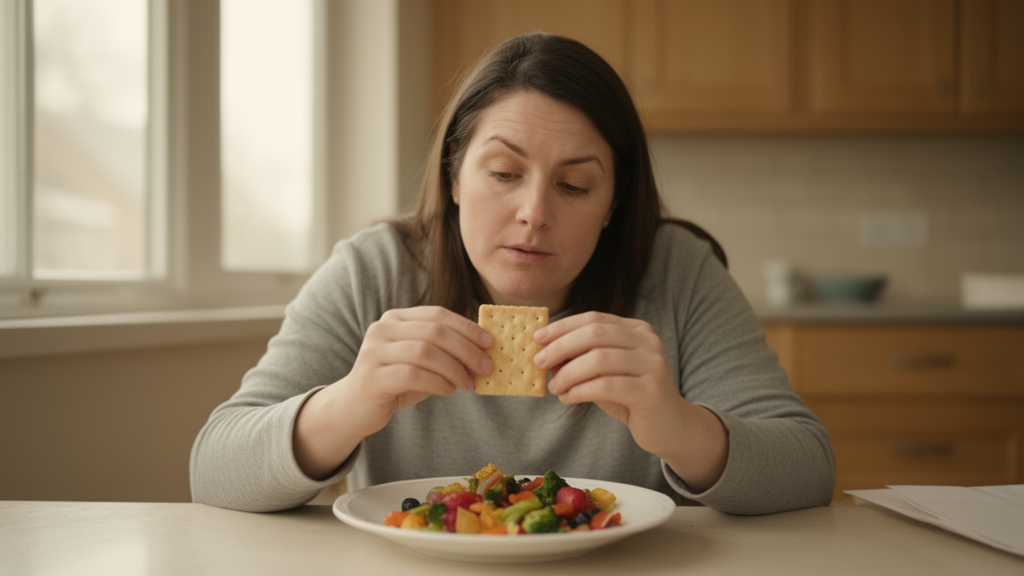
Eating disorders are among the most lethal psychiatric conditions, and clinicians have long known that they strike autistic people at disproportionately high rates. What has been far less clear is how autistic adults themselves experience these illnesses, and whether the standard clinical playbook, built around body image distress and the fear of weight gain, actually describes what is happening inside their minds and bodies. A new systematic review published in Frontiers in Psychiatry argues that for many autistic adults, it does not. Drawing together the first-person accounts scattered across thirteen qualitative studies, researchers from the University of Sheffield and Cardiff University conclude that eating disorders in autistic people are often inseparable from autism itself, shaped by sensory overload, unreliable internal bodily signals, and a deep need for predictability rather than a desire to be thin.
The review team, led by Becky Watts of the University of Sheffield alongside Samuel Chawner, Gareth Burchell and John Fox, searched four major databases, PsycINFO, MEDLINE, Scopus and CINAHL, for peer-reviewed qualitative studies of autistic adults with lived experience of eating disorders or disordered eating. From 424 initial records, thirteen studies survived full-text screening. Each was appraised with the Critical Appraisal Skills Programme qualitative checklist, and the findings were combined using thematic synthesis, a three-stage method that codes participant quotations and author interpretations line by line, groups the codes into descriptive themes, and then distils higher-order analytical themes that cut across individual studies. Eleven of the thirteen studies were rated high quality, and the review was registered prospectively on PROSPERO.
Three analytical themes emerged, and together they amount to a quiet revolution in how the intersection of autism and eating disorders might be understood. The first is that eating disorder experiences cannot be understood independently of autistic ways of processing the world. The second is that recovery is enabled through developing self-understanding and integrating autism into personal identity. The third is that recovery is facilitated when support aligns with autistic needs rather than neurotypical assumptions. Each theme is anchored in vivid first-person testimony, and each carries direct implications for how clinicians assess, formulate and treat eating disorders in this population.
The sensory thread runs through nearly every account. Participants described food choices driven by texture, smell and temperature rather than calories or body shape. One person explained that a salad was terrifying because its components were mixed together. Another described restricting food after weight gain not because of how their stomach looked but because they disliked the sensation of how it felt. A third traced the onset of restriction to the school canteen, a space of overwhelming noise, crowds and social demands. For some, the sensory experience of clothing or of their own skin was itself aversive, one participant describing her body as a cage she decorated with tattoos. These are not the classic mechanisms of anorexia nervosa as taught in textbooks, and the review argues that sensory-driven restriction was frequently experienced entirely independently of body image concerns.
Interoception, the brain’s perception of internal bodily states, emerged as a second crucial mechanism. Many participants reported profound difficulty recognising hunger, fullness, thirst and satiety. One described being able to identify dizziness, stomach pain or a dry mouth without ever connecting those signals to hunger. Another said they could binge or miss meals very easily because they did not fully understand their thirst and hunger responses. In the context of binge eating disorder, neurodivergent participants described eating as a form of sensory seeking or emotional regulation, with one noting that recognising they wanted sensory input rather than food helped them choose vegetables instead. These accounts suggest that both restriction and bingeing can arise from the same underlying difference: an unreliable channel of information between body and brain.
The third mechanism is cognitive. A preference for routine, predictability and rule-based thinking appeared repeatedly, both as a driver of rigid eating patterns and, paradoxically, as a resource for recovery. Participants described self-imposed food rules that felt impossible to break, and eating routines so entrenched that travel or social occasions became untenable. Yet the same preference for structure meant that predictable, planned approaches to eating, such as meal plans agreed in advance, reduced anxiety and supported engagement with treatment. One participant noted that the containment and structure of an inpatient ward was genuinely helpful, precisely because it removed the burden of self-organisation.
Perhaps the most striking finding concerns identity. Many participants received an autism diagnosis only in adulthood, often after years of eating disorder treatment that never addressed what they felt was the real cause. One woman summarised the experience bluntly: for her, the anorexia was just a symptom, and the cause was the autism. Receiving a diagnosis frequently acted as a turning point, allowing people to reinterpret decades of struggle not as personal failure but as the predictable consequence of navigating a neurotypical world with a differently wired nervous system. Participants described greater self-compassion, a re-storying of their lives, and connection with others who shared the dual experience. The review notes, however, that this process could also carry grief, as people mourned the years in which their needs went unrecognised.
Against this backdrop, conventional treatment often fell short. Participants reported being told off in hospital for autistic behaviours such as walking on tiptoes, which staff interpreted as calorie-burning. Others described clinicians who insisted on body image work even when patients said their difficulties had nothing to do with weight or shape, an approach one person found humiliating and condescending. Some were discharged from services because their cases were deemed too complex. In contrast, support that worked was individualised and collaborative: therapists who provided written summaries and goal setting, services that gave advance notice of changes and allowed comforting sensory items, families who respected a person’s refusal of intolerable foods without pressure. The behaviours of autism and the behaviours of an eating disorder can look identical, participants stressed, but their causes, and therefore their treatments, can be entirely different.
These findings have conceptual consequences that reach beyond the clinic. The review highlights a potential overlap with avoidant/restrictive food intake disorder, or ARFID, a diagnosis characterised by sensory-based food avoidance without body image concern. Because the evidence base is dominated by anorexia nervosa, the authors caution that some autistic people with primarily sensory-driven restriction may historically have been misclassified, and they argue that whether such presentations constitute ARFID, or simply eating behaviours embedded within autistic experience, remains an open question. They suggest the field may need a paradigm shift, from treating autism and eating disorders as co-occurring conditions toward a model rooted in lived phenomenological experience, in which autistic characteristics such as sensory processing, interoceptive differences and a preference for predictability are understood as mechanisms that shape how eating disorders develop, persist and resolve.
The authors are careful about limitations. Only thirteen studies met the criteria, most focused on anorexia nervosa, most participants were women, and all included research was published in English, leaving bulimia nervosa, binge eating disorder, ARFID, men and non-English-speaking populations underrepresented. Reflexivity was the most common methodological weakness in the primary studies. The review itself was conducted by a non-autistic researcher without lived experience of an eating disorder, a position the authors acknowledge and address through explicit reflexive consideration. Even so, the synthesis represents the most comprehensive attempt yet to centre autistic voices in this literature, and its message is unambiguous. When autistic adults say their eating difficulties are about the way food feels rather than the way their body looks, clinicians should listen, because recovery, the evidence suggests, begins when treatment is built around autistic needs rather than neurotypical assumptions.
Subject of Research: Lived experiences of eating disorders in autistic adults
Article Title: A systematic review of qualitative research of eating disorders in autistic adults: convergent and divergent experiences
Article References: Watts, B., Chawner, S. J. R. A., Burchell, G., & Fox, J. R. E. (2026). A systematic review of qualitative research of eating disorders in autistic adults: convergent and divergent experiences. Frontiers in Psychiatry, 17, Article 1953234. https://doi.org/10.3389/fpsyt.2026.1953234
Image Credits: AI Generated
DOI: 10.3389/fpsyt.2026.1953234
Keywords: autism, eating disorders, anorexia nervosa, ARFID, sensory sensitivities, interoception, qualitative research, systematic review, thematic synthesis, neurodiversity, mental health, recovery
Cite Scienmag News
Ophelia Keating. (October 17, 2026). For Autistic Adults, Eating Disorders May Be Rooted in Sensory Experience, Not Body Image. Scienmag. https://scienmag.com/for-autistic-adults-eating-disorders-may-be-rooted-in-sensory-experience-not-body-image/
Ophelia Keating. "For Autistic Adults, Eating Disorders May Be Rooted in Sensory Experience, Not Body Image." Scienmag, 17 October 2026, https://scienmag.com/for-autistic-adults-eating-disorders-may-be-rooted-in-sensory-experience-not-body-image/. Accessed 17 October 2026.
Ophelia Keating. "For Autistic Adults, Eating Disorders May Be Rooted in Sensory Experience, Not Body Image." Scienmag. October 17, 2026. https://scienmag.com/for-autistic-adults-eating-disorders-may-be-rooted-in-sensory-experience-not-body-image/


