


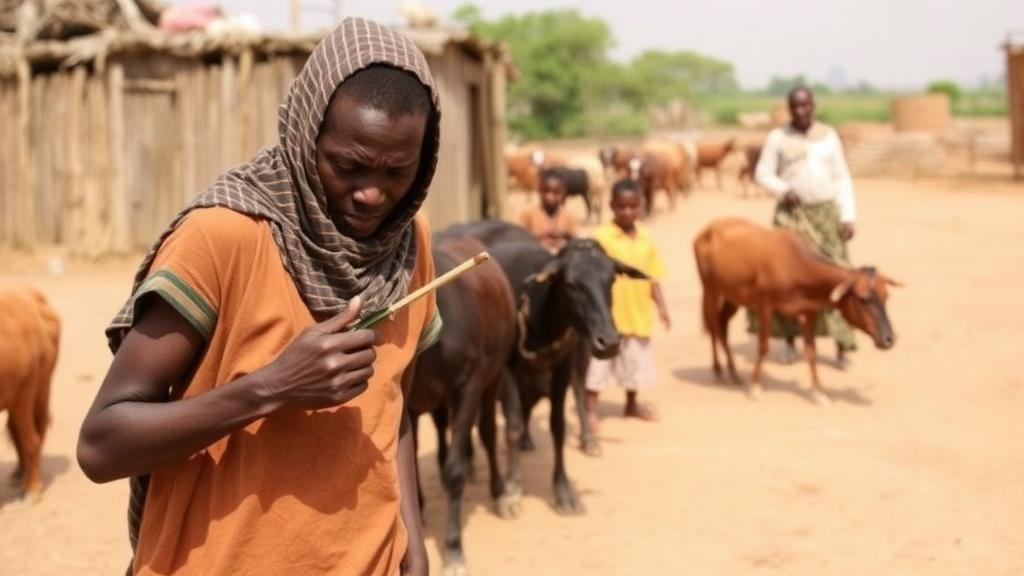
In the rural villages of Arabsiyo District, in Somaliland’s agro-pastoral heartland, the daily arithmetic of survival has become unforgiving. A new study of 114 households has found that fewer than one in five families in the district can be considered food secure, while the overwhelming majority live with moderate hunger and a small but alarming fraction face severe food insecurity. The research, published in SN Social Sciences by Mohamed Abdullahi Omer of the University of Hargeisa’s National Institute for Climate Change and Environmental Sustainability and Mabsoud Elmi Mawlid, offers one of the most detailed portraits yet of how climate stress and social circumstance intertwine to shape hunger in a region where livelihoods depend on both crops and livestock.
The team deployed a mixed-methods, cross-sectional design that went well beyond a simple questionnaire. Household surveys were combined with key informant interviews, direct field observations, long-term climate records stretching back more than three decades, and secondary data on cereal production. Food insecurity was measured using the Household Food Insecurity Access Scale, or HFIAS, a validated instrument that grades households along a continuum from secure access to severe deprivation. Quantitative survey results were analyzed with descriptive statistics and bivariate association tests, interview material was subjected to thematic analysis, and climate records were examined using non-parametric trend analysis capable of detecting gradual shifts in temperature and rainfall behavior.
The headline numbers are stark. Only 19.3 percent of surveyed households were classified as food secure. A striking 74.6 percent were moderately food insecure, meaning they regularly compromise on the quality or quantity of the food they consume, while 6.1 percent were severely food insecure, experiencing hunger at a level that threatens health and productivity. Taken together, more than four in five households in the sample reported some degree of food insecurity, a prevalence that places Arabsiyo among the harder-pressed corners of the Horn of Africa’s drylands, where recurrent drought and volatile food prices have long strained subsistence economies.
When the researchers probed which household characteristics tracked with food security status, two factors emerged as statistically significant: market accessibility and marital status. Households with better access to markets were more likely to be food secure, a finding that underscores the importance of physical and economic connectivity in dryland farming systems, where the ability to sell surplus animals or purchase cereals during lean seasons can make the difference between stability and hunger. Marital status, meanwhile, appears to shape household composition, labor availability, and resource pooling, all of which influence a family’s capacity to withstand shocks. The association with education proved sensitive to the statistical test applied, a cautionary reminder that in small samples the choice of analytical method can determine which relationships appear robust.
Perhaps the most striking dimension of the study is the near-unanimity of climate perception among residents. Fully 89.5 percent of households reported noticing changes in temperature patterns, and 90.4 percent said droughts and floods had become more frequent. Some 85.1 percent observed shifts in the timing of planting and harvesting periods, 86.0 percent reported declining crop yields and reduced availability of staple foods, and 86.8 percent noted falling livestock productivity. In a community whose calendar, income, and diet are calibrated to the rhythm of the rains, such consensus is not anecdotal color; it is a collective diagnosis delivered by the people who live closest to the evidence.
Crucially, the instrumental record backs much of that testimony. Analyzing climate data from 1991 to 2023, the researchers found a statistically significant warming trend, quantified with a Mann-Kendall test that produced a tau statistic of 0.356 and a p-value of 0.004, indicating that the upward trajectory in temperature is very unlikely to be random fluctuation. Rainfall told a more complicated story: annual and seasonal totals displayed substantial variability from year to year, but no significant monotonic trend emerged. In other words, the rains have not simply disappeared; they have become erratic, arriving late, departing early, or failing in ways that disrupt planting schedules and pasture regeneration even when seasonal totals look superficially normal.
The qualitative strand of the research filled in the texture behind those statistics. Key informant interviews and field observations documented rainfall irregularity, chronic water scarcity, limited pasture availability, and persistent constraints on both crop and livestock production. For agro-pastoralists, who deliberately balance cultivation with herding to spread risk, such compound pressures are particularly corrosive. When rains fail, crops wither and pasture thins simultaneously, leaving families with few buffers. Livestock sales, the classic fallback, become less lucrative precisely when demand for slaughter animals falls and herds are weakened by poor grazing, creating a feedback loop that deepens food insecurity across the community.
The Arabsiyo findings resonate with a broader body of evidence from the Horn of Africa. Previous research in neighboring Ethiopia has documented similar patterns of smallholder vulnerability, coping strategies, and adaptation limits under climate variability, while studies across Somaliland have traced declining crop and livestock productivity in regions such as Marodijeh and Gabiley. Regional food security monitoring bodies have repeatedly flagged acute food insecurity in Somalia and its surroundings, and recent work has emphasized that socio-economic determinants, not climate alone, often dominate household food insecurity outcomes. The new study adds granular, district-level evidence to this picture, showing how global climate signals translate into household hunger through the mediating filters of market access, household structure, and livelihood design.
What distinguishes the research methodologically is its insistence on triangulation. Perceptions alone can be contested; statistics alone can be mute about lived experience. By aligning what residents say they observe with what thermometers and rain gauges actually recorded, and by cross-checking both against production data and on-the-ground observation, the authors built a case in which each line of evidence reinforces the others. The significant warming trend validates community reports of changing temperatures, while the absence of a rainfall trend, despite widespread perception of change, highlights how increased variability and unpredictability, rather than a simple decline in totals, may be the operative hazard for farming decisions.
The policy implications are correspondingly concrete. The authors point to improved market access as a priority, since connectivity emerged as one of the few statistically significant correlates of food security in the sample. They also emphasize the need for locally appropriate, climate-resilient agricultural and livelihood strategies, from water harvesting and rangeland management to crop and livestock interventions suited to semi-arid conditions. In a territory that remains internationally unrecognized and chronically under-resourced, the study is a reminder that adaptation planning must begin from the granular realities of specific districts. For the households of Arabsiyo, the data describe a present in which hunger is the norm and the climate is measurably warming; the question the research poses to planners and policymakers is whether interventions can arrive quickly enough to change that arithmetic.
Subject of Research: Household food insecurity and climate change perceptions among agro-pastoral communities in rural Arabsiyo District, Somaliland
Article Title: Household socio-demographics, climate change perceptions, and food security in agro-pastoral Somaliland: evidence from rural Arabsiyo District
Article References: Omer, M. A., & Mawlid, M. E. (2026). Household socio-demographics, climate change perceptions, and food security in agro-pastoral Somaliland: evidence from rural Arabsiyo District. SN Social Sciences, 6(10), Article 523. https://doi.org/10.1007/s43545-026-01826-6
Image Credits: AI Generated
DOI: 10.1007/s43545-026-01826-6
Keywords: food security, climate change, agro-pastoralism, Somaliland, Arabsiyo District, HFIAS, drought, rainfall variability, warming trend, market access, smallholder farmers, climate adaptation
Cite Scienmag News
Sloane Callahan. (October 11, 2026). Food Insecurity Grips Rural Somaliland as Warming Climate Reshapes Agro-Pastoral Life. Scienmag. https://scienmag.com/food-insecurity-grips-rural-somaliland-as-warming-climate-reshapes-agro-pastoral-life/
Sloane Callahan. "Food Insecurity Grips Rural Somaliland as Warming Climate Reshapes Agro-Pastoral Life." Scienmag, 11 October 2026, https://scienmag.com/food-insecurity-grips-rural-somaliland-as-warming-climate-reshapes-agro-pastoral-life/. Accessed 11 October 2026.
Sloane Callahan. "Food Insecurity Grips Rural Somaliland as Warming Climate Reshapes Agro-Pastoral Life." Scienmag. October 11, 2026. https://scienmag.com/food-insecurity-grips-rural-somaliland-as-warming-climate-reshapes-agro-pastoral-life/


