


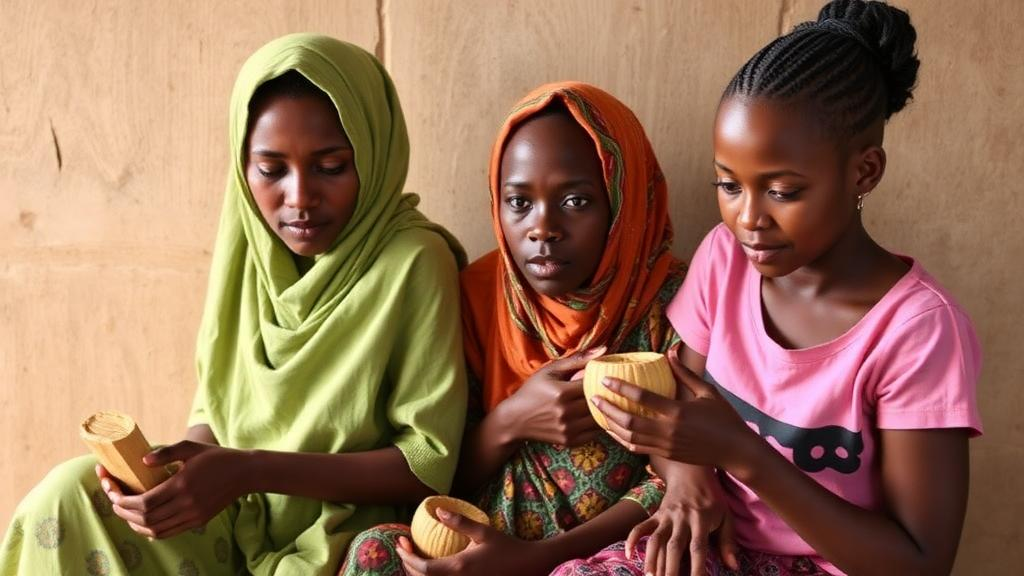
Across much of sub-Saharan Africa, the girls who become mothers before they turn twenty are often fighting a battle that remains invisible in national statistics: the battle to put enough food on the table. A new review published in the journal PLOS ONE has brought that struggle into sharp focus, synthesizing evidence from sixteen studies conducted across seven countries to show that food insecurity among adolescent mothers aged 10 to 19 is far more than a nutrition problem. It is, the researchers conclude, a critical health and equity challenge that ripples outward from hungry households to shape mental health, HIV vulnerability, and the sexual and reproductive wellbeing of an entire generation.
The scoping review, led by Suliat Fehintola Akinwande, a PhD candidate at the Factor-Inwentash Faculty of Social Work at the University of Toronto, examined the drivers, coping strategies, and health impacts of food insecurity among adolescent mothers in the region. The team found that inadequate access to food was consistently linked to depression, suicidal thoughts and attempts, HIV vulnerabilities, and poorer sexual and reproductive health outcomes. In other words, an empty pantry is not merely a sign of poverty; it is a signal that a young mother and her child may be facing compounding risks to their bodies, minds, and futures.
“Food insecurity among adolescent mothers is not simply about hunger,” Akinwande explained in the announcement accompanying the study. “Our review shows how poverty, disrupted education, stigma, and limited livelihood opportunities combine to create a cycle of disadvantage that affects both young mothers and their children.” That framing captures the central insight of the work: the same structural forces that push girls into early motherhood often determine whether they can feed themselves and their infants afterward, locking families into intergenerational disadvantage that is difficult to escape without deliberate policy intervention.
Poverty emerged as the most consistently reported driver of food insecurity across the studies. Adolescent mothers in the reviewed research frequently described how school dropout, limited employment opportunities, low literacy, and chronic financial hardship left them struggling to secure adequate food for themselves and their children. The mechanism is straightforward and unforgiving. A girl who leaves school because of pregnancy loses the educational credentials that might later open doors to stable work. Without stable work, she cannot reliably purchase food. Without reliable nutrition, her health, her mental wellbeing, and her capacity to care for her child all deteriorate, and the cycle begins again with the next generation.
But the review makes clear that economics alone does not explain the pattern. Social and ecological factors compound the material ones. Stigma surrounding adolescent pregnancy often led to rejection by family members and communities, severing the social support networks that many young mothers would otherwise depend on. In some communities, environmental challenges such as infertile land, poor infrastructure, and declining agricultural productivity further limited access to food, meaning that even mothers with some resources or determination could find themselves unable to grow or buy enough to eat. The result is a layered vulnerability in which personal history, social judgment, and environmental constraint all press down on the same young household at once.
Faced with these pressures, adolescent mothers in the reviewed studies demonstrated considerable ingenuity. Common coping strategies included informal work, farming, drawing on social support networks, borrowing food from neighbors and relatives, and reducing meal sizes to stretch limited supplies. These tactics reveal both resilience and desperation. Reducing meal sizes may keep a family afloat in the short term, but chronic undernutrition carries serious consequences for adolescent mothers, whose own bodies are still developing, and for their infants, who depend on them for breastfeeding and care. “Many adolescent mothers demonstrate remarkable resilience in the face of enormous challenges,” said co-author Kehinde Akinwande. “However, the evidence shows that some are forced into difficult choices simply to meet basic needs, underscoring the urgent need for stronger social and economic supports.”
Those difficult choices form one of the most alarming threads running through the review. The researchers found that severe food insecurity sometimes pushed young mothers into high-risk survival strategies. Studies linked food insecurity to transactional sex, age-disparate relationships, and substance-influenced sex, all of which heighten exposure to HIV and other sexually transmitted infections. Among adolescent mothers living with HIV, food insecurity was associated with difficulties adhering to antiretroviral treatment, a finding with implications not only for the mothers’ own survival but for prevention of vertical transmission to their children. Hunger, in this framing, is not a background condition; it is an active driver of epidemiological risk.
The mental health findings were equally striking. Multiple studies in the review found that food-insecure adolescent mothers were more likely to experience depression, while others reported associations with suicidal thoughts and suicide attempts. “One of the most concerning findings was the consistent relationship between food insecurity and mental health challenges,” said senior author Dr. Carmen Logie, Professor at the Factor-Inwentash Faculty of Social Work and Canada Research Chair in Social and Environmental Justice for Global Health Equity. “Addressing hunger may also help reduce depression, psychological distress, and other mental health burdens experienced by adolescent mothers.” The implication is significant for health systems in the region: interventions that guarantee food access could function as mental health interventions, potentially easing the burden on services that are often overstretched and underfunded.
The researchers are careful to situate these findings within the broader circumstances of adolescent motherhood. Young mothers, they note, often become parents within conditions they did not fully choose or control. Across sub-Saharan Africa, poverty, child marriage, unintended pregnancies, gender inequities, disrupted education, and limited access to healthcare all shape the transition to motherhood. These same structural forces then determine whether a young mother can secure adequate food, social support, and economic opportunity for herself and her child. The review thus reframes adolescent food insecurity not as an individual failing but as the predictable output of systems that fail girls at multiple points, from the classroom to the clinic to the household.
In response, the authors call for expanded investment in food assistance programs, school re-entry initiatives, livelihood training, mental health services, and adolescent-friendly healthcare. Each of these targets a specific link in the chain of disadvantage identified by the review: food assistance addresses immediate hunger, school re-entry restores educational trajectories, livelihood training builds economic resilience, and integrated health services can catch depression, HIV risk, and reproductive health needs before they compound. The researchers also emphasize the need for more research to deepen understanding of food insecurity among this population and to develop evidence-based solutions capable of breaking intergenerational cycles of disadvantage. The message of the review is ultimately one of convergence: supporting adolescent mothers, the evidence shows, means supporting two generations at once, because the nutrition, mental health, and safety of a young mother and the development and future of her child are inseparable. Policies that treat them as separate problems, the study suggests, will continue to miss the mark.
Subject of Research: Food insecurity and its health impacts among adolescent mothers in sub-Saharan Africa
Article Title: Supporting adolescent mothers means supporting two generations at once
Article References: Supporting adolescent mothers means supporting two generations at once. (n.d.). Original publication
Image Credits: AI Generated
DOI: Not provided
Keywords: food insecurity, adolescent mothers, sub-Saharan Africa, mental health, depression, HIV, sexual and reproductive health, poverty, stigma, PLOS ONE, scoping review, public health
Cite Scienmag News
Glenn Wilkins. (September 30, 2026). Food insecurity drives depression and HIV risk among adolescent mothers in sub-Saharan Africa. Scienmag. https://scienmag.com/food-insecurity-drives-depression-and-hiv-risk-among-adolescent-mothers-in-sub-saharan-africa/
Glenn Wilkins. "Food insecurity drives depression and HIV risk among adolescent mothers in sub-Saharan Africa." Scienmag, 30 September 2026, https://scienmag.com/food-insecurity-drives-depression-and-hiv-risk-among-adolescent-mothers-in-sub-saharan-africa/. Accessed 4 October 2026.
Glenn Wilkins. "Food insecurity drives depression and HIV risk among adolescent mothers in sub-Saharan Africa." Scienmag. September 30, 2026. https://scienmag.com/food-insecurity-drives-depression-and-hiv-risk-among-adolescent-mothers-in-sub-saharan-africa/


