


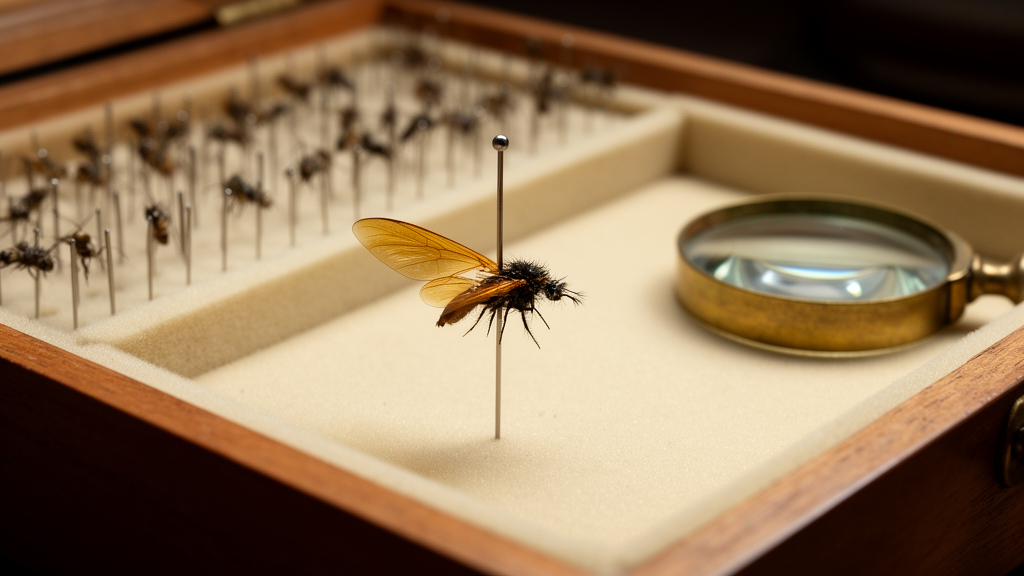
In the storerooms of the Natural History Museum Vienna, a handful of flies collected in Brazil more than two centuries ago have finally given up their secret. Researchers re-examining tachinid fly specimens gathered by the Austrian naturalist Johann Baptist Natterer during his epic 18-year expedition to Brazil (1817–1835) have discovered among them a species previously unknown to science. The insect, now formally described as Prophorostoma nattereri, belongs to the family Tachinidae, a large and ecologically important group of flies whose larvae are parasitoids of other insects. The new species is the first member of the subfamily Dexiinae ever identified in Natterer’s vast Brazilian collections, and its description sets what the authors believe is a record for any animal species: more than 200 years between the moment a specimen was collected in the field and the moment it was recognized and named as new.
Natterer’s expedition was one of the most ambitious scientific undertakings of the nineteenth century. The Austrian expedition to Brazil, which ran from 1817 to 1835, dispatched a team of naturalists to document the flora, fauna and peoples of a country then barely explored by European science. Among them was Natterer, son of Joseph Natterer, the first inspector of the zoology department of what would later become the Natural History Museum Vienna. Johann Natterer spent eighteen years in the field, travelling thousands of kilometers through the Southeast, the Central-West and the Amazon basin, reaching as far as the borders with Colombia and Venezuela. His haul was staggering: 32,825 insects, a collection that instantly made the Vienna museum one of the world’s most comprehensive repositories of South American fauna at the time.
It was within this immense trove that the new fly came to light. The genus Prophorostoma, established by Charles Townsend in 1927, is endemic to the Neotropics and, until now, contained only two known species: Prophorostoma pulchra, described by Townsend himself, and Prophorostoma tomjobimi, named by Silvio Nihei in 2006. The addition of a third species, based on specimens that have rested in Vienna since the 1820s, is a striking reminder of how much undiscovered diversity can hide inside historical museum collections. The researchers emphasize that the remarkable history of the specimens, which survived over 200 years after being collected in Brazil, highlights the unique scientific value of these archives of past biodiversity.
Superficially, members of Prophorostoma are flies with a well-developed facial carina, the ridged structure running down the middle of the face, three to four katepisternal setae on the thorax, and an abdomen lacking discal setae, with the third abdominal segment bearing a single pair of median marginal bristles. The genus resembles the New World genus Ptilodexia, but the absence of discal setae on the third to fifth abdominal segments easily separates the two. The new species, however, is distinguished from its closest relative, Prophorostoma pulchra, by a suite of precise characters that a trained dipterist can check under a stereomicroscope.
Those differences are subtle but consistent. The head of Prophorostoma nattereri carries a fronto-orbital plate that is completely silver pruinose, dusted with a silvery microsculpture, whereas in Prophorostoma pulchra the same region is slightly golden. Scattered setulae, small bristle-like hairs, reach the dorsal region of the parafacial in the new species, but not in its relative. The gena, the cheek area below the eye, is about one-fifth to one-sixth of the eye’s height in the new species, compared with about one-third in Prophorostoma pulchra. The wing is conspicuously darkened along its anterior region, while the wing of Prophorostoma pulchra is darkened mostly at the base. The abdomen of the new species is somewhat cylindrical and flattened from top to bottom, with a dark yellowish ground color, in contrast to the globose, reddish abdomen of its cousin.
The description was built on careful morphological work. The researchers examined the material with a Leica M165C stereomicroscope under a white light ring LED, and photographed the holotype with a Canon EOS R5 camera fitted with an MP-E 65 mm macro lens mounted on a manual macro-metric rail. Stacked images were combined with Helicon Focus software to produce sharp focus throughout, and the resulting plates were assembled in Adobe Photoshop. Measurements were made in Adobe Illustrator. In addition to the Vienna material, the male holotype of Prophorostoma pulchra, held at the Smithsonian National Museum of Natural History in Washington DC, was examined through photographs, allowing direct comparison of the diagnostic characters. The authors also provide illustrations of the holotype and an updated identification key separating all three species of the genus.
The type series is rich by the standards of historical material: one male holotype and more than a dozen male paratypes, all collected by Natterer. Most came from a locality recorded on the old labels simply as Ypanema, with a single paratype from Mato Grosso. The specific epithet nattereri is a homage to the collector himself, but it also preserves the intention of another nineteenth-century figure. Rudolf Ignaz Schiner, who worked for many years with the Diptera collection in Vienna, left a manuscript name, Naterreri Schin., in the box alongside the specimens, apparently intending to name the species after Natterer. The modern authors maintained his plan, completing a naming decision that had waited in a drawer for a century and a half.
The type specimens were collected between 1819 and 1829 in places that today are the municipalities of Iperó in São Paulo State and Vila Bela da Santíssima Trindade in Mato Grosso State. The Ipanema locality has a remarkable history of its own. In 1810, Dom João VI created the Royal Iron Factory of São João de Ipanema, the first Brazilian steelworks, which remained active until 1895. Natterer spent 417 days there between 1819 and 1822, likely because one of the factory’s first directors, the German Friedrich Ludwig Wilhelm Varnhagen, was a close friend. The exact dates of his stays are known, which means the moment the holotype was collected can be bracketed: not earlier than February 1819 and not later than early October 1822. After the factory closed in the mid-1890s, the site served as a military barracks until the end of the 1930s, and its remains are today known as Fazenda Ipanema, part of the Ipanema National Forest in Iperó, covering nearly 5,180 hectares.
The Mato Grosso paratype carries a label reading M: grosso, a reference to the city founded in 1746 as Vila Bela da Santíssima Trindade and renamed Mato Grosso in 1820, when Natterer collected in the region. The city reverted to its original name in 1978. Tracking Natterer’s itineraries, researchers estimate the paratype was probably collected between 1826 and 1829. Together, the two localities define the known distribution of the new species: São Paulo and Mato Grosso in Brazil.
Perhaps the most sobering implication of the study concerns the fly’s fate. The authors note that they have examined rich tachinid collections from many localities in São Paulo State held at the Museu de Zoologia of the Universidade de São Paulo, as well as recently collected dipterans from Mato Grosso, and found no specimens of the new species among them. A species that went virtually undetected for almost 200 years, despite its home regions having been sampled intensively by modern collectors, may indicate that Prophorostoma nattereri could be extinct. Whether it persists in unsampled pockets of the Brazilian Atlantic Forest or cerrado remains unknown, as does its biology. What is certain is that the description sets a new record for the waiting time between collecting and describing a new species, more than 200 years, a timeframe that applies not only to tachinid flies but, as far as the authors know, to any animal species. The finding is a powerful argument for the continued study of historical museum collections, which may still hold species that no longer exist anywhere in the living world.
Subject of Research: Taxonomy and biodiversity of Neotropical tachinid flies
Article Title: A new species of Prophorostoma Townsend ( Diptera , Tachinidae ) collected by Johann Natterer during the Austrian scientific expedition to Brazil (1817–1835)
Article References: de Santis, M. D., & Camargo, A. (2026). A new species of Prophorostoma Townsend (Diptera, Tachinidae) collected by Johann Natterer during the Austrian scientific expedition to Brazil (1817–1835). Evolutionary Systematics, 10(2), 403-408. https://doi.org/10.3897/evolsyst.10.204851
Image Credits: AI Generated
DOI: 10.3897/evolsyst.10.204851
Keywords: taxonomy, new species, Tachinidae, Diptera, museum collections, Brazil, Johann Natterer, Natural History Museum Vienna, species, Prophorostoma, Townsend, collected
Cite Scienmag News
Gavin Prescott. (October 15, 2026). Fly collected 200 years ago by Austrian explorer turns out to be a brand-new species. Scienmag. https://scienmag.com/fly-collected-200-years-ago-by-austrian-explorer-turns-out-to-be-a-brand-new-species/
Gavin Prescott. "Fly collected 200 years ago by Austrian explorer turns out to be a brand-new species." Scienmag, 15 October 2026, https://scienmag.com/fly-collected-200-years-ago-by-austrian-explorer-turns-out-to-be-a-brand-new-species/. Accessed 15 October 2026.
Gavin Prescott. "Fly collected 200 years ago by Austrian explorer turns out to be a brand-new species." Scienmag. October 15, 2026. https://scienmag.com/fly-collected-200-years-ago-by-austrian-explorer-turns-out-to-be-a-brand-new-species/


