


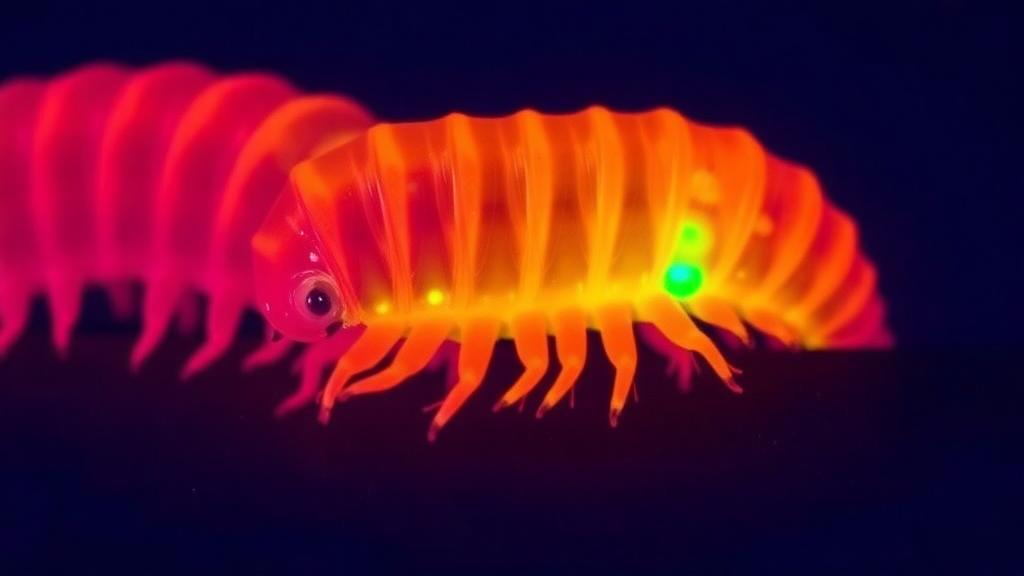
Microplastics have become one of the defining pollutants of our age, and while the world’s oceans have absorbed most of the scientific attention, soils are quietly accumulating their share of plastic debris. Fragments shed by agricultural films, sewage sludge, household waste and tire wear persist in the ground for decades, where they collide with the animals that keep soils alive. Among those animals are millipedes, the abundant saprophagous arthropods that chew through leaf litter and organic matter in forests across the globe. A new experimental study published in One Ecosystem has now developed a fluorescence microscopy protocol that makes it possible to see exactly where microplastic particles end up inside the digestive tract of these detritivores, and the answer turns out to be strikingly region-specific.
The research team, working with three common species of julid millipedes collected from a forest belt near Rostov-on-Don in southern Russia, set out to solve a problem that has hampered soil ecotoxicology for years: how to reliably visualise ingested microplastics within the gut of an animal whose own body glows under the microscope. The cuticle of arthropods, including millipedes, exhibits strong autofluorescence under ultraviolet light, a property attributed not to chitin itself but to endogenous fluorophores such as pterins and porphyrins embedded in the cuticular layers. That glow is visually similar to the fluorescence emitted by stained plastic particles, creating a serious risk of false positives when researchers try to distinguish real microplastics from the animal’s own tissues.
To overcome this, the researchers designed a careful experimental pipeline. They ground larger fragments of two plastics, low-density polyethylene and polylactide, into particles measuring three to five millimetres, a size class that previous work had shown millipedes readily consume. The particles were pre-stained with Nile red dissolved in n-hexane, a fluorescent dye that binds to a wide range of polymer types. Pre-staining was essential because staining sections after cutting would have required dehydrating the samples, destroying the living cells the team wanted to preserve for analysis. Conveniently, both LDPE and PLA also possess intrinsic autofluorescence under UV light, providing a backup signal even where dye molecules are sparse.
The experimental animals, three adult females each of Nopoiulus kochii, Brachyiulus jawlowskii and Byzantorhopalum rossicum, were first starved for two days in clean arenas to purge their intestines of any plastic particles ingested in the wild. The sand used in the experimental jars had been wrapped in aluminium foil and baked at 500 degrees Celsius for 24 hours to burn away any contaminating microplastics. Stained particles were then sprinkled on the sand surface alongside oat flakes, a food source that earlier studies suggest stimulates rather than interferes with microplastic ingestion by soil saprophages. After five days of exposure at 23 to 25 degrees Celsius under natural light, the millipedes were euthanised with ethyl acetate vapour, chosen specifically because, unlike ether or chloroform, it does not dissolve microplastic particles.
The first methodological attempt proved instructive in its failure. When the researchers cryosectioned whole millipede bodies without dissecting out the gut, the heavily sclerotised cuticle fractured and crumbled under the microtome blade. The multilayered cuticle, comprising epicuticle, exocuticle and endocuticle built on a chitin-protein matrix and often mineralised in diplopods, simply could not survive sectioning intact. Worse, the autofluorescent fragments scattered across the slice surface, including into the intestinal cavity, where they were nearly impossible to distinguish from genuine microplastic particles. Whole-body sectioning, the team concluded, produces exactly the kind of false-positive contamination the technique was meant to eliminate.
Dissecting the gut out before cryosectioning changed everything. Isolated digestive tracts, embedded in optimal cutting temperature compound and sectioned at five to seven micrometres on a cryostat held at minus 20 degrees Celsius, yielded clean preparations in which plastic particles stood out clearly against the surrounding tissue. The sections were counterstained with Sytox Green, a fluorescent nucleic acid dye marking cell nuclei, and mounted in antifade medium. The critical breakthrough came in choosing the right excitation wavelength. Under blue and green excitation, the fluorescence colours of the microplastics and the cell nuclei overlapped, rendering them indistinguishable. Under UV excitation, however, the stained particles glowed blue or blue-white while the nuclei shone bright green, producing a clean visual separation between gut tissue and plastic.
With the method validated, the researchers documented a pattern never before reported in diplopods: microplastic distribution differs dramatically across gut regions. In the foregut and hindgut, which are of ectodermal origin and lined internally by a thin cuticular intima, particles adhered closely to the gut wall. The researchers attribute this to the rough or structured surface of the cuticular lining, which can physically trap particles. In the midgut, by contrast, which lacks a cuticular lining and instead secretes a peritrophic membrane that envelops the food bolus, the particles remained mostly suspended in the lumen, separated from the epithelium by this delicate barrier.
This differential localisation carries functional weight. The peritrophic membrane of the midgut acts as a shield preventing direct contact between microplastics and the midgut epithelium, potentially reducing translocation of plastic fragments into body tissues. Meanwhile, the arthropod gut microbiome is compartmentalised, with distinct microbial communities inhabiting the foregut, midgut and hindgut. Because microplastics accumulate preferentially in particular regions, their exposure to plastic-degrading microbes varies accordingly. Prior research suggests the hindgut of saprophagous arthropods harbours a particularly diverse microbiota capable of breaking down recalcitrant polymers, and the densest microbial populations colonise the cuticular surface of the hindgut. The finding that microplastics sit near the hindgut wall supports the hypothesis that this region could be a hotspot for plastic biodegradation inside the animal.
The authors are candid about the limitations of their study. The observations are qualitative rather than quantitative, with no counts of particles per unit area or estimates of how much ingested plastic each gut section retains. Only one exposure duration and one particle size class were tested, and smaller microplastics in the one-to-one-hundred-micrometre range may behave very differently, potentially penetrating the peritrophic matrix or even entering epithelial cells. The sample size was small, three individuals per species, and the team acknowledges that very small fragments of the foregut or hindgut cuticular intima could conceivably have been misidentified as microplastics, a concern that spectral imaging or Raman spectroscopy could resolve in future work.
Even so, the ecological implications are considerable. Millipedes are known to ingest and fragment microplastics, which means they can act as vectors transporting plastic from the soil surface into deeper soil layers and into the food web, where predatory centipedes, birds and small mammals await. Knowing where particles lodge within the gut may help predict their residence time and the likelihood of excretion versus retention. The researchers propose a roadmap for follow-up studies: quantitative assessment of particle distribution using automated image analysis, long-term exposure experiments tracking fragmentation and translocation, testing of smaller particles down to one micrometre and additional polymer types, coupling the visualisation protocol with fluorescence in situ hybridisation to identify bacteria attached to plastic surfaces, and ex vivo assays with isolated gut segments to measure degradation activity directly. For a pollutant as pervasive as plastic, understanding its journey through the guts of the animals that process the world’s dead leaves may prove an essential piece of the terrestrial puzzle.
Subject of Research: Visualisation and gut-region distribution of microplastics in millipedes using fluorescence microscopy
Article Title: Visualisation of microplastics in the gut of arthropods: An experimental approach on millipedes (Diplopoda, Julida)
Article References: Evsyukov, A., Kirichenko, E., Logvinov, A., & Al-Kinani, B. (2026). Visualisation of microplastics in the gut of arthropods: An experimental approach on millipedes (Diplopoda, Julida). One Ecosystem, 11, Article e203494. https://doi.org/10.3897/oneeco.11.e203494
Image Credits: AI Generated
DOI: 10.3897/oneeco.11.e203494
Keywords: microplastics, millipedes, Diplopoda, soil arthropods, fluorescence microscopy, Nile red, gut microbiome, peritrophic membrane, soil ecology, plastic biodegradation, cryosectioning, LDPE
Cite Scienmag News
Morgan Morrow. (October 15, 2026). Fluorescence technique reveals where microplastics lodge inside millipede guts. Scienmag. https://scienmag.com/fluorescence-technique-reveals-where-microplastics-lodge-inside-millipede-guts/
Morgan Morrow. "Fluorescence technique reveals where microplastics lodge inside millipede guts." Scienmag, 15 October 2026, https://scienmag.com/fluorescence-technique-reveals-where-microplastics-lodge-inside-millipede-guts/. Accessed 15 October 2026.
Morgan Morrow. "Fluorescence technique reveals where microplastics lodge inside millipede guts." Scienmag. October 15, 2026. https://scienmag.com/fluorescence-technique-reveals-where-microplastics-lodge-inside-millipede-guts/


