


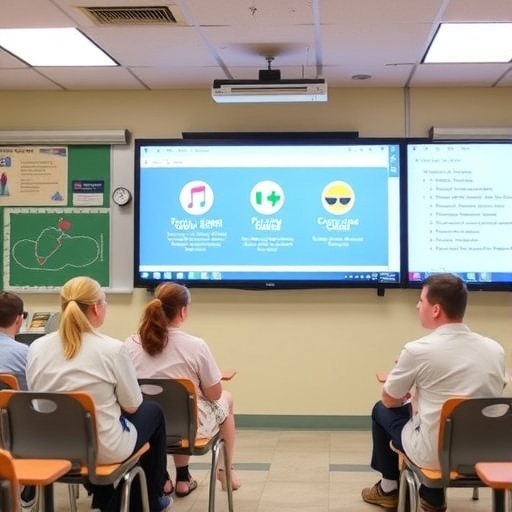
In a rapidly evolving medical landscape, the competency of students in handling medical emergencies is non-negotiable. Recent research published in BMC Medical Education has spotlighted the efficacy of innovative instructional strategies in bridging the gap between theoretical knowledge and practical application. A study conducted by Ruesseler, Britz, Herrmann-Werner, and their team presents compelling evidence that a flipped classroom model significantly enhances medical students’ abilities to manage critical, real-world situations.
The flipped classroom represents a paradigm shift in educational methodologies, characterized by the inversion of traditional teaching practices. Instead of delivering lectures in person, students engage with instructional materials at their own pace, often through online platforms. This allows valuable classroom time to be reserved for hands-on experiences and interactive discussions. The recent study capitalizes on these principles by focusing specifically on their application within the context of medical education.
In this groundbreaking research, the authors conducted a rigorous intervention-control study involving multiple cohorts of medical students. This design allowed for a comparative analysis of student performance between those who were exposed to the flipped classroom model and those who followed the conventional approach to learning. The main objective was to investigate whether such an innovative instructional strategy would yield measurable improvements in emergency management skills, which are critical for future healthcare providers.
The study employed a robust methodology that assessed both knowledge retention and practical proficiency in emergency scenarios. An extensive curriculum was designed to provide students with a thorough grounding in emergency medicine principles, incorporating simulated patient interactions to mimic real-life challenges. The findings indicated substantial improvements in student preparedness, confidence, and overall skill level when evaluated against their counterparts in traditional learning environments.
One of the remarkable aspects of the flipped classroom approach is its inherent flexibility. Students are empowered to engage with educational content at times that suit their individual learning styles, which can significantly impact their ability to absorb complex information related to medical emergencies. The study documented that students reported a greater sense of ownership over their learning process, suggesting an increase in motivation and accountability.
Moreover, the social interactions that occur within the flipped classroom setting create an environment conducive to collaborative learning. By facilitating discussion and teamwork in scenarios where time-critical decisions must be made, students not only hone their technical skills, but also foster soft skills essential for any healthcare professional. Communication and teamwork are vital in emergency situations, and this study highlights how educational innovation can be harnessed to prepare students for success in these areas.
Statistical analysis of the collected data further illustrated the tangible benefits of the flipped classroom model. An increase in test scores and improved simulation performance were both observed in students who participated in this non-traditional instructional format. These outcomes reinforce the notion that innovative teaching methods could lead to more effective preparation among medical students, equipping them better for the challenges of contemporary healthcare settings.
Conducting this research at a time when the healthcare system faces unprecedented challenges due to growing demands and technological advancements showcases the importance of adaptive education. By cultivating a methodology that emphasizes active learning, medical schools can redefine how they train future practitioners, enhancing not only academic outcomes but also overall patient care.
In addition, the implications of this research extend beyond individual student performance; they have vital consequences for healthcare systems as a whole. As medical professionals emerge from their training with improved emergency response capabilities, patient outcomes stand to benefit significantly. This study reinforces the notion that the investment in innovative teaching approaches warrants further exploration by educators, administrators, and policymakers alike.
While the flipped classroom model may not be a one-size-fits-all solution, the results from this intervention-control study point to a clear trend: teaching methods that promote active engagement yield substantial benefits in practical, skills-based disciplines such as medicine. With continued research and refinement, this educational strategy could potentially revolutionize how health professionals are nurtured and trained.
The study not only contributes to existing literature on medical education but also opens avenues for future investigations. Areas such as curriculum design, long-term retention of emergency response skills, and the integration of technology into learning processes could provide additional insights into enhancing medical training across various disciplines.
Ultimately, the groundbreaking findings of Ruesseler, Britz, Herrmann-Werner, and colleagues stand as a testament to the power of innovation in education. As the field of medical training continues to adapt to the complexities of modern healthcare, the pursuit of effective teaching methodologies must remain a top priority for institutions worldwide.
In conclusion, the integration of the flipped classroom model into medical education represents a hopeful stride toward producing adept healthcare providers. By fostering environments where students can explore, collaborate, and practice essential skills, educators have the opportunity to significantly alter the trajectory of medical training and patient care moving forward. As the study illustrates, embracing pedagogical shifts like these can empower future physicians to rise to the occasion when the stakes are highest, ultimately improving the health outcomes of the populations they serve.
Ruesseler, M., Britz, V., Herrmann-Werner, A. et al. A flipped classroom improves medical students’ skills how to manage medical emergencies—an intervention-control study. BMC Med Educ 25, 1362 (2025). https://doi.org/10.1186/s12909-025-07898-x
Cite Scienmag News
Courtney Benton. (October 7, 2025). Flipped Classroom Boosts Medical Students’ Emergency Skills. Scienmag. https://scienmag.com/flipped-classroom-boosts-medical-students-emergency-skills/
Courtney Benton. "Flipped Classroom Boosts Medical Students’ Emergency Skills." Scienmag, 7 October 2025, https://scienmag.com/flipped-classroom-boosts-medical-students-emergency-skills/. Accessed 5 September 2026.
Courtney Benton. "Flipped Classroom Boosts Medical Students’ Emergency Skills." Scienmag. October 7, 2025. https://scienmag.com/flipped-classroom-boosts-medical-students-emergency-skills/


