


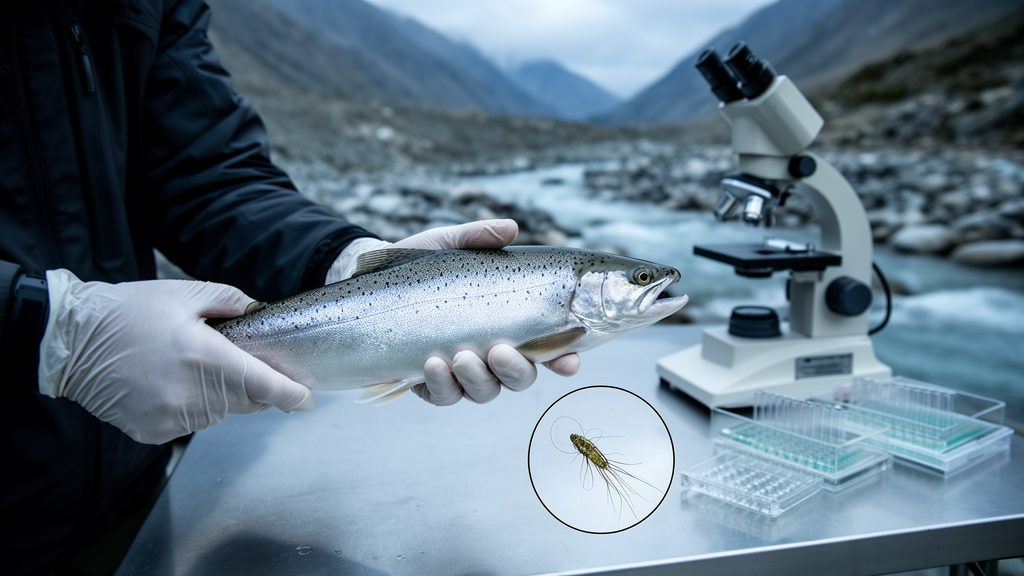
Deep in the Kashmir Himalayas, where the River Jhelum winds from the Verinag spring through dense human settlements and farmland, a team of fish health researchers has documented something no one has recorded before in this region: a flagellate protozoan parasite known as Ichthyobodo necator clinging to the skin of a wild snowtrout, Schizothorax niger. The finding, published in Frontiers in Aquaculture, marks the first record of this notorious fish parasite in the riverine fish fauna of the Kashmir Valley, and it offers a rare, high-resolution look at how a single-celled pathogen wages war on the skin of its host.
The discovery was unexpected. Researchers from the Faculty of Fisheries at Sher-e-Kashmir University of Agricultural Sciences and Technology of Kashmir, together with a colleague from ICAR-Central Institute of Fisheries Education in Mumbai, were conducting a six-month parasitological survey for ectoparasites in Schizothorax species along the River Jhelum. Between February and July 2023, they collected 290 specimens of three native snowtrout species: Schizothorax niger, S. esocinus, and S. curvifrons. Sampling took place at three sites representing different demographic profiles of the valley: Chatabal in Srinagar district, Guree in Anantnag district, and Sopore in Baramulla district, a stretch of river characterized by dense human population and moderate agricultural activity.
Out of all 290 fish examined, only one specimen tested positive for Ichthyobodo necator, and that fish was a Schizothorax niger from the Chatabal site. The overall prevalence was a mere 0.34 percent, rising to 0.95 percent among the 105 S. niger specimens. The infected fish carried eight parasites, giving a mean intensity of 8.00 and a relative density of 0.03. No infections were recorded in any of the fish from the Guree or Sopore sites, and none of the S. esocinus or S. curvifrons specimens harbored the parasite. Such a low prevalence might seem trivial, but for parasitologists it is precisely the kind of signal that matters: it establishes that the parasite is present in the ecosystem and provides a foundation for future ecological and disease-management research in a region where its flagellate protozoan fauna had never been cataloged.
Ichthyobodo necator, formerly known as Costia necatrix, is one of the most widely distributed and clinically important flagellate ectoparasites of freshwater fish worldwide. It was originally described from diseased brown trout alevins cultured in tanks at the College de France in Paris, and it has since been documented across Asia, including Iran, Japan, Singapore, the Philippines, and Sri Lanka. The parasite causes ichthyobodosis, also called costiosis, primarily infecting the skin and gills of fish and capable of producing heavy mortality, a common problem on fish farms. In India, a prevalence assessment in Sambalpur, western Orissa, revealed the occurrence of Costia necatrix on 16 percent of fish farms in that region, with the most affected species being major carps such as Labeo rohita, Catla catla, and Cirrhinus mrigala. Remarkably, the parasite is not confined to freshwater: it has been found in 25 species of marine fish and three species of anadromous salmon across the Pacific and Atlantic Oceans and nearby seas from subarctic to tropical zones, and seawater infections were first discovered in freshwater salmonids transported to the sea, indicating that the parasite is native to freshwater but can survive and flourish in marine environments.
The infected snowtrout in the Kashmir survey showed clinical signs familiar to fish health specialists: lethargy, excessive mucus secretion, and reddish areas indicative of hemorrhage. Under the light microscope, wet mount preparations of skin smears revealed actively motile, small, somewhat comma-shaped trophozoites, with a pair of flagella clearly visible. These microscopic observations set the stage for the study’s most technically revealing work: a combination of classical histopathology and scanning electron microscopy that allowed the researchers to correlate the fine structure of the parasite with the pathological damage in the host tissue.
For histopathology, infected skin samples were fixed in 10 percent neutral buffered formalin, dehydrated through graded ethanol concentrations, cleared with xylene, and infiltrated with molten paraffin wax. Five-micrometer sections were cut, stained with hematoxylin and eosin, and mounted with Canada balsam and DPX mountant for examination at 10X and 40X magnification. The results were striking. The epidermis showed destruction, with vacuoles forming in epidermal cells and significant hyperplasia of the goblet cells, the mucus-secreting cells of the fish skin. Epidermal cells had lost their interlinking cell membranes, and the outer surface layers of the epidermis occasionally appeared to slough off. An inflammatory reaction was evident at the site of parasite attachment. These changes mirror the extensive epidermal destruction and necrosis documented in salmonids infected with Ichthyobodo, including freshwater salmonid juveniles and Japanese flounder, where epidermal hyperplasia and vacuolation are followed by degeneration and sloughing of the skin surface.
Scanning electron microscopy pushed the investigation to an entirely different scale. Infected skin was fixed in 2.5 percent glutaraldehyde and then 1 percent osmium tetroxide, dehydrated through ethanol series, critical-point dried, mounted on aluminum stubs, and sputter-coated with gold before examination with a Gemini SEM 500. The images revealed numerous comma-shaped organisms on the infected skin surface, some clustered together at the same attachment site. The ultrastructure showed exactly how the parasite invades: Ichthyobodo necator attaches to host cells through a specialized attachment disc, and through this disc a cytostome canal, supported by microtubules, penetrates the host cell cytoplasm. The cytostome, the parasite’s feeding apparatus, was clearly visible at a scale bar of one micrometer. Flagellated trophozoites displayed one or two pairs of flagella of unequal length, with the short flagella ending inside a groove and the long flagella extending past the posterior tip of the body. These observations are consistent with earlier ultrastructural studies of the parasite on hatchery-reared salmon parr and on the skin cells of juvenile Atlantic salmon.
The morphological details matter for more than curiosity. The genus Ichthyobodo currently comprises three recognized species: I. necator, I. nitschei from goldfish, and the only identified marine species, I. hippoglossi, which infects Atlantic halibut. Molecular studies using small subunit rDNA sequencing have suggested that I. necator is actually a complex of sibling species, and many unnamed Ichthyobodo species likely remain to be described in cyprinids and other fish. In freshwater, the free-swimming form of I. necator is almost round, while the attached form is pyriform, and the parasite’s shape changes between these states. The distinctive comma-shaped body and smooth attachment disc observed in the Kashmir specimen are consistent with published descriptions of I. necator infecting freshwater fish, which earlier cytological studies reported to possess a smooth cytostome process. However, the authors acknowledge an important limitation: the parasite identity was not confirmed through molecular barcoding, and all clinical and pathological observations rest on a single infected individual, making the findings preliminary and descriptive rather than broadly representative of the parasite’s pathogenicity in S. niger.
Context makes the discovery more consequential. The River Jhelum, the largest and longest river in Kashmir, supports an average annual fish yield of approximately 20.5 kilograms per hectare, but it faces mounting challenges from human encroachment and pollution. Over the past decade, the native Schizothorax population has become susceptible to a range of parasites spanning protozoans, platyhelminthes, nematodes, and acanthocephalans, and the fish population has been steadily declining. Previous research in the valley has shown that pathogenic invasion becomes more likely when water quality changes, and that rising eutrophication of lakes drives parasite infections in schizothoracine fishes. Pollution stress may have direct or indirect effects on parasite prevalence, which raises questions about whether environmental degradation of the Jhelum is creating conditions favorable for flagellate pathogens like Ichthyobodo to establish themselves in the river’s fish communities.
The researchers argue that the finding contributes not only to knowledge of parasite diversity in the Kashmir Himalayas but also serves as a foundation for future research on the ecology, biology, and management of the region’s freshwater ecosystems. They call for monitoring and surveillance programs to assess the long-term implications of Ichthyobodo infection on the health and sustainability of S. niger populations in the River Jhelum, and for further studies to explore the parasite’s life cycle, transmission dynamics, and host-parasite interactions. For a food fish that is widely distributed and highly valued across Kashmir, the appearance of a parasite capable of causing heavy mortality in fish farms is a warning worth heeding. Whether I. necator remains a rare curiosity in the Jhelum or becomes an emerging threat to the valley’s iconic snowtrout may depend on how quickly science and conservation efforts respond to this first, microscopic glimpse of the parasite in Himalayan waters.
Subject of Research: First report of Ichthyobodo necator, a flagellate protozoan parasite, in Schizothorax niger from the River Jhelum in the Kashmir Himalayas, India
Article Title: First report of Ichthyobodo necator, a flagellate protozoan parasite, in Schizothorax niger from the River Jhelum in the Kashmir Himalayas, India
Article References: Shafi, I., Wali, A., Shah, F. A., Iqbal, G., Dar, S. A., & Sofi, N. A. (2026). First report of Ichthyobodo necator, a flagellate protozoan parasite, in Schizothorax niger from the River Jhelum in the Kashmir Himalayas, India. Frontiers in Aquaculture, 5, Article 1846130. https://doi.org/10.3389/faquc.2026.1846130
Image Credits: AI Generated
DOI: 10.3389/faquc.2026.1846130
Keywords: First, report, Ichthyobodo, necator, flagellate, protozoan, parasite, Schizothorax, niger, River, Jhelum, Kashmir
Cite Scienmag News
Rebecca Stewart. (October 15, 2026). Flagellate Parasite Found on Himalayan Snowtrout for First Time. Scienmag. https://scienmag.com/flagellate-parasite-found-on-himalayan-snowtrout-for-first-time/
Rebecca Stewart. "Flagellate Parasite Found on Himalayan Snowtrout for First Time." Scienmag, 15 October 2026, https://scienmag.com/flagellate-parasite-found-on-himalayan-snowtrout-for-first-time/. Accessed 15 October 2026.
Rebecca Stewart. "Flagellate Parasite Found on Himalayan Snowtrout for First Time." Scienmag. October 15, 2026. https://scienmag.com/flagellate-parasite-found-on-himalayan-snowtrout-for-first-time/


