


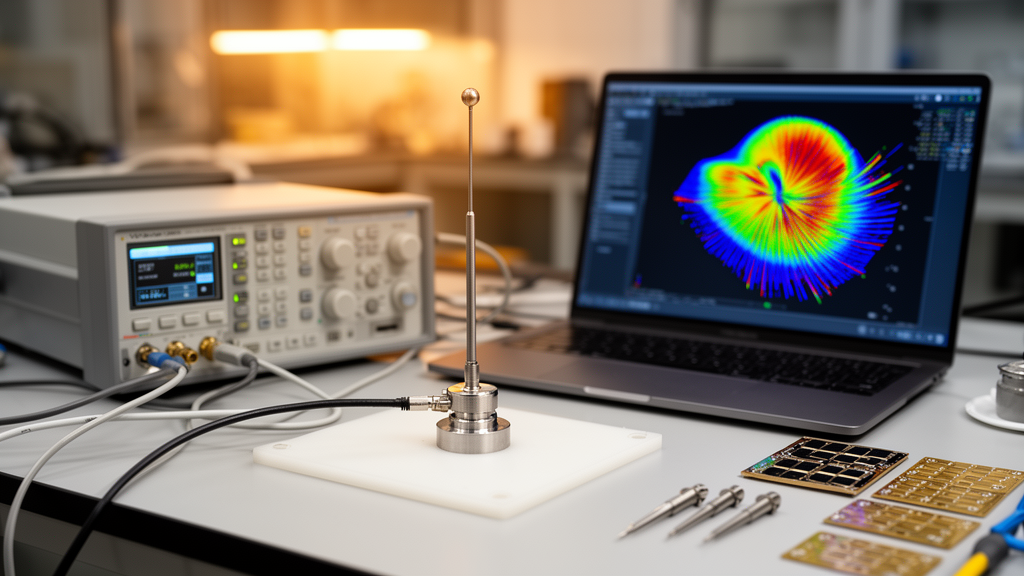
Designing a microstrip patch antenna sounds deceptively simple: a small rectangle of copper on a circuit board, fed by a probe, radiating at a chosen frequency. Yet behind that simplicity lies a computational grind. Tiny changes in patch width, length, or feed position can shift the resonance, wreck the impedance match, or shrink the operating bandwidth, and the only reliable way to know is a full-wave electromagnetic simulation that solves Maxwell’s equations on a fine numerical grid. A new study published in Frontiers in Antennas and Propagation shows how a self-calibrating, physics-aware machine learning workflow can find well-matched patch designs in a fraction of the simulations that conventional optimizers demand, and, crucially, do so across different substrates and frequency bands without being retuned for each one.
The work, carried out by David Jin Tao Leong and Doreen Ying Ying Sim of the University of Nottingham Malaysia, tackles a stubborn weakness in the growing field of simulation-driven antenna optimization. Physics-aware active learning, in which analytical antenna knowledge guides a surrogate-assisted search, has already proven it can cut the cost of full-wave electromagnetic analysis. But the sampling rules and probe locations in such systems are usually tuned to one specific design case. Constants that work beautifully for an FR4 patch at 2.4 gigahertz may fail completely on a low-loss Rogers laminate at 5.8 gigahertz, quietly reintroducing the manual tuning the optimizer was supposed to eliminate.
The researchers’ answer is an integrated workflow that combines four ideas: online calibration, matching-first recovery, physics-informed probes, and a lightweight surrogate model. Instead of prescribing where the optimizer should look for a matched design, the workflow estimates sampling bands from its own observations after every batch of simulations. When too few designs achieve a good impedance match, the system switches into a recovery mode that focuses the search on the best near-miss geometry until matches appear. A radial-basis-function surrogate, seeded with closed-form patch equations and deterministic physical transforms such as effective permittivity and electrical length, then ranks candidate designs so that each expensive simulation is spent where it is most informative.
The headline experiment was deliberately austere. Four optimizers, the integrated workflow, random search, a budget-limited genetic algorithm, and an unstructured surrogate search, were each given exactly 37 attempted simulations per run using the open-source openEMS solver. They competed on four substrate and frequency cases, spanning FR4 and Rogers laminates at 2.4 and 5.8 gigahertz, with ten replicate random seeds per case. The integrated workflow won decisively: it produced the lowest mean and median final objective in every single case and returned a properly matched design in all forty runs. The baselines, while competitive on individual seeds, showed far heavier upper tails and between one and eight unmatched endpoints depending on the case and method.
The statistical treatment was unusually careful for an engineering study. Using exact Mann-Whitney rank tests with Holm adjustment within each case, the integrated workflow was significantly lower than the three baselines in nine of twelve directional comparisons. Six contrasts remained significant in a stricter two-sided unpaired analysis, and seven in a paired-by-seed sensitivity analysis. The authors are candid about the limits: comparisons on the easier fourth case against the genetic and unstructured surrogate baselines were not statistically resolved, suggesting the method shines brightest when an unfamiliar substrate or band makes impedance matching genuinely hard.
The second major contribution is a multi-fidelity screening protocol that exploits the huge cost gap between coarse and fine simulation meshes. The workflow runs its entire 37-call search on a coarse mesh, then promotes the twelve best candidates to full resolution for confirmation. Measured in equivalent high-fidelity simulations, this cut the mean cost by 19 to 46 percent across cases, an overall reduction of 36.9 percent, while still returning a matched full-resolution design in 39 of 40 runs. The researchers are equally clear about the trade-off: endpoint objective quality was not uniformly preserved, with one case showing a modestly worse average result than a full-resolution search. Cost savings and final quality, they show, must be reported together rather than cherry-picked.
To check that the optimized designs were not artifacts of one particular numerical setup, the team subjected the four selected finalists to twelve stability checks involving a finer mesh, a 50 percent larger air domain, and perfectly matched layer boundaries. All twelve checks preserved the impedance match, with maximum changes of just 0.180 decibels in broadside directivity and 0.121 decibels in realized gain. Nominal far-field calculations gave directivities of 6.51 to 7.00 dBi and realized gains of 3.59 to 5.77 dBi. Notch depth and threshold-defined bandwidth proved more sensitive, varying by up to 3.7 decibels and 27.8 percent respectively, a useful reminder that some antenna metrics are inherently fragile under small numerical perturbations.
Two exploratory extensions probe how far the approach can stretch. A ten-variable E-shaped patch case, adding slot geometry and two-dimensional probe placement to the search, matched all ten integrated-workflow runs and beat random search with statistical robustness, though comparisons with the adaptive baselines were inconclusive. A five-seed pilot that folded realized gain into the acquisition loop alongside impedance produced a directionally favorable but non-significant hypervolume trend, establishing feasibility rather than a demonstrated multi-objective win. The authors frame both studies as bounded extensibility tests, not claims of high-dimensional or multi-objective superiority.
What makes the study notable is its intellectual honesty. The authors state explicitly that all evidence is numerical and openEMS-based, that no commercial-solver replication, fabricated prototype, or anechoic-chamber measurement is claimed, and that the advantage belongs to the integrated workflow as a whole rather than to any single component. They also disclose that one legacy implementation detail involving solver-inert feature columns was corrected before the primary comparisons, and that the second through fourth cases should be read as cross-case transfer evaluations rather than a formal held-out validation set.
The implications reach beyond patch antennas. As wireless systems multiply across the Internet of Things, 5G and 6G bands, and satellite constellations, the demand for rapidly optimized radiators on wildly different substrates keeps growing. A workflow that transfers across materials and frequencies without case-specific retuning, and that documents its own statistical evidence with per-seed tables and exact rank tests, offers a template for how simulation-hungry engineering design might adopt machine learning responsibly. The authors point toward tolerance and yield studies, richer multi-objective acquisition, and tests on arrays and multilayer structures as the next frontier. For now, the message is clear: with the right physics in the loop, even 37 simulations can be enough to tame an antenna.
Subject of Research: Self-calibrating multi-fidelity active learning for low-budget full-wave optimization of microstrip patch antennas across substrates and frequency bands
Article Title: Self-calibrating multi-fidelity active learning for microstrip patch optimization across substrates and bands
Article References: Leong, D. J. T., & Sim, D. Y. Y. (2026). Self-calibrating multi-fidelity active learning for microstrip patch optimization across substrates and bands. Frontiers in Antennas and Propagation, 4, Article 1935948. https://doi.org/10.3389/fanpr.2026.1935948
Image Credits: AI Generated
DOI: 10.3389/fanpr.2026.1935948
Keywords: active learning, antenna design optimization, microstrip patch antenna, full-wave electromagnetic simulation, multi-fidelity simulation, surrogate modeling, openEMS, impedance matching, Bayesian-inspired optimization, radial basis function, computational electromagnetics, self-calibrating priors
Cite Scienmag News
Katie Riggs. (October 15, 2026). Self-Calibrating AI Slashes Antenna Design Simulations Across Substrates and Bands. Scienmag. https://scienmag.com/self-calibrating-ai-slashes-antenna-design-simulations-across-substrates-and-bands/
Katie Riggs. "Self-Calibrating AI Slashes Antenna Design Simulations Across Substrates and Bands." Scienmag, 15 October 2026, https://scienmag.com/self-calibrating-ai-slashes-antenna-design-simulations-across-substrates-and-bands/. Accessed 15 October 2026.
Katie Riggs. "Self-Calibrating AI Slashes Antenna Design Simulations Across Substrates and Bands." Scienmag. October 15, 2026. https://scienmag.com/self-calibrating-ai-slashes-antenna-design-simulations-across-substrates-and-bands/


