

A groundbreaking nationwide study has delivered the first comprehensive assessment of established non-native species across Türkiye, revealing critical insights into their distribution, origins, and ecological impacts. Published in the renowned journal NeoBiota, this seminal research interrogates a large global dataset, meticulously refining it through expert taxonomic scrutiny to isolate 271 non-native species that are firmly established within the country’s boundaries. This scientific endeavor marks a pivotal step toward understanding the biodiversity challenges faced by Türkiye and lays an essential foundation for future biosecurity and conservation initiatives.
The initial identification process harnessed a recent and expansive global database on non-native species, highlighting an alarming total of 1,092 such species recorded within Türkiye. However, the raw numbers included misidentifications and species not firmly established, such as natives mistakenly catalogued or cryptogenic species of uncertain origin. Expert review trimmed this expansive list down to 271 confidently established non-native species, providing a clearer and more actionable picture of Türkiye’s alien biodiversity footprint.
Strikingly, the study reveals marine habitats as hotspots of non-native species establishment, with 198 species categorized as strictly marine. Terrestrial and freshwater environments, while less affected numerically, still harbored 42 and 27 non-native species respectively. This disproportion underscores the profound influence of Türkiye’s extensive maritime interfaces—the Black Sea, Aegean, and Mediterranean coasts—on invasive species dynamics. These regions’ complex ecological matrices, combined with high human population density and bustling trade activities, offer fertile grounds for species introductions and colonization.
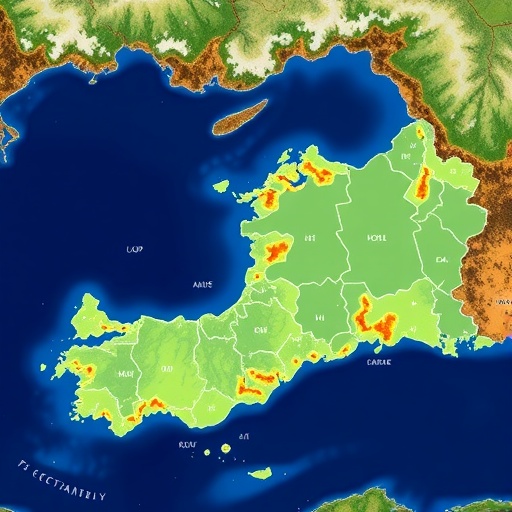
Spatial distribution patterns emerged prominently in the analysis, painting a vivid west-to-east gradient in non-native species prevalence. Western administrative regions, notably Kayseri and Muğla with 37 species each and Antalya with 34, harbor the densest concentrations of these species. This distribution likely reflects a confluence of environmental and anthropogenic factors, including environmental suitability, urbanization, trade volume, and connectivity through transport networks, all of which facilitate species ingress and establishment.
The biogeographic provenance of these non-native species is also noteworthy, with close to half originating from the Indo-Malayan realm, succeeded by significant representation from the Australasian realm. Such skewed geographical origins implicate global trade and travel corridors in shaping Türkiye’s invasive species profile. The prevalence of Indo-Malayan species may reflect historical and ongoing maritime trade routes, whereas Australasian introductions signify increasing globalization impacts.
A pressing concern highlighted by the research is the glaring knowledge gap regarding the impacts of these established species within Türkiye. A staggering 83% of the 271 species lack any recorded impact reports domestically, a percentage considerably higher than the 59% unreported impact rate found globally. This discrepancy underscores a critical deficit in local monitoring, ecological impact assessments, and reporting infrastructures. By contrast, numerous species with no documented impact in Türkiye have been demonstrated to exert substantial ecological and socio-economic consequences elsewhere.
For the minority of species with documented impacts within Türkiye, ecological and environmental disruptions dominate. Mechanistic drivers of harm include competition with native species, predation pressures, and rapid proliferation that outcompetes indigenous biota. These biological interactions have cascading effects on ecosystem functioning, jeopardizing the integrity of native communities and exacerbating biodiversity loss.
The future trajectories of these invasive species present a worrying outlook. Utilizing the Aquatic Species Invasiveness Screening Kit (AS-ISK), researchers evaluated 62 aquatic species, with half assessed as posing high to very high risk of invasiveness now. Alarmingly, model projections incorporating climate warming scenarios forecast this proportion escalating beyond 60%. Climate change is anticipated to modify habitat suitability and species interactions, potentially amplifying invasiveness risks and challenging existing management paradigms.
The study emphatically calls for enhanced, nationally coordinated efforts to confront the multifaceted challenges posed by non-native species in Türkiye. Effective mitigation of long-term biodiversity and ecosystem impacts necessitates robust biosecurity measures, intensified monitoring programs, and integrative risk assessments explicitly accounting for future climate shifts. Establishing such frameworks will be critical to safeguarding Türkiye’s rich biodiversity heritage.
Methodologically, this research leverages cutting-edge data synthesis and expert validation to bridge data gaps, combining global databases with local taxonomic knowledge. This integrative approach exemplifies best practices in invasion biology research and provides a replicable blueprint for other regions grappling with invasive species management. It also highlights the urgent need for comprehensive, systematic impact evaluations across taxa and habitats.
Socio-economic implications of established non-native species extend beyond ecological disturbances. In coastal and economically vibrant regions, invasive species can threaten fisheries, aquaculture, tourism, and public health. Recognizing these cross-sectoral impacts is vital for stakeholder engagement and crafting holistic policy responses that align conservation goals with community well-being and economic sustainability.
In conclusion, this landmark national assessment delivers an unprecedented overview of Türkiye’s established non-native species landscape and associated risks. As international trade, climate change, and human activities continue to reshape biogeographical boundaries, such rigorous scientific insights are indispensable. The study not only charts a course for immediate research and policy priorities but also serves as a clarion call for proactive stewardship to protect Türkiye’s ecosystems for future generations.
Subject of Research: Established non-native species distribution, impact assessment, and invasiveness risk in Türkiye.
Article Title: The first national assessment of established non-native species in Türkiye.
News Publication Date: 16-Feb-2026.
Web References:
DOI link
References:
Tarkan AS, Yapıcı S, Kurtul I, Błońska D, Vilizzi L, Baş Sermenli H, Farooq S, Aldemir C, Uçma Uysal T, Giannetto D, Bilge G, Çiftçioğlu M, Najafi-Majd E, Aktay-Sözüer L, Kaya C, Bayçelebi E, Aydın İ, Haubrock PJ, Briski E, Soto I (2026) The first national assessment of established non-native species in Türkiye. NeoBiota 105: 297-317.
Image Credits: Credit to Tarkan et al., 2026.
Keywords: Non-native species, invasive species, Türkiye, biodiversity, marine invasions, ecological impact, biosecurity, climate change, risk assessment, Aquatic Species Invasiveness Screening Kit, biogeography, conservation.


