…
…
The discovery that Aganaspis daci carries nine chromosomes in its haploid set adds a small but meaningful piece to a much larger puzzle: reconstructing how genome organization has evolved across the parasitoid wasps. Chromosome numbers in insects vary enormously, from single-digit counts in some nematoceran flies to several hundred in certain butterflies, and Hymenoptera occupy a particularly interesting middle ground. Within the parasitoid lineages, haploid numbers between five and roughly twenty are common, and the pattern documented here for the Figitidae, spanning n = 5 to n = 11, sits comfortably within that range. What makes the new data valuable is not the number itself but the structural detail attached to it, because karyotypes can only be compared meaningfully when both counts and chromosome morphologies are known.
The very large first metacentric chromosome of A. daci deserves particular attention. Accounting for more than a quarter of the total haploid genome length, this element is more than twice the size of the next largest chromosome, a configuration that immediately distinguishes the karyotype from most published figitid complements. In cytogenetic studies of parasitoid Hymenoptera, unusually large metacentric elements are frequently interpreted as the products of centric fusion events, in which two ancestral acrocentric chromosomes join at or near their centromeres to form a single larger element. Each such fusion reduces the haploid number by one while preserving nearly all of the genetic material. The authors’ suggestion that the n = 9 complement of A. daci, together with similar complements in other Eucoilinae, arose through independent fusions from an ancestral n = 10 state fits this well-established framework. If correct, it implies that the reduction from ten to nine chromosomes occurred separately in different lineages rather than being inherited from a single common ancestor, a conclusion that can only be drawn when karyotypes of multiple related species are available for comparison.
The identification of a presumptive nucleolus organizing region on chromosome 6 adds another layer of comparative value. Secondary constrictions and terminal satellites, such as those observed on the short arm of this metacentric element, mark the sites of ribosomal DNA clusters, the tandemly repeated genes that encode the structural RNA components of ribosomes. These loci are among the most frequently mapped chromosomal landmarks in comparative cytogenetics because they can often be detected without molecular probes, and because their positions can shift over evolutionary time through translocation, inversion, or amplification events. In parasitoid wasps, NOR-bearing chromosomes have been documented in several families, and their placement sometimes serves as a synapomorphy linking species that share a recent common ancestor. Confirming the exact location of the rDNA in A. daci would ideally require fluorescent in situ hybridization with a ribosomal probe, but the morphological evidence from conventional and fluorochrome staining provides a strong working hypothesis that future molecular cytogenetic work can test directly.
The use of acridine orange staining in this study is also worth considering in methodological terms. Acridine orange is a fluorochrome that intercalates between the stacked base pairs of DNA and, depending on staining conditions and chromatin state, can produce differential fluorescence that reflects regional differences in base composition or chromatin condensation. In many insect groups, fluorochrome banding reveals heterochromatic blocks rich in AT or GC base pairs, providing markers that supplement morphometric data. The finding that acridine orange produced essentially homogeneous staining across all chromosomes of A. daci suggests an absence of large, compositionally distinct heterochromatic blocks detectable by this method. This is not unusual in Hymenoptera, where heterochromatin tends to be relatively sparse compared with many other insect orders, but it does mean that the karyotype description relies primarily on chromosome size and centromere position. Techniques with higher resolving power, such as C-banding, silver staining of active NORs, or FISH mapping of repetitive sequences, would be needed to reveal finer structural features and to confirm the rDNA assignment.
The practical route by which this karyotype was obtained also illustrates why chromosomal data for parasitoid wasps remain scarce. Chromosome preparations in Hymenoptera typically rely on dissecting neural tissues from late larvae or prepupae, stages in which dividing cells are abundant enough to yield scorable metaphase plates. For A. daci, this required maintaining a laboratory colony, rearing the Mediterranean fruit fly host on artificial diet, exposing cohorts of host larvae to ovipositing females on a daily schedule, and then timing the dissection of parasitized puparia to the narrow window when prepupae had reached the appropriate developmental stage, roughly twenty-four to twenty-six days after oviposition under the colony’s rearing conditions. The extraction of prepupae from opened puparia, followed by hypotonic treatment of cerebral ganglia and mechanical disruption on slides, is a delicate procedure that demands both live material and considerable hands-on expertise. These logistical constraints explain why, for a family containing well over seventeen hundred described species and an estimated global diversity that may approach twenty-four thousand, chromosomes have now been characterized for only eleven members.
That gap between known and estimated diversity is itself scientifically significant. Figitidae is the most species-rich family within Cynipoidea, and its members occupy a wide range of ecological roles, with many lineages acting as parasitoids of Diptera and other insects. Because haploid chromosome numbers and karyotype structures have proven useful as auxiliary characters in hymenopteran systematics, the near-total absence of cytogenetic data for most figitid lineages limits the resolution of comparative analyses. Each newly described karyotype, such as the one presented here, contributes a data point that can be mapped onto molecular phylogenies to test hypotheses about chromosomal evolution. The observation that haploid numbers within the family range from five to eleven, with ten apparently ancestral at least for Eucoilinae, hints at a pattern of descending aneuploidy driven by fusions, a trend documented repeatedly in other parasitoid groups. Whether the same directional trend holds across the family as a whole, and whether particular chromosome morphologies such as very large first metacentrics recur independently, are questions that only additional karyotype descriptions can answer.
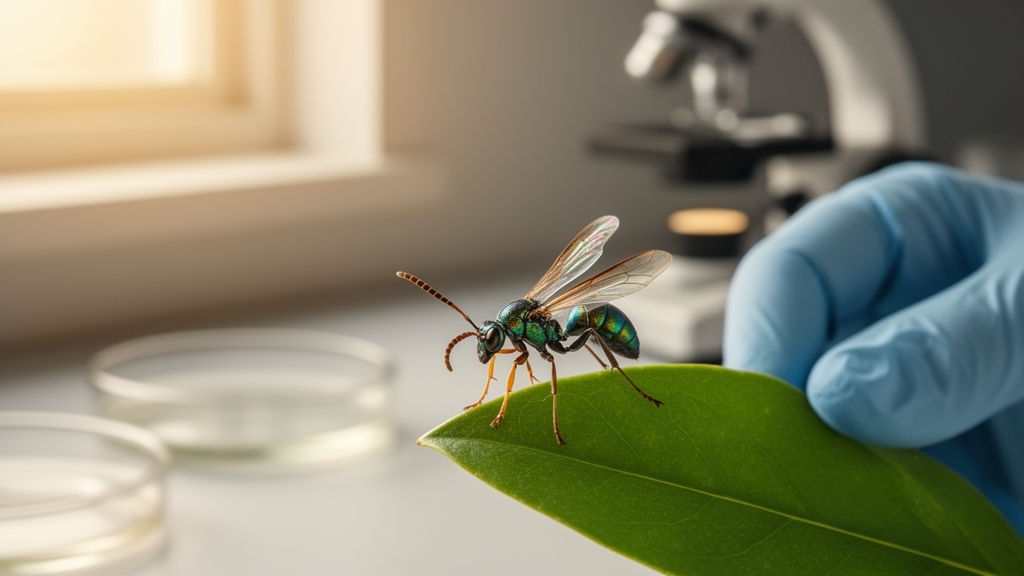
The biological context of A. daci itself amplifies the applied relevance of the work. As a solitary larval-pupal endoparasitoid of major tephritid fruit fly pests, including species of Anastrepha, Bactrocera, and Ceratitis, this wasp is a candidate agent in biological control programs targeting some of the world’s most economically damaging orchard pests. The recent detection of Bactrocera dorsalis in Italy and its ongoing spread lend urgency to the characterization of natural enemies that might suppress it. Cytogenetic data contribute to this applied agenda in several ways. Laboratory colonies of parasitoids used in mass rearing or classical biological control benefit from cytogenetic monitoring, since chromosomal changes can arise during colonization and may signal inbreeding or genetic drift that could compromise colony fitness. Moreover, accurate species delimitation in parasitoid complexes increasingly relies on integrative approaches combining morphology, molecules, and, where available, cytogenetic markers, and cryptic species differing in karyotype have been documented in several hymenopteran groups.
The provenance of the studied material also carries biogeographic interest. The colony was established in 2023 from parasitoids recovered in the Campania region from Mediterranean fruit fly-infested fruits, and the species had only recently been recorded from Italy for the first time. A. daci occurs across various subtropical regions, including the Mediterranean basin, and its presence in southern Italy may reflect either long-established populations or more recent range expansion, possibly aided by human-mediated movement of infested fruit or by deliberate and accidental releases for biological control. Chromosomal data from populations across the species’ range could eventually help clarify population structure and invasion history, since karyotypic variants, when they exist, sometimes serve as geographic markers. For now, the Campania stock provides a documented reference point against which future samples can be compared.
From a broader evolutionary standpoint, the karyotype of A. daci fits into a growing body of evidence that chromosome evolution in parasitoid Hymenoptera is dynamic at the level of chromosome number while remaining conservative in overall genome content. Fusions and fissions can alter counts substantially over modest evolutionary timescales without necessarily changing gene content, which may explain why closely related species can differ in haploid number while remaining morphologically and ecologically similar. The independent derivation of n = 9 complements within Eucoilinae, if confirmed by denser taxon sampling, would represent a case of parallel chromosomal evolution, a phenomenon increasingly recognized across eukaryotes. Parallel changes in chromosome number may be facilitated by shared features of genome architecture, such as the distribution of repetitive elements or the positions of telomeric sequences, that make certain fusion configurations more likely than others. Testing such hypotheses in Figitidae will require not only more karyotypes but eventually molecular cytogenetic maps that can identify which ancestral elements have combined in each lineage.
In sum, the first karyotype description of A. daci delivers a precise morphometric profile, a presumptive NOR location, and a comparative framework within Figitidae, all obtained from a modest but carefully executed laboratory effort. It raises the number of cytogenetically characterized figitid species by one, anchors the Eucoilinae pattern of fusion-derived chromosome sets with a new example, and establishes a cytogenetic baseline for a parasitoid of growing importance in Mediterranean fruit fly management. As more members of this speciose family are examined with comparable methods, the emerging picture of chromosomal evolution in Figitidae will become progressively clearer, and species such as A. daci will serve as reference points in that expanding comparative landscape.
Subject of Research: …
Article Title: Chromosomes of Aganaspis daci (Weld, 1951) and a review of known karyotypes of the family Figitidae ( Hymenoptera )
Article References: Chromosomes of Aganaspis daci (Weld, 1951) and a review of known karyotypes of the family Figitidae ( Hymenoptera ). (n.d.). https://doi.org/10.3897/compcytogen.20.180400
Image Credits: AI Generated
DOI: 10.3897/compcytogen.20.180400
Keywords: Aganaspis daci, Figitidae, karyotype, chromosomes, parasitoid wasps, biological control, Cynipoidea, cytogenetics, chromosomal fusion, Eucoilinae, tephritid fruit flies, acridine orange staining
Cite Scienmag News
Gavin Prescott. (October 16, 2026). First chromosome map of a fruit fly parasitoid wasp reveals hidden evolutionary story. Scienmag. https://scienmag.com/first-chromosome-map-of-a-fruit-fly-parasitoid-wasp-reveals-hidden-evolutionary-story/
Gavin Prescott. "First chromosome map of a fruit fly parasitoid wasp reveals hidden evolutionary story." Scienmag, 16 October 2026, https://scienmag.com/first-chromosome-map-of-a-fruit-fly-parasitoid-wasp-reveals-hidden-evolutionary-story/. Accessed 16 October 2026.
Gavin Prescott. "First chromosome map of a fruit fly parasitoid wasp reveals hidden evolutionary story." Scienmag. October 16, 2026. https://scienmag.com/first-chromosome-map-of-a-fruit-fly-parasitoid-wasp-reveals-hidden-evolutionary-story/