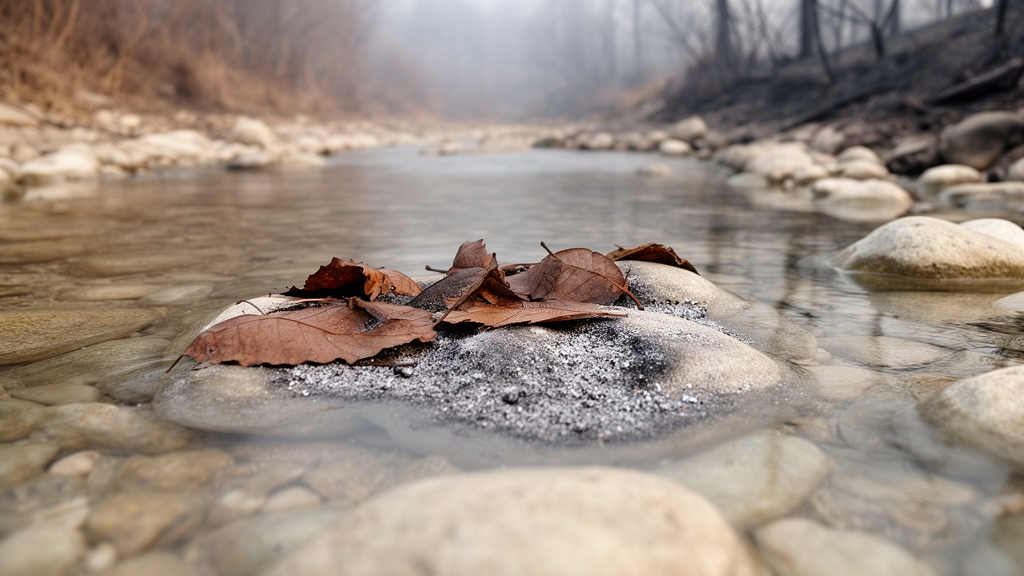
Wildfire smoke plumes can significantly alter the decomposition of leaf litter in headwater streams, even when the trees themselves survive the fire. A new field experiment published in Fire Ecology demonstrates that heat from fire plumes reduces the rate at which certain leaves break down in water, with the strongest effects observed in alder. The study, conducted in three low-order streams in northern Spain, highlights how brief exposure to high temperatures can change the functioning of aquatic ecosystems by modifying the chemical and physical traits of leaf litter before it enters the water.
The research team, led by Alberto Alonso and colleagues, aimed to understand the specific mechanisms by which wildfires affect terrestrially derived leaf litter in riparian areas where canopy cover is not completely lost. While previous studies have focused on the loss of riparian vegetation and direct ash deposition, the impact of heated smoke on leaves that remain in the canopy has been less understood. The heat from smoke plumes can damage leaf cuticles and tree xylem, inducing premature senescence and altering the chemical composition of the leaves. These changes can subsequently influence how the litter is processed by microorganisms and macroinvertebrates once it falls into the stream.
To test these effects, the researchers collected leaf litter from three tree species common in the study region: alder (Alnus glutinosa), oak (Quercus robur), and eucalypt (Eucalyptus globulus). Alder and oak are native species that dominate the riparian forests of the area, while eucalypt is an exotic tree widely used in forestry plantations. The leaves were collected in autumn 2021 immediately after their natural abscission. Half of the leaves from each species were subjected to a simulated fire plume treatment by being exposed to 150 degrees Celsius for three hours in an oven. The other half served as controls and were only air-dried. This temperature was chosen to simulate the heat experienced by leaves in the lower parts of the canopy during a wildfire, which is below the combustion point but high enough to cause significant physiological stress.
In May 2022, the treated and control leaf litter was deployed in three headwater streams in the Agüera catchment in northern Spain. The streams are characterized by siliceous substrates, well-oxygenated water, and low nutrient concentrations. The researchers used paired coarse-mesh and fine-mesh nylon bags to measure total decomposition and microbial decomposition, respectively. Coarse-mesh bags allowed macroinvertebrates to access the litter, while fine-mesh bags restricted access to microorganisms. The bags were incubated in the streams for 21 days, after which they were retrieved to analyze mass loss and the associated aquatic communities.
The results showed that fire-plume exposure reduced both total and microbial decomposition rates, with the most significant reduction occurring in alder leaf litter. Alder, which typically decomposes faster than oak or eucalypt due to its higher nitrogen content, experienced a marked slowdown in breakdown when exposed to the simulated fire plume. Oak also showed a reduction in total decomposition, though to a lesser extent, while eucalypt decomposition rates remained largely unchanged. This pattern suggests that the impact of fire plumes on decomposition is linked to the intrinsic decomposition rates of the leaves, with faster-decomposing species being more susceptible to the negative effects of heat exposure.
The study also examined the responses of aquatic hyphomycetes and macroinvertebrates to the fire-exposed leaf litter. Aquatic hyphomycete sporulation rates and species richness were affected by the tree species but not by the fire exposure treatment. Alder supported the highest levels of hyphomycete activity, consistent with its nutrient-rich nature, while oak and eucalypt, which contain higher concentrations of inhibitory compounds, supported lower levels. However, the fire plume treatment did not significantly alter the assemblage structure or richness of these fungi, indicating that the microbial communities were resilient to the heat-induced changes in leaf traits.
In contrast, the abundance of macroinvertebrates within the leaf packs responded differently to fire-plume exposure depending on the tree species. In alder leaf litter, macroinvertebrate abundance was reduced in the fire-exposed treatment compared to the control. This decrease was observed across several functional feeding groups, including detritivores and grazers. Conversely, in oak and eucalypt leaf litter, macroinvertebrate abundance increased following fire exposure. This divergent response highlights the complex interactions between leaf litter traits and invertebrate communities, where heat exposure may remove inhibitory compounds from recalcitrant leaves, making them more suitable as resources for certain invertebrate groups.
The researchers noted that the reduction in macroinvertebrate abundance on fire-exposed alder leaves may be linked to the loss of nutrient-rich traits that typically support high invertebrate consumption. Alder leaves are softer and richer in nutrients, which usually favor detritivore activity. However, the heat exposure may have caused a loss of these favorable traits, reducing the sustainability of the litter as a food source. In contrast, oak and eucalypt leaves, which are generally less palatable due to high tannin and phenolic content, may have benefited from the removal of these inhibitors by the heat, thereby increasing their attractiveness to macroinvertebrates.
The study also identified shifts in the composition of macroinvertebrate assemblages. The genus Baetis was characteristic of fire-exposed leaves, while Chloroperla was associated with control leaves. Baetis is a generalist taxon with high dispersal ability, which allows it to exploit various organic matter sources efficiently. The presence of Chloroperla in control leaves, a taxon often associated with pristine conditions, suggests that fire-exposed litter may create environmental conditions that are less favorable for sensitive species. These compositional changes indicate that fire plumes can alter the structure of stream communities, even if overall richness remains stable.
A potential limitation of the study is the use of an artificial heating treatment to simulate fire plumes. The three-hour exposure to 150 degrees Celsius in an oven is longer than natural wildfire plumes, which typically last for minutes. This extended duration was chosen to ensure consistent effects on leaf litter traits, but it may have overestimated the impact of fire plumes. Additionally, the experimental leaves were detached from the trees, meaning they did not experience the physiological stress of remaining attached during a fire. In nature, fire plumes affect leaves through heat and chemical changes driven by premature senescence and impaired nutrient resorption, processes that are difficult to replicate in a laboratory setting.
Despite these limitations, the findings provide valuable insights into the mechanisms by which wildfires affect stream ecosystems. The study demonstrates that even lower-severity wildfires, which do not fully consume tree crowns, can have significant impacts on aquatic ecosystem functioning. The marked differences in effects among tree species underscore the importance of maintaining diverse riparian corridors to buffer the impacts of wildfires. By preserving a variety of tree species, stream ecosystems may be better equipped to handle the changes in leaf litter quality and quantity that result from fire events.
The results of this field experiment complement previous microcosm studies that have shown similar patterns of reduced decomposition in fire-exposed leaf litter. The consistency of findings across controlled and natural environments strengthens the evidence that fire plumes play a crucial role in altering stream processes. As wildfires become more frequent and intense due to climatic warming and land use changes, understanding these subtle but significant effects on aquatic ecosystems is essential for developing effective conservation and restoration strategies. The study highlights the need for further research into the combined effects of fire plumes and other wildfire-related stressors, such as reduced shading and increased suspended solids, to fully assess their impacts on stream health.
Subject of Research: Impact of fire plume heat on leaf litter decomposition and macroinvertebrate communities in headwater streams
Article Title: Fire-plume exposed leaf litter alters decomposition and macroinvertebrate assemblages in headwater streams
Article References: Alonso, A., Brand, C., Pérez, J., Sarasa, A., Gómez-Capponi, F., Rojo, D., & Boyero, L. (2026). Fire-plume exposed leaf litter alters decomposition and macroinvertebrate assemblages in headwater streams. Fire Ecology, 22(1), Article 118. https://doi.org/10.1186/s42408-026-00572-7
Image Credits: AI Generated
DOI: 10.1186/s42408-026-00572-7
Keywords: wildfire, leaf litter, decomposition, macroinvertebrates, headwater streams, fire ecology, aquatic hyphomycetes, riparian forests, ecosystem functioning, alder, oak, eucalypt
Cite Scienmag News
Gavin Prescott. (November 8, 2026). Fire Smoke Heat Slows Stream Leaf Decomposition. Scienmag. https://scienmag.com/fire-smoke-heat-slows-stream-leaf-decomposition/
Gavin Prescott. "Fire Smoke Heat Slows Stream Leaf Decomposition." Scienmag, 8 November 2026, https://scienmag.com/fire-smoke-heat-slows-stream-leaf-decomposition/. Accessed 8 November 2026.
Gavin Prescott. "Fire Smoke Heat Slows Stream Leaf Decomposition." Scienmag. November 8, 2026. https://scienmag.com/fire-smoke-heat-slows-stream-leaf-decomposition/