


When a building burns, firefighters face an agonizing choice: douse the flames with water or let the structure cool naturally. A new experimental study suggests that this split-second decision may leave a lasting fingerprint on the very material that holds the building together. Researchers in China have shown that cement mortar, after being baked at temperatures up to 500 degrees Celsius, can actually become stiffer in shear if it is allowed to cool slowly in air — but that quirk of physics vanishes, and turns into outright weakening, when the same hot material is plunged into water. The findings, published in Frontiers in Built Environment, offer a fresh warning that how a fire is extinguished matters almost as much as how hot the fire was.
The team, led by Yanfu Zhao and Hongtu Xiu of China Communications Construction Company First Highway Engineering Bureau Group, together with colleagues at Guizhou University and Beibu Gulf University, prepared cube-shaped cement mortar specimens measuring 70 by 70 by 70 millimeters. The mix was deliberately simple: Portland cement, standard sand and water in a mass ratio of 2:1:0.4, with no coarse aggregate at all. That choice matters, because it means the results describe mortar rather than structural concrete, and the authors are careful not to overreach. After casting, the specimens were demolded within 24 hours and cured for 28 days at 20 degrees Celsius and 95 percent relative humidity, giving the cement paste time to develop its full hydration skeleton before any thermal punishment began.
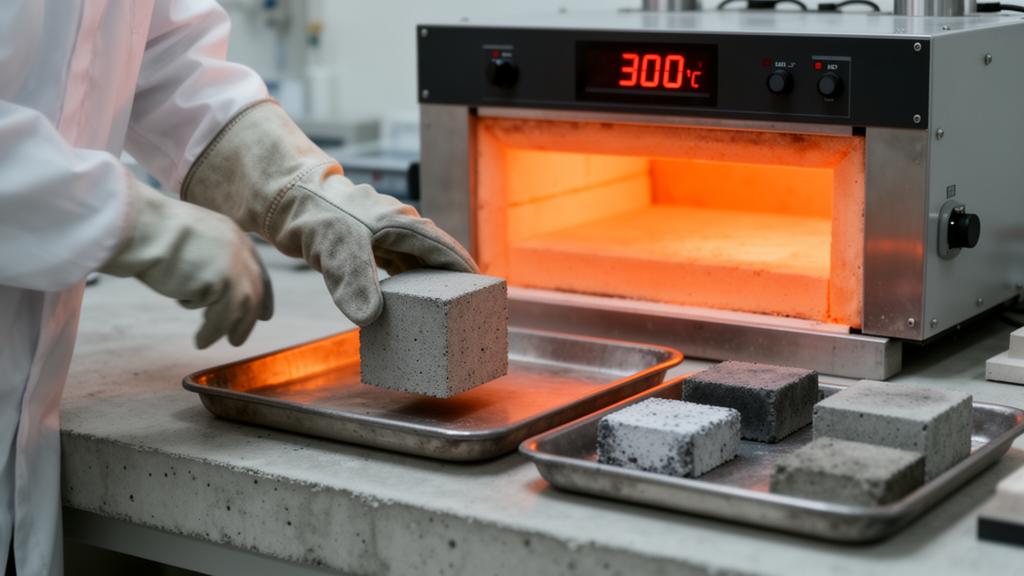
The heating protocol was methodical. Specimens were placed in a rapid-heating resistance furnace and raised at a steady 6 degrees Celsius per minute to one of six target temperatures: room temperature, 100, 200, 300, 400 or 500 degrees Celsius. Once the target was reached, the temperature was held constant for two hours, ensuring the interior of each cube experienced the same thermal exposure as its surface. Then came the experimental fork in the road. One group of specimens was dropped into a water tank for rapid cooling, while its twin was left to cool naturally in the surrounding air. For each temperature and cooling combination, three independent specimens were tested, and the reported mechanical values represent the means of those replicates.
With the specimens cooled, the researchers moved to the heart of the study: direct shear testing. Each cube was mounted in a rock mechanics system capable of applying up to 500 kilonewtons of horizontal load. The apparatus uses a shear box in which the upper half can slide horizontally while the lower half is fixed. Before any shear force was applied, a constant normal stress of 1 megapascal was pressed onto the specimen, simulating the confining pressure a material layer might experience in a real structure. Only then was the shear load ramped up until failure. The resulting stress-displacement curves all shared a recognizable anatomy: an initial compaction stage, a linear elastic stage, an elastic-plastic stage, and finally the post-peak descent into fracture.
The most striking result emerged from the air-cooled series. Peak shear stress and shear modulus did not simply fall as temperature rose. Instead, both parameters climbed with increasing temperature and reached a local maximum near 300 degrees Celsius, after which they collapsed. The shear modulus of air-cooled specimens heated to 300 degrees was a remarkable 78 percent higher than that of untreated material — a counterintuitive boost for a substance that most engineers assume only degrades with heat. Above that threshold, however, the decline was cliff-like. The authors stress that this apparent strengthening is condition-dependent rather than a universal thermal hardening effect, and they interpret it cautiously as a temporary reduction in mechanically active defects rather than proof of a unique strengthening mechanism.
Water-cooled specimens told a far grimmer story. Their peak shear stress decreased monotonically with temperature, a relationship the researchers could capture with a simple linear fit, and their shear modulus rose only slightly up to 100 degrees before declining linearly to just 22 percent of the untreated value at 500 degrees Celsius. At every temperature, the water-quenched material was weaker and more plastic than its air-cooled counterpart, deforming gradually rather than failing in the sudden brittle manner seen in the 300-degree air-cooled group, which exhibited the greatest brittleness of all. The message is unambiguous: thermal shock during rapid cooling inflicts additional, measurable damage on top of whatever the heating itself caused.
To understand why, the team listened to the material literally. Four acoustic emission sensors, coupled to the specimen surface with vaseline and calibrated by a pencil-lead-break test, recorded ultrasonic bursts at a 40-decibel threshold while the shear load was applied. In untreated specimens, the acoustic signature followed a clear two-stage pattern: a quiet, stable pre-peak phase during which cohesion in the cement matrix resisted the load, followed by an explosive post-peak surge as microcracks in the matrix and at the paste-sand interfaces linked up into a continuous shear fracture surface. After the peak, intense but decaying emissions continued as the two halves of the specimen ground against each other in frictional sliding, shedding debris from the fracture faces.
The acoustic records from heated specimens revealed something unexpected. In the 200- and 300-degree air-cooled groups, pre-peak acoustic activity was almost entirely absent, and cumulative event counts fell well below those of untreated specimens. Scanning electron microscopy offered a possible explanation: the shrinkage microcracks that normally pepper the paste-sand interface in cured mortar appeared narrower, or even vanished, after moderate heating. Differential thermal expansion and the removal of moisture may have pressed the cement paste into tighter contact with the sand grains, temporarily quieting the defects that would otherwise crack and pop under load. The authors are careful to note that SEM cannot directly quantify bond strength and that no phase-composition or pore-structure measurements were performed, so this mechanism remains a plausible interpretation rather than a verified conclusion. Above 400 degrees, the picture reversed: thermal microcracking spread through the paste and interfaces, and small acoustic events returned even before the peak load.
The microscopy also settled a question about where the final fracture travels. Post-failure surfaces showed most sand particles still embedded in the cement paste, with only some grains debonded or pulled out, leaving pits behind. There was no evidence of the shear plane slicing extensively through sand particles themselves, even though at 500 degrees thermally induced cracks had appeared locally within some grains. The macroscopic shear localization, in other words, follows the path of least resistance: through the cement paste matrix and along the paste-sand interfaces that bind the composite together. That detail matters for engineers, because it identifies the interfacial transition zone — the weakest link in cementitious materials — as the region where fire damage concentrates its attack.
The physics of water cooling explains the extra deterioration. When a hot specimen meets cold water, its surface temperature drops almost instantly while the interior remains hot, creating a steep thermal gradient. The chilled exterior tries to contract but is restrained by the hot interior, generating transient tensile stresses at the surface. Once those stresses exceed the material’s tensile strength, surface cracks open, and water then penetrates through them, softening the forces between cement gel particles and further eroding load-bearing capacity. The researchers’ stress analysis predicts that shrinkage cracking should concentrate along particular planes of the cube — exactly where the experiments showed it did. For post-fire assessment, the practical implication is that inspectors must reconstruct not only the peak temperature a structure experienced but also how it was cooled, since a water-quenched element may be significantly more damaged than an identical one that cooled in air. The results provide a material-level reference for evaluating repair mortars, cementitious joints and other interface-dominated regions after fire, though the authors caution that their findings, based on mortar without coarse aggregate and a single normal stress of 1 megapascal, should not be directly generalized to structural concrete. Future work with X-ray diffraction, thermogravimetric analysis and computed tomography will be needed to trace the full three-dimensional evolution of pores and cracks through realistic fire-and-cooling histories.
Subject of Research: Effects of elevated temperature and cooling method on the shear behavior and microstructural damage of cement mortar
Article Title: Shear behavior of cement mortar after exposure to elevated temperatures under different cooling conditions
Article References: Shear behavior of cement mortar after exposure to elevated temperatures under different cooling conditions. (n.d.). https://doi.org/10.3389/fbuil.2026.1949325
Image Credits: AI Generated
DOI: 10.3389/fbuil.2026.1949325
Keywords: cement mortar, elevated temperature, cooling method, direct shear, acoustic emission, scanning electron microscopy, thermal shock, fire damage, shear modulus, microcracking, construction materials, post-fire assessment
Cite Scienmag News
Violet Maxwell. (October 15, 2026). Fire-Hit Cement Mortar Gains Strength at 300 Degrees, but Only If It Cools Slowly. Scienmag. https://scienmag.com/fire-hit-cement-mortar-gains-strength-at-300-degrees-but-only-if-it-cools-slowly/
Violet Maxwell. "Fire-Hit Cement Mortar Gains Strength at 300 Degrees, but Only If It Cools Slowly." Scienmag, 15 October 2026, https://scienmag.com/fire-hit-cement-mortar-gains-strength-at-300-degrees-but-only-if-it-cools-slowly/. Accessed 15 October 2026.
Violet Maxwell. "Fire-Hit Cement Mortar Gains Strength at 300 Degrees, but Only If It Cools Slowly." Scienmag. October 15, 2026. https://scienmag.com/fire-hit-cement-mortar-gains-strength-at-300-degrees-but-only-if-it-cools-slowly/


