Engineers in Ethiopia have built and tested an indirect solar coffee dryer whose air collector carries aluminum fins and faces the sun from both north and south sides, and the combination appears to pay off. After optimizing the fin geometry with computational fluid dynamics and response surface methodology, the team fabricated the design and dried coffee parchment from an initial moisture content of 60 grams of water per gram of dry matter down to roughly 0.11 kilograms per kilogram on a dry basis in about 20 hours of effective drying, spread over roughly two days of field testing in Harar. The work, published in Results in Engineering, reports an average experimental collector efficiency of 62 percent and a peak of 80.1 percent at an air mass flow rate of 0.03 kilograms per second.
The study, led by Gadisa D. Shekata with Getachew Sh. Tibba and Aklilu T. Baheta, set out to close a specific gap in the solar drying literature. Previous research has examined individual absorber modifications such as ribs, baffles, or fins in isolation, or has coupled CFD with response surface methodology to refine chamber geometry rather than the absorber and fin configuration itself. Dual-sided collector concepts, in which both faces of an absorber contribute to heat collection, had not previously been reported as part of a fin-augmented, CFD- and RSM-optimized indirect solar dryer for agricultural products. The authors also note that coffee quality is highly sensitive to weather variability, yet no robust framework existed for evaluating how solar drying systems perform under fluctuating environmental conditions.
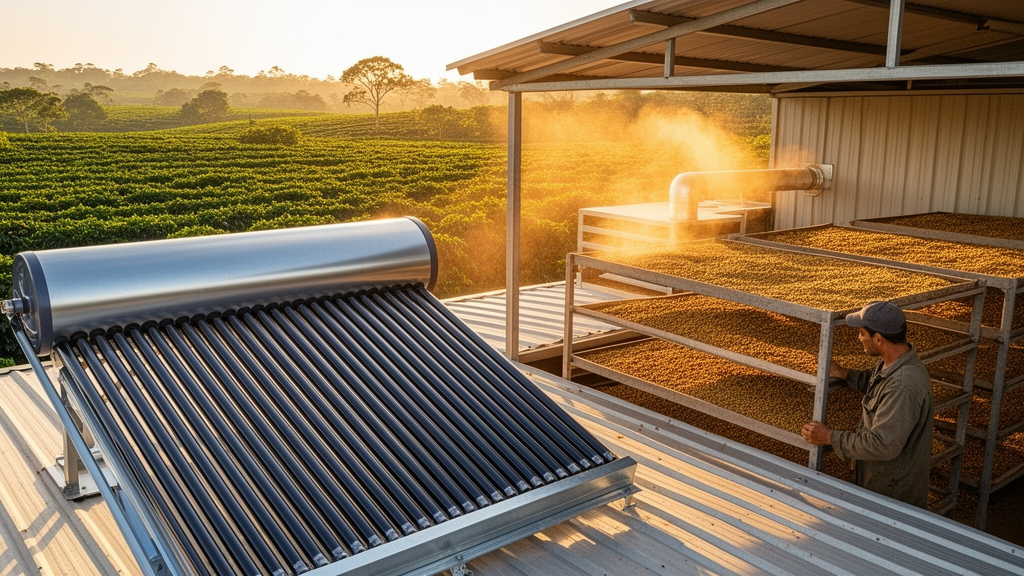
The device itself is deliberately simple. The indirect configuration heats air separately in a solar air collector before circulating it into the drying chamber, keeping the coffee out of direct sunlight, which the authors identify as a way to preserve color, flavor, and nutritional value compared with open sun drying. The prototype was fabricated entirely from sheet metal and insulation materials. Its two absorber plates, each measuring 1000 by 500 by 1 millimeter, were coated with black paint of absorptivity 0.97. A 12-watt fan provides the forced airflow, and the drying chamber frame measures 965 by 1000 by 250 millimeters with 75 by 500 millimeter air inlet and outlet openings. The collector was installed on a platform tilted at 15 degrees.
Three fin arrangements were compared in simulation: parallel fins aligned with the airflow, vertical fins mounted perpendicular to the absorber plate, and opposed fins oriented against the flow. Each configuration used fourteen aluminum fins, 1 millimeter thick. In the CFD results at a mass flow rate of 0.03 kilograms per second, the opposed-fin design reached the highest absorber temperature at roughly 190 degrees Celsius, compared with 53 degrees Celsius for the standard finless configuration, with vertical fins at about 180 degrees and parallel fins at about 140 degrees. The collector outlet air temperature with opposed fins reached approximately 366 kelvin against 335 kelvin for the standard design, an increase of about 30 percent. Temperature peaks concentrated near the fin surfaces, which the authors read as confirmation of enhanced heat transfer.
Fins, however, are not free. The volume-averaged static pressure results show that the vertical- and opposed-fin configurations create larger low-pressure regions and higher flow resistance than the standard and parallel designs. The vertical-fin setup produced the largest pressure penalty at 0.23 pascals, while the opposed-fin design kept its drop to 0.20 pascals while still delivering the best thermal performance: an outlet temperature of 62.4 degrees Celsius, collector efficiency of 75.9 percent, and air velocity of 0.46 meters per second at the constant 0.03 kilograms per second flow rate, against 52.4 degrees Celsius and 58.2 percent efficiency for the finless baseline. The authors conclude that opposed fins offer the best balance between thermal enhancement and pressure loss.
To find the optimal design, the team ran a Box-Behnken design of 17 CFD simulation cases spanning air mass flow rates from 0.01 to 0.05 kilograms per second, fin heights from 2 to 4 centimeters, and fin counts from 6 to 14, with five replicated center points to estimate pure error. Second-order polynomial models were fitted for outlet temperature, outlet velocity, thermal efficiency, and outlet pressure, and all four were statistically significant at P below 0.0001. Mass flow rate emerged as the most influential factor overall, though its effects diverge by response: outlet temperature is best increased by lowering flow rate while raising fin height and fin number, which extends air residence time and enlarges the heat transfer surface, whereas outlet velocity rises mainly with higher flow rate but falls as taller or more numerous fins add resistance.
The optimization converged on a mass flow rate of 0.03 kilograms per second, a fin height of 3.4 centimeters, and six fins. Under these conditions the model predicted a collector thermal efficiency of 75.9 percent, an outlet temperature of 326.4 kelvin, and an outlet velocity of 0.46 meters per second. Desirability function values for outlet temperature, collector thermal efficiency, outlet velocity, and pressure were 1, 0.99, 1, and 0.99 respectively. The authors benchmark these figures against earlier work: an indirect solar dryer with flat and corrugated absorbers tested at higher flow rates of 0.043 to 0.0689 kilograms per second achieved outlet temperatures of 53.1 to 61.2 degrees Celsius and collector efficiencies of 56.8 percent under natural convection and 68.7 percent under forced convection.
The CFD model was validated against measured collector outlet air temperature from experiments conducted in February in Harar, at 9.23 degrees north latitude and 42.79 degrees east longitude. The comparison used time-averaged measurements from three samples, each based on two days of testing within February 20 to 26, under conditions of 955 watts per square meter solar irradiance, 2.3 meters per second wind speed, and 20 degrees Celsius ambient temperature. The model predicted outlet temperature with a deviation of less than 1 percent, and the coefficient of determination reached 0.96. The authors caution that this agreement reflects a specific, relatively stable averaging window: the simulation applied a constant heat flux of 662 watts per square meter, derived from the five-year average irradiance for Harar, whereas the outdoor experiment recorded a peak irradiance of 955 watts per square meter under naturally fluctuating conditions.
The field experiments used coffee parchment samples loaded at 250 grams per square meter on each of two perforated trays placed in series in the drying chamber, with all runs held at the constant 0.03 kilograms per second flow rate and repeated three times. Over the two test days, average maximum solar radiation reached 1038 and 1033 watts per square meter on the south-facing absorber and 930 and 932 watts per square meter on the north-facing absorber, both peaking at 12:30. The maximum absorber temperature hit 71 degrees Celsius and the highest outlet air temperature 69 degrees Celsius. Ambient temperatures ranged from 20 to 39 degrees Celsius on the first day and 21.5 to 40 on the second, while relative humidity averaged 22 percent in ambient air and 25 percent in the drying chamber on day one, and 25 and 36 percent on day two.
The moisture data tell the rest of the story. Moisture content decreased over time in a falling-rate pattern, with most of the loss occurring on the first day as unbound water was removed, and the final moisture contents were 0.111 and 0.117 kilograms per kilogram dry basis for trays 1 and 2 respectively, the gradient attributed to the first tray seeing hotter drying air. The peak drying rate reached 0.114 kilograms per hour, and both trays performed similarly, which the authors take as evidence of good drying uniformity. They place the 20-hour drying time against reported figures of 30.2 hours for a similar product in earlier work, 48 hours in another study, and 24 to 32 hours for coffee beans in a rotary dryer. The authors are explicit about the limits of the work: no exergy analysis, life-cycle assessment, economic evaluation, or direct assessment of dried coffee quality such as color, defect rate, or cupping scores was performed, so sustainability and quality claims must await further study.
Subject of Research: CFD and RSM optimization and experimental testing of a fin-enhanced dual-sided indirect solar coffee dryer
Article Title: Experimental and numerical investigation of a fin-enhanced indirect solar coffee dryer
Article References: Shekata, G. D., Tibba, G. S., & Baheta, A. T. (2026). Experimental and numerical investigation of a fin-enhanced indirect solar coffee dryer. Results in Engineering, 32, Article 113645. https://doi.org/10.1016/j.rineng.2026.113645
Image Credits: AI Generated
DOI: 10.1016/j.rineng.2026.113645
Keywords: solar dryer, coffee parchment, CFD, response surface methodology, opposed fins, solar air collector, thermal efficiency, Harar Ethiopia, drying time, moisture content, Box-Behnken design, forced convection
Cite Scienmag News
Audrey Campbell. (October 28, 2026). Finned Solar Air Collector Dries Coffee Parchment in 20 Hours. Scienmag. https://scienmag.com/finned-solar-air-collector-dries-coffee-parchment-in-20-hours/
Audrey Campbell. "Finned Solar Air Collector Dries Coffee Parchment in 20 Hours." Scienmag, 28 October 2026, https://scienmag.com/finned-solar-air-collector-dries-coffee-parchment-in-20-hours/. Accessed 28 October 2026.
Audrey Campbell. "Finned Solar Air Collector Dries Coffee Parchment in 20 Hours." Scienmag. October 28, 2026. https://scienmag.com/finned-solar-air-collector-dries-coffee-parchment-in-20-hours/