


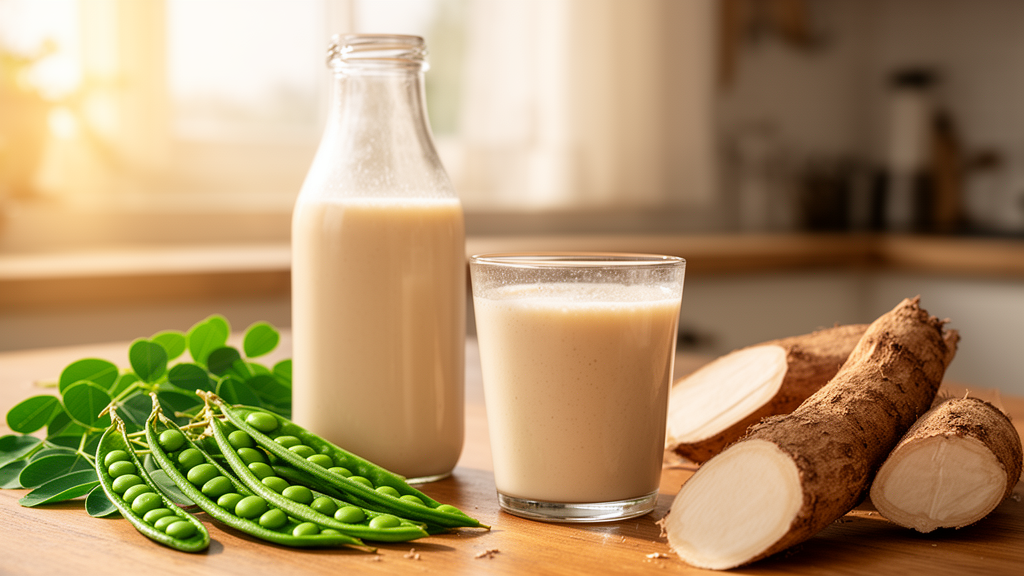
Scientists in Nigeria have transformed two of the tropics’ most familiar crops into something neither could achieve alone: a tangy, fermented drink that packs a serious nutritional punch. By blending nutrient-dense moringa seed powder with cassava flour and letting lactic acid bacteria work their magic for 24 hours, researchers at Michael Okpara University of Agriculture have created a beverage that could deliver nearly half of a schoolchild’s daily protein needs in a single serving. The findings, published in Frontiers in Industrial Microbiology, arrive at a moment when the global functional food market is racing toward USD 120 billion, and when millions of children in cassava-dependent regions still fall short of basic micronutrient requirements.
Cassava is a paradox of tropical agriculture. It feeds hundreds of millions of people across Africa, Asia, and Latin America, tolerates drought and poor soils, and anchors food security wherever it grows. Yet its starchy roots are notoriously poor in protein and essential minerals, and children raised on cassava-heavy diets frequently show signs of stunting, anemia, and developmental delays. Moringa oleifera, by contrast, is the celebrated “miracle tree” whose seeds contain 28 to 51 percent protein with a balanced essential amino acid profile comparable to beef and eggs, along with iron, calcium, and heart-healthy unsaturated fats dominated by oleic acid. The problem has always been putting the two together: moringa seeds carry antinutritional factors such as phytate, tannins, and oxalates that bind minerals and proteins, while their bitter compounds have limited their use in food processing to just a handful of value-added products.
The research team, led by Paul Ndubuisi Anyiam, attacked both obstacles simultaneously through fermentation. They prepared three beverage formulations, substituting cassava flour with 15, 25, or 35 percent moringa seed powder, then inoculated each with a commercial starter culture containing Lactobacillus plantarum and Streptococcus thermophilus. The blends were boiled to gelatinize starch, homogenized, and incubated at 30 degrees Celsius until the pH dropped to roughly 4.5 after 24 hours. Before fermentation even began, the moringa seeds had been soaked for eight hours and dried at 50 degrees Celsius, pretreatments that leach soluble antinutrients and soften the seed matrix. The result is a beverage the researchers call MOSCAB, short for Moringa oleifera seed-cassava beverage, designed with school feeding programs in mind.
The chemical transformation was dramatic. Protein content climbed from a meager 2.43 grams per 100 grams in the pure cassava control to 28.73 grams in the highest moringa formulation, a more than tenfold increase driven by the seed’s globulin and albumin storage proteins. Fat content rose from 1.79 to as high as 15.29 grams per 100 grams, reflecting moringa’s oil-rich seeds, while carbohydrate content fell from 83.41 to 46.34 percent as the starchy cassava was progressively diluted. Energy values peaked at 432 kilocalories per 100 grams in the 25 percent formulation. Perhaps most striking was the mineral profile: calcium jumped more than fivefold, from 21.37 to 112.67 milligrams per 100 grams, a level approaching that of cow’s milk, while iron surged from 1.55 to 9.41 milligrams and zinc rose from 2.34 to 3.68 milligrams.
Fermentation proved to be the key that unlocked these nutrients. Levels of phytate, oxalate, and tannins all fell significantly across the formulations, with the greatest reductions observed at the highest moringa inclusion. The mechanism is elegant: lactic acid bacteria produce microbial phytase enzymes that hydrolyze phytic acid into lower inositol phosphates and free phosphate, while fermentation-induced acidification enhances phytate solubility and facilitates enzymatic degradation. Tannase enzymes from the bacteria break down tannins into simpler phenolic compounds. The researchers attribute the progressive decline in antinutritional factors to the combined effects of soaking, thermal processing, and 24 hours of bacterial activity. In vitro protein digestibility rose in parallel, from 61.58 percent in the control to 89.64 percent in the 35 percent formulation, as proteolytic enzymes released during fermentation broke complex storage proteins into smaller peptides and free amino acids.
Antioxidant activity told a similar story. DPPH radical scavenging capacity soared from 26.86 percent in the unfortified control to 86.08 percent with maximum moringa inclusion, while ferric reducing antioxidant power climbed from 31.86 to 122.67 milligrams of Trolox equivalents per 100 grams. The researchers point to two mechanisms at work. First, moringa seeds are naturally rich in polyphenols, flavonoids, and bioactive polysaccharides, including the phenolic glycoside niazirin, which has been shown to counteract hyperglycemic oxidative stress in experimental models. Second, fermentation itself generates antioxidant metabolites: microbial biotransformation converts plant polyphenols into lower-molecular-weight compounds with higher bioactivity, while proteolysis releases bioactive peptides whose aromatic amino acid residues donate protons to stabilize free radicals. Fermented moringa leaf has previously been shown to produce melatonin, kynurenine, and 3-hydroxyanthranilic acid, potent antioxidants in vivo.
B-group vitamins also multiplied with moringa addition, though with some intriguing exceptions. Riboflavin and niacin rose significantly across formulations, likely reflecting both the seed’s intrinsic vitamin content and microbial biosynthesis by the lactic acid bacteria, which are known producers of B vitamins during food fermentation. Thiamine, however, peaked at moderate moringa levels before declining at the highest inclusion, possibly because intensified fermentation consumed thiamine as a metabolic cofactor in the decarboxylation of pyruvate to acetyl-CoA. Vitamin C fell unexpectedly, dropping from 22.02 to as low as 8.84 milligrams per 100 grams, a loss the researchers attribute to oxidation during thermal processing and microbial consumption of ascorbate during fermentation. Despite the decline, the beverage’s vitamin C content still exceeds that of many commercial plant-based alternatives.
Sensory evaluation with a 40-member panel revealed the central tension of the study. The 15 percent formulation scored highest for overall acceptability at 6.45 on a 9-point hedonic scale, benefiting from moringa’s glutamic acid content, which imparts a pleasant umami taste, and from fermentation-derived aromatic compounds. But as moringa levels rose, bitterness from phenolic compounds and glucosinolates intensified, mouthfeel grew coarser from increased fiber, and the lowest pH formulation turned noticeably sour. The 35 percent beverage, despite its superior nutritional profile, scored below 5 for overall acceptability. The researchers used a radar plot comparison to identify the sweet spot: the 25 percent formulation, T25, offered substantially improved protein, vitamin, and mineral contents while maintaining sensory scores within the acceptable range, striking the most favorable balance between nutrition, bioactivity, and consumer liking.
Nutrient intake modelling revealed what this balance means for vulnerable populations. A single 250-milliliter serving of the 25 percent formulation, corresponding to 44.81 grams of dry weight, could supply 45.6 percent of the recommended daily protein intake for children aged 4 to 8 years and 35.5 percent for those aged 9 to 13, with protein values adjusted for measured digestibility. Iron contributions reached 30.7 to 38.4 percent of daily requirements, and zinc supplied 20.6 to 33.0 percent, a meaningful advance against the anemia and immune deficits that plague cassava-dependent communities. Calcium and vitamin C contributions remained modest, suggesting the beverage should complement rather than replace other calcium- and vitamin C-rich foods such as dairy, leafy vegetables, and fruits.
The researchers acknowledge limitations: amino acid profiling and mineral bioavailability were not directly assessed, in vitro digestibility may not fully capture human digestion, and the sensory panel included students and staff rather than the target population of schoolchildren. Still, the findings position fermented moringa seed-cassava beverage as a sustainable functional food born from locally available raw materials, requiring no exotic ingredients and no industrial infrastructure beyond basic fermentation equipment. Previous animal studies by the same team showed that moringa seed-cassava feed increased catalase and superoxide dismutase activities and elevated glutathione levels in diabetic rats, hinting at health benefits beyond basic nutrition. As climate pressures strain staple crop yields and malnutrition persists across the Global South, this humble fermented drink, crafted from the miracle tree and the security crop, offers a quietly radical proposition: that the answer to child malnutrition may already be growing in the backyard.
Subject of Research: Lactic acid-fermented Moringa oleifera seed–cassava beverage: chemical composition, in vitro antioxidant activity, and dietary contribution
Article Title: Lactic acid-fermented Moringa oleifera seed–cassava beverage: chemical composition, in vitro antioxidant activity, and dietary contribution
Article References: Anyiam, P. N., Nwuke, C. P., Ikechi, C. N., Ndukwo, B. O., & Salvador, E. M. (2026). Lactic acid-fermented Moringa oleifera seed–cassava beverage: chemical composition, in vitro antioxidant activity, and dietary contribution. Frontiers in Industrial Microbiology, 4, Article 1846828. https://doi.org/10.3389/finmi.2026.1846828
Image Credits: AI Generated
DOI: 10.3389/finmi.2026.1846828
Keywords: Lactic, acid-fermented, Moringa, oleifera, seed, cassava, beverage, chemical, composition, vitro, antioxidant, activity
Cite Scienmag News
Alan Morgan. (October 16, 2026). Fermented Moringa Seed-Cassava Beverage Could Tackle Child Malnutrition. Scienmag. https://scienmag.com/fermented-moringa-seed-cassava-beverage-could-tackle-child-malnutrition/
Alan Morgan. "Fermented Moringa Seed-Cassava Beverage Could Tackle Child Malnutrition." Scienmag, 16 October 2026, https://scienmag.com/fermented-moringa-seed-cassava-beverage-could-tackle-child-malnutrition/. Accessed 16 October 2026.
Alan Morgan. "Fermented Moringa Seed-Cassava Beverage Could Tackle Child Malnutrition." Scienmag. October 16, 2026. https://scienmag.com/fermented-moringa-seed-cassava-beverage-could-tackle-child-malnutrition/


