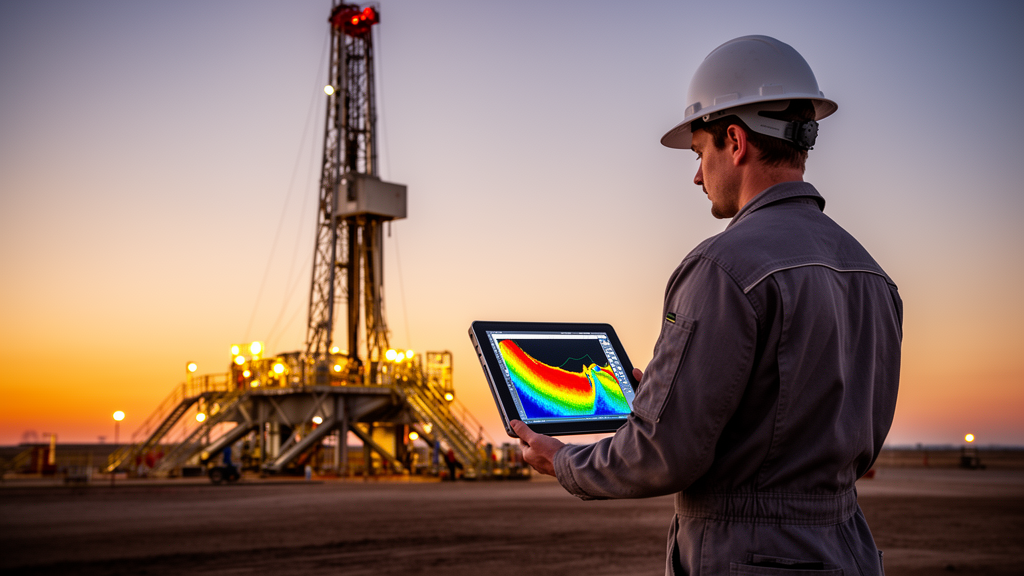
Drilling teams often learn what rock lies ahead only after the drill bit has already passed through it. Logging-while-drilling gamma-ray tools measure natural radioactivity near the bit, but the sensing geometry means formation information always arrives with a delay. A new study in Geomechanics and Geophysics for Geo-Energy and Geo-Resources evaluates whether a federated learning framework can sharpen fixed-step depth-ahead prediction of these gamma-ray logs, allowing several oilfields to train a shared model without pooling their raw well data.
Federated learning is a training strategy in which each participating site keeps its data locally and shares only model updates with a central coordinator. In this study, the sites were three oilfields with different feature sets, different data volumes, and different native measured-depth sampling intervals. The framework was tested on a fixed prediction task: using 300 historical samples from a well to predict the next 50 gamma-ray samples, with all preprocessing fitted only on the corresponding training well to avoid information leaking from the evaluation data.
The headline benchmark compared federated averaging, known as FedAvg, against isolated local training at each field. Under uniform client weighting, FedAvg reduced the mean absolute error from 7.13 to 4.44 gAPI in the Volve field, from 2.23 to 1.49 gAPI in the BH field, and from 5.76 to 2.79 gAPI in the XJ field. The method also substantially reduced dispersion across random seeds, meaning its performance was more stable from run to run. Notably, the paired mean differences did not reach the conventional threshold of p < 0.05, so the authors treat the error reductions with appropriate statistical caution.
The study went beyond a single favorable comparison. Four strictly causal baselines, designed to respect the sequential nature of depth-ahead prediction, were weaker than FedAvg on the evaluated holdouts. Additional diagnostics examined field-dependent effects of sample-size weighting and gap-aware windowing, which accounts for irregular sampling gaps in measured-depth data. A matched-volume source-composition test did not support attributing the observed gains to cross-field source diversity itself, an important nuance for interpreting why collaborative training helped.
One evaluation case illustrates the small-sample challenges inherent in this setting. The XJ 300/50 case contained only five highly overlapping test windows, covering just 54 unique target gamma-ray points. Such limited and overlapping evaluation data make it difficult to draw strong conclusions about generalization, and the authors flag this explicitly as a limitation alongside irregular sampling, severe client imbalance, and domain heterogeneity across the fields.
Latency characteristics differ sharply between the two operational phases of the framework. Local inference, the step that would matter during drilling, runs at millisecond scale, which is compatible with real-time interpretation workflows. Federated model updating, by contrast, is a separate process operating at minutes scale, and its communication tolerance depends on available bandwidth and the chosen model-refresh interval. This separation means the approach can support fast on-site predictions even while the shared model refreshes more slowly in the background.
The practical appeal of the data-local design is that no raw well data ever leaves its owning organization. The study’s Article Highlights state that data-local federated learning supports cross-oilfield fixed-step depth-ahead gamma-ray prediction without pooling raw well data, and that uniform-weighted FedAvg primarily reduces run-to-run variability relative to isolated local training.
The authors are careful about the scope of their claims. The evidence supports data-local collaborative training for fixed-step depth-ahead gamma-ray prediction, but the identified limitations from irregular sampling, severe client imbalance, domain heterogeneity, and small-sample evaluation remain important. The work is published as an open access article, shared early as a peer-reviewed, accepted version that carries a permanent DOI and is subject to further edits before the final Version of Record.
For formation evaluation and drilling decisions, the study offers a measured contribution: a way for geographically separated oilfields to collaborate on behind-bit prediction models without exchanging raw logs, with error reductions that are consistent in direction across three fields but not individually statistically significant, and with diagnostics that honestly map where the approach breaks down. As with any benchmark study, the value lies as much in the documented limitations as in the reported gains.
Subject of Research: Federated learning for depth-ahead prediction of logging-while-drilling gamma-ray logs across multiple oilfields
Article Title: Data-local federated learning for fixed-step depth-ahead prediction of LWD gamma-ray logs in heterogeneous oilfields
Article References: Liu, Y., Dong, B., Guo, C., Li, Y., Cao, J., Wang, B., & Dai, R. (2026). Data-local federated learning for fixed-step depth-ahead prediction of LWD gamma-ray logs in heterogeneous oilfields. Geomechanics and Geophysics for Geo-Energy and Geo-Resources. https://doi.org/10.1007/s40948-026-01264-x
Image Credits: AI Generated
DOI: 10.1007/s40948-026-01264-x
Keywords: federated learning, gamma-ray logs, logging while drilling, depth-ahead prediction, oilfields, FedAvg, formation evaluation, machine learning, well logging, data privacy, Data-local, federated
Cite Scienmag News
Veronica Carney. (October 28, 2026). Federated learning predicts gamma-ray logs ahead of the drill bit without sharing well data. Scienmag. https://scienmag.com/federated-learning-predicts-gamma-ray-logs-ahead-of-the-drill-bit-without-sharing-well-data/
Veronica Carney. "Federated learning predicts gamma-ray logs ahead of the drill bit without sharing well data." Scienmag, 28 October 2026, https://scienmag.com/federated-learning-predicts-gamma-ray-logs-ahead-of-the-drill-bit-without-sharing-well-data/. Accessed 29 October 2026.
Veronica Carney. "Federated learning predicts gamma-ray logs ahead of the drill bit without sharing well data." Scienmag. October 28, 2026. https://scienmag.com/federated-learning-predicts-gamma-ray-logs-ahead-of-the-drill-bit-without-sharing-well-data/