


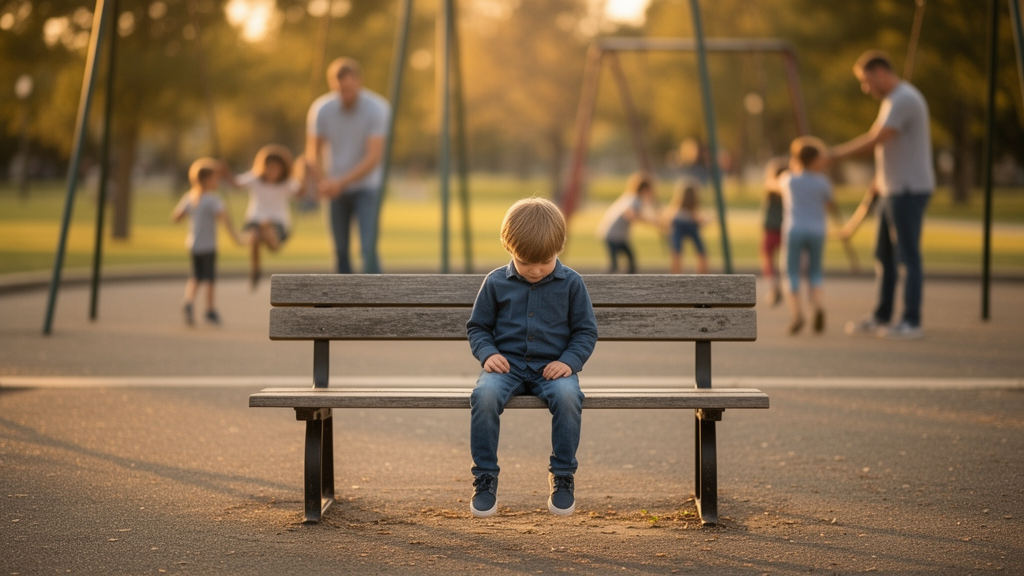
A survey of 3,199 junior middle school students has identified distinct patterns of paternal disengagement within families and linked them to measurable differences in children’s emotional well-being. The study, published open access in BMC Psychology, introduces the term “fathering insufficiency” to describe a situation that researchers argue is broader than simple father absence: a father may live in the same household yet still fail to provide adequate paternal functioning, while the physical absence of fathers often leads to a lack of paternal functioning, the two are not entirely equivalent.
The researchers used latent profile analysis, a statistical technique that sorts individuals into unobserved subgroups based on their response patterns, drawing on the short version of the Inventory of Father Involvement, the Inventory of Mother Involvement, and the Emotional Experience of Well-being Questionnaire. The analysis yielded four classes of children: those experiencing moderate parental functioning, those with high parental functioning, those with mild parenting insufficiency, and a fourth group labelled fathering-lack-high-mothering, in which paternal involvement was markedly low while maternal involvement remained high. Both the mild parenting insufficiency class and the fathering-lack-high-mothering class were characterized as experiencing fathering insufficiency, but with different configurations of parental input.
The prevalence of fathering insufficiency varied sharply across family structures. In dual-parent co-resident families, 21.4 percent of children fell into the fathering-insufficient categories. That figure rose to 29.9 percent in left-behind families, where children remain at home while one or both parents migrate for work, and reached 66.1 percent in divorced families. These proportions describe the present sample rather than a general population rate, but they quantify how often paternal functioning falls short even within intact households.
Children’s emotional well-being differed across the profile classes in a pattern the authors describe as noteworthy. Those in the fathering-lack-high-mothering class reported significantly lower emotional well-being than children in the moderate parental functioning class, yet significantly higher well-being than children in the mild parenting insufficiency class. The finding indicates that the two fathering-insufficient patterns carry distinct associations with children’s emotional experience, and that high maternal involvement does not simply offset low paternal involvement in a uniform way. The comparison between the fathering-lack-high-mothering and mild parenting insufficiency classes suggests that the configuration of parental functioning, not merely the degree of paternal shortfall, is associated with how children feel.
The study’s conclusions point toward practical applications rather than tested interventions. The authors suggest that parenting programs can offer family education on fathering insufficiency, that fathers should use fragmented time and digital tools to raise their engagement with children, and that couples need constructive conflict management and careful consideration before divorce. The study itself did not evaluate whether such programs change fathering behavior or children’s well-being; these are responses the authors propose in light of the survey data.
By showing that different insufficiency patterns align with different levels of children’s emotional well-being, the research adds to work on parental involvement in family structures under strain. The authors position the four-class latent profile model as a foundation for future studies examining how fathering insufficiency develops and how family education might address it.
Subject of Research: Fathering insufficiency and its association with children's emotional well-being
Article Title: Fathering insufficiency and its association with children’s emotional well-being: a latent profile analysis
Article References: Chen, S.-M., Lin, Q.-Y., Wang, L.-L., Zhang, J., & Sun, P.-Z. (2026). Types of fathering insufficiency and their association with children's emotional well being: a latent profile. BMC Psychology, 14(1), Article 1344. https://doi.org/10.1186/s40359-026-05460-y
Image Credits: AI Generated
DOI: 10.1186/s40359-026-05460-y
Keywords: fathering insufficiency, latent profile analysis, children's emotional well-being, parental involvement, family structures, father absence, left-behind children, divorced families, BMC Psychology, survey research, Fathering, insufficiency
Cite Scienmag News
Glenn Wilkins. (October 25, 2026). Fathering Insufficiency Linked to Lower Emotional Well-Being in Children. Scienmag. https://scienmag.com/fathering-insufficiency-linked-to-lower-emotional-well-being-in-children/
Glenn Wilkins. "Fathering Insufficiency Linked to Lower Emotional Well-Being in Children." Scienmag, 25 October 2026, https://scienmag.com/fathering-insufficiency-linked-to-lower-emotional-well-being-in-children/. Accessed 25 October 2026.
Glenn Wilkins. "Fathering Insufficiency Linked to Lower Emotional Well-Being in Children." Scienmag. October 25, 2026. https://scienmag.com/fathering-insufficiency-linked-to-lower-emotional-well-being-in-children/


