

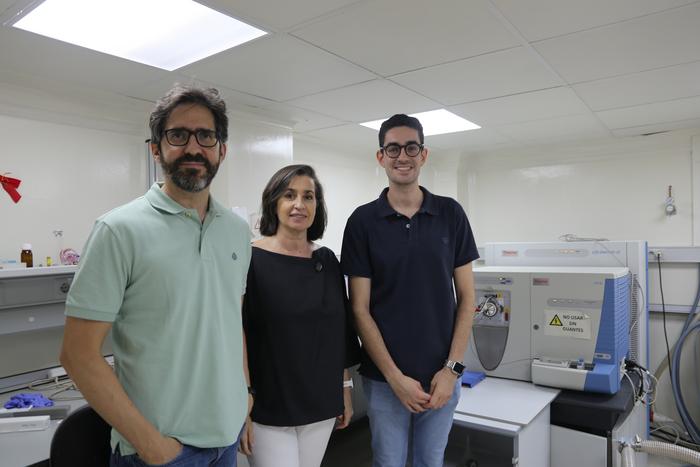
With just a few drops of saliva and in a few minutes the presence of THC can be detected thanks to a technique developed by the universities of Cordoba and Valencia, making it possible to accelerate the analysis process and to use very small samples

Credit: University of Cordoba
With just a few drops of saliva and in a few minutes the presence of THC can be detected thanks to a technique developed by the universities of Cordoba and Valencia, making it possible to accelerate the analysis process and to use very small samples
Cannabis is the most widely used illegal drug in Europe. It is estimated that around 8% of adults used cannabis in 2022. Widespread abuse of this substance has health consequences, and is viewed as an important social problem. A fundamental resource to control its use and avoid these health problems would be a quick, simple, non-invasive, and reliable form of analysis that uses a fluid that is easy to extract, such as saliva.
In order to expedite this type of analysis and make it effective in smaller saliva samples, the FQM-215 – Affordable and Sustainable Sample Preparation group at the University of Cordoba worked together with the GICAPC group at the University of Valencia to design a new analysis technique that simplifies processing of the sample and makes it possible to verify the presence of THC (Tetrahydrocannabinol) with only 0.25 mL of saliva.
To this end, a technique known as dispersive microextraction by sorption, with a miniaturized stirrer bar, is used, which “consists of the addition of a material capable of extracting the analytes in the sample (in this case, the tetrahydrocannabinol in the saliva), which has magnetic properties, in such a way that when a very small magnet (the stirrer bar) is placed into the device in which the saliva is located, a magnetic agitation occurs causing a vortex to form, dispersing those particles that interact with the analytes in the sample. When the agitation is stopped, the particles with the analytes are attracted to the magnet again,” explained UCO researcher Jaime Millán Santiago. In this way, the THC molecules in the saliva can be extracted very quickly. “We have reduced to 2 steps what would otherwise be 5,” said UCO professor Marisol Cárdenas.
After the sample preparation step comes the second one: “we transfer the miniaturized magnet, coated with the particles that have trapped the THC that was in the sample, and transfer it to a needle, to which we apply a high voltage and add an organic solvent capable of interrupting the interaction between the extractant material and the THC, generating an electrospray that is introduced into the mass spectrometer” the researcher explained. In just two steps, and with a very small sample of saliva, the concentration of cannabis in saliva can be determined in just a few minutes. This technology, as Professor Rafael Lucena explained, “could already be incorporated into the analysis methods of routine laboratories” and stands out for its sensitivity, sensibility, precision and accuracy.
Collaboration is strength
This technology is possible thanks to the combination of two innovations developed by the teams in Cordoba and Valencia. While the step of extracting and preparing the sample was designed by the University of Valencia, the method of analysis was devised by this team in the Department of Analytical Chemistry at the University of Cordoba. “We use stainless steel needles (an inexpensive and available material) and we take advantage of the non-metallic part of the needle (luer cavity) to couple the magnet with THC, retained on the extractant material, and, to immobilize it, we use another external magnet, thus allowing the flow of the solvent to pass and elute the analytes, which come out of the tip of the needle as a spray that enters the analytical instrument, where the concentration of THC is measured,” explained Jaime Millán, one of the creators of this method.
Reference
López-Juan AL, Millán-Santiago J, Benedé JL, Chisvert A, Lucena R, Cárdenas S. Coupling Miniaturized Stir Bar Sorptive Dispersive Microextraction to Needle-Based Electrospray Ionization Emitters for Mass Spectrometry: Determination of Tetrahydrocannabinol in Human Saliva as a Proof of Concept. Anal Chem. 2024 Jun 11;96(23):9629-9635. doi: 10.1021/acs.analchem.4c01297
Journal
Analytical Chemistry
Method of Research
Experimental study
Subject of Research
Not applicable
Article Title
Coupling Miniaturized Stir Bar Sorptive Dispersive Microextraction to Needle-Based Electrospray Ionization Emitters for Mass Spectrometry: Determination of Tetrahydrocannabinol in Human Saliva as a Proof of Concept
Article Publication Date
14-May-2024

