


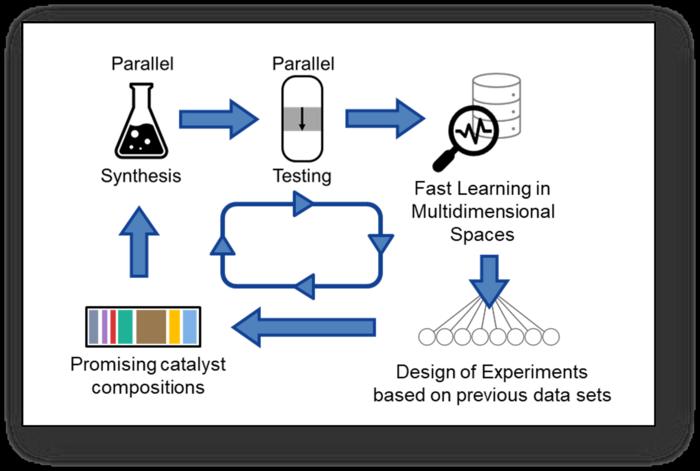
Addressing climate change demands rethinking of established chemical processes on a timescale of years rather than decades as in traditional R&D cycles. In collaboration with BasCat (UniCat BASF JointLab), a team of researchers from the Theory Department at the Fritz Haber Institute developed an accelerated discovery approach to identify a promising catalytic promoter formulation for the conversion of propane into the base chemical propylene. Discovered in a few weeks and with fewer than 100 experiments conducted, the novel promoted catalyst rivals those discovered through decades of research. The findings, published in ACS Catalysis, not only highlight the partnership’s success but also open avenues for a more efficient and informed development of multi-promoter formulations.

Credit: © Dr. Frederik Rüther – BasCat (UniCat BASF JointLab)
Addressing climate change demands rethinking of established chemical processes on a timescale of years rather than decades as in traditional R&D cycles. In collaboration with BasCat (UniCat BASF JointLab), a team of researchers from the Theory Department at the Fritz Haber Institute developed an accelerated discovery approach to identify a promising catalytic promoter formulation for the conversion of propane into the base chemical propylene. Discovered in a few weeks and with fewer than 100 experiments conducted, the novel promoted catalyst rivals those discovered through decades of research. The findings, published in ACS Catalysis, not only highlight the partnership’s success but also open avenues for a more efficient and informed development of multi-promoter formulations.
Catalysis plays a crucial role in the chemical industry, influencing multiple aspects of everyday life, such as plastic production, drug development, and manufacturing of fuels and fertilizers. Catalysts accelerate chemical reactions and improve their selectivity to desired products, while reducing energy consumption and waste. Although performance and longevity of catalysts can be further boosted by using promoters, their identification and optimization are oftentimes tedious, time-consuming, and costly.
Our Institute’s collaboration with BasCat focuses on fundamental research in the field of heterogeneous catalysis and especially on the catalytic transformation of hydrocarbons to value-added products.
The first results of this fruitful collaboration were recently published in ACS Catalysis. Here, the team´s research proposed an accelerated discovery approach which explores a multi-promoter design space with only a limited number of experiments, based on an efficient adaptive design-of-experiment (DoE) experiment planning and a throughput maximization through parallelized testing. The design space comprised on the order of 20000 possible promoter combinations for the non-oxidative propane dehydrogenation to propylene, using platinum on alumina as a catalyst. An exhaustive experimental testing would have required years of research. Instead, their discovery approach successfully identified a promising new promoter formulation by conducting less than 100 experiments in a few weeks.
Currently, propylene is a crucial feedstock chemical for polymer production and it is anticipated to see its demand reach 200 megatons by 2030. Existing cracking processes are unfortunately insufficient to meet this expected demand and more recent commercially applied processes still present limitations to reach high product yield. Consequently, discovering new combinations of high-performance multi-promoters and gaining a deeper understanding of the chemical mechanisms behind their promoting effects are seen as crucial elements.
The findings not only offer insights into more efficient and informed methodologies for creating multi-promoter formulations but also stand as a testament to the successful collaboration between our Institute’s Theory Department and BasCat.
Journal
ACS Catalysis
Article Title
Systematic Exploration of a Multi-Promoter Catalyst Composition Space with Limited Experiments: Non-Oxidative Propane Dehydrogenation to Propylene
Article Publication Date
29-May-2024
Cite Scienmag News
Bethany Barker. (May 30, 2024). Fast learning collaboration with BasCat leads to discovery of a new catalytic promoter on par with decades of study. Scienmag. https://scienmag.com/fast-learning-collaboration-with-bascat-leads-to-discovery-of-a-new-catalytic-promoter-on-par-with-decades-of-study/
Bethany Barker. "Fast learning collaboration with BasCat leads to discovery of a new catalytic promoter on par with decades of study." Scienmag, 30 May 2024, https://scienmag.com/fast-learning-collaboration-with-bascat-leads-to-discovery-of-a-new-catalytic-promoter-on-par-with-decades-of-study/. Accessed 13 September 2026.
Bethany Barker. "Fast learning collaboration with BasCat leads to discovery of a new catalytic promoter on par with decades of study." Scienmag. May 30, 2024. https://scienmag.com/fast-learning-collaboration-with-bascat-leads-to-discovery-of-a-new-catalytic-promoter-on-par-with-decades-of-study/

