


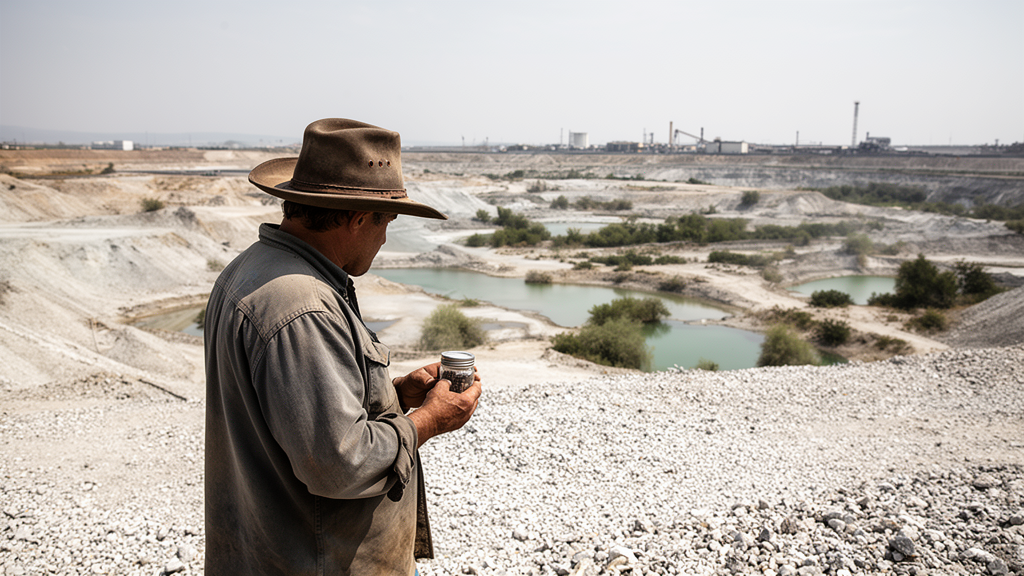
A cross-sectional survey of 202 indigenous-chicken households near a chromite mine tailings facility in Limpopo Province, South Africa, found that farmers’ descriptions of dust conditions and chicken-health problems did not follow a simple pattern based on distance from the facility. Households closest to the site reported more visibly affected birds, higher mortality by mean rank and more frequent use of traditional remedies, yet farmers furthest away gave the highest ratings for perceived dust accumulation, dust visibility and environmental contamination. The contrasting findings do not establish that tailings dust caused illness or that distance protected flocks, because the researchers measured neither airborne particulates nor veterinary diagnoses.
The study, conducted from May through August 2025 during the cool-dry season, divided participating households into three spatial groups around the tailings facility: 1–5 kilometres away, 6–10 kilometres away and more than 10 kilometres away. These groups contained 70, 77 and 55 households, respectively. The surveyed household groups were located approximately 1.96, 6.60 and 18.24 kilometres from the facility, respectively.
Local traditional leaders, agricultural extension officers and community livestock groups helped identify eligible households, and an adult who was responsible for or knowledgeable about poultry management completed a face-to-face, 17-item questionnaire. The chickens were generally managed in extensive scavenging or semi-scavenging systems, spending time outdoors during the day and sheltering at night. Questionnaire items covered household and flock characteristics, management practices, environmental conditions perceived by farmers, visible signs of illness, mortality and treatment.
Environmental indicators included dust accumulation, dust visibility and environmental contamination, while health indicators included coughing, nasal discharge, swollen eyes, reduced activity and the number of visibly affected birds. These were farmer observations, not diagnoses. The research team conducted no direct veterinary clinical examinations, laboratory diagnoses, necropsies or direct measurements of particulate concentrations and composition.
Wind speed and direction, meteorological conditions, source-specific dust dispersion, topography, vegetation cover and land use were also not quantified, so the distance categories served only as geographic groupings rather than validated measures of particulate exposure. Ocular and nasal discharge were recorded as a combined response, preventing separate evaluation of the two signs. The investigators also analysed the questionnaire variables using non-parametric comparisons because the measures were ordinal or did not satisfy assumptions of normality.
Kruskal–Wallis tests assessed differences among the three distance groups, followed by Wilcoxon rank-sum pairwise tests with Holm adjustment when the overall result was significant. A multivariable binary logistic regression then evaluated factors associated with whether a household reported chicken-health challenges; the findings represented associations rather than causal effects. Farmer-perceived environmental conditions differed strongly among the three groups.
Kruskal–Wallis tests produced p-values below 0.0001 for perceived dust accumulation, dust visibility and environmental contamination, and all pairwise comparisons remained significant after Holm adjustment. Mean ranks for each indicator were lowest in the 1–5-kilometre group, intermediate in the 6–10-kilometre group and highest in the group beyond 10 kilometres. Mean ranks for dust visibility were 51.5, 104 and 162, respectively, while those for perceived contamination were 53.8, 105 and 158.
The inverse ordering to proximity is important: farmers nearest the tailings facility did not report the worst perceived dust conditions. The study did not measure wind or dust transport, so the pattern cannot be attributed directly to emissions from the facility. Chicken-health outcomes followed yet another spatial arrangement.
Reports of health challenges differed among the groups overall, but the 6–10-kilometre group had a lower mean rank than both the nearest and most distant households; the 1–5-kilometre and beyond-10-kilometre groups did not differ significantly from one another after adjustment. By contrast, the number of visibly affected birds declined progressively with distance, with mean ranks of 140, 96.2 and 60.5 in the nearest, intermediate and most distant groups. All three pairwise comparisons were significant after Holm adjustment.
Mortality was ranked highest in the nearest group, with a mean rank of 140, compared with 86.7 and 73.9 in the other groups. The nearest group also ranked higher for traditional-remedy use, while reduced activity differed between the nearest and most distant groups. A multivariable binary logistic regression examined which questionnaire-derived variables were associated with a household reporting any chicken-health challenge.
Greater perceived dust visibility was associated with lower odds of reporting such a challenge, with an adjusted odds ratio of 0.08 and a 95% confidence interval of 0.03–0.19. Perceived environmental contamination was similarly associated with lower reported odds, with an adjusted odds ratio of 0.14 and a 95% confidence interval of 0.08–0.27. These negative associations do not mean dust protected the birds.
They show that the questionnaire-derived variables did not conform to a simple model in which increasingly poor perceived environmental conditions accompanied increasingly frequent health complaints. The number of visibly affected birds was positively associated with reporting a health challenge, with an adjusted odds ratio of 1.45 per unit and a 95% confidence interval of 1.15–1.82. This is consistent with households recognizing and reporting a problem when more birds displayed observable signs.
Traditional-remedy use had the largest estimate, an adjusted odds ratio of 20.8, but its confidence interval ranged from 1.20 to 360. That very wide interval signals substantial uncertainty. Because mortality and treatment use were measured concurrently with reported health challenges, the analysis could not determine which came first; these measures were treated as associated questionnaire-derived indicators and management responses rather than temporally antecedent causal predictors.
The findings should also be interpreted in light of differences among the sampled households. Household size and income did not differ significantly among distance groups, but flock size did. The nearest households had the highest mean rank for flock size, and the difference between the nearest and intermediate groups was significant after adjustment.
More broadly, the non-linear results are compatible with several potential influences, including infectious disease, nutrition, housing, husbandry, wind, vegetation and local dust sources. However, the study did not test those explanations, so treating any of them as a demonstrated cause would exceed the evidence. The findings therefore show distinct patterns in farmer observations rather than a demonstrated environmental-health gradient.
Farmers can be valuable observers in smallholder poultry systems where veterinary services, diagnostic facilities and structured disease surveillance may be limited. The questionnaire identified health concerns, mortality patterns and treatment responses that could guide later veterinary and environmental investigation. Yet the results are best treated as baseline observational evidence and hypothesis generation.
Respondents retrospectively reported respiratory illness and mortality during the preceding 12 months, creating potential for recall and reporting bias, while nasal and ocular discharge were recorded together and could not be evaluated separately. No conclusions about metal exposure or tailings-specific pathology were possible because elemental composition, bioavailability and metal concentrations in chickens were not assessed. The study also did not establish seasonal relationships because it was conducted during one cool-dry survey period.
Future work would need to connect farmer reporting with direct measurements and clinical evidence. The authors recommend repeated seasonal surveys, veterinary examinations, diagnostic testing, necropsy where appropriate, particulate monitoring and meteorological observations, alongside spatial analysis of exposure. Such an approach could distinguish environmental, infectious and management-related contributors and test whether dust from the tailings facility occurs along particular exposure pathways.
Until that work is done, the clearest conclusion is narrower than a causal link: among these surveyed households, proximity to the facility, perceived dust conditions and reported chicken-health problems were not aligned in a single distance-response gradient, and the cross-sectional associations cannot establish causation or seasonal trends.
Subject of Research: Farmer-reported poultry health and perceived dust exposure near a South African chromite mine tailings facility
Article Title: Farmer-reported chicken-health challenges and perceived dust exposure near a mine tailings facility
Article References: Machubeng, T. S., Mdletshe, Z. M., Manyelo, T. G., & Gunya, B. (2026). Farmer-reported chicken-health challenges and perceived dust exposure near a mine tailings facility. Frontiers in Veterinary Science, 13, Article 1956527. https://doi.org/10.3389/fvets.2026.1956527
Image Credits: AI Generated
DOI: 10.3389/fvets.2026.1956527
Keywords: poultry health, mine tailings, perceived dust exposure, indigenous chickens, smallholder farming, cross-sectional survey, farmer reporting, airborne particulates, Limpopo Province, veterinary epidemiology, Farmer-reported, chicken-health
Cite Scienmag News
William Thompson. (October 22, 2026). Farmer reports reveal no simple dust-health pattern near mine tailings. Scienmag. https://scienmag.com/farmer-reports-reveal-no-simple-dust-health-pattern-near-mine-tailings/
William Thompson. "Farmer reports reveal no simple dust-health pattern near mine tailings." Scienmag, 22 October 2026, https://scienmag.com/farmer-reports-reveal-no-simple-dust-health-pattern-near-mine-tailings/. Accessed 22 October 2026.
William Thompson. "Farmer reports reveal no simple dust-health pattern near mine tailings." Scienmag. October 22, 2026. https://scienmag.com/farmer-reports-reveal-no-simple-dust-health-pattern-near-mine-tailings/


