


Toronto, Ontario—A comparative analysis between FAPI and 18F-FDG PET/CT for the systemic staging of newly diagnosed breast cancer shows that FAPI PET/CT is more accurate in staging patients. Nearly 20 percent of patients were restaged by FAPI PET/CT, indicating the radiotracer’s efficacies and benefits for clinical practice. This research was presented at the 2024 Society of Nuclear Medicine and Molecular Imaging Annual Meeting.
18F-FDG PET/CT, while commonly used in breast cancer staging, has limitations, such as false positives in inflammatory breast lesions and reduced sensitivity in specific breast cancer subtypes. Previous small-sample retrospective studies suggest that 68Ga-FAPI might outperform 18F-FDG PET/CT with its high sensitivity in the detection of primary tumors and metastases among breast cancer patients.
“There is currently a lack of evidence on the efficacy of FAPI PET/CT, especially in large sample cohorts,” said Zhixin Hao, MD, a nuclear medicine physician at Peking Union Medical College Hospital in Beijing, China. “Our study sought to add to the literature by assessing FAPI PET/CT for the systemic staging of newly diagnosed breast cancer compared with 18F-FDG PET/CT.”
A total of 121 patients newly diagnosed with breast cancer were included in the study. All patients underwent 18F-FDG imaging. In addition, 53 patients were imaged with 68Ga-FAPI-04 PET/CT and 68 patients were imaged with A118F-FAPI-04 PET/CT. Data was analyzed and lesions were recorded as positive if their uptake exceeded that of the adjacent background tissue. The TNM clinical stage was determined from 18F-FDG and FAPI PET/CT, according to the American Joint Committee on Cancer Staging Manual.
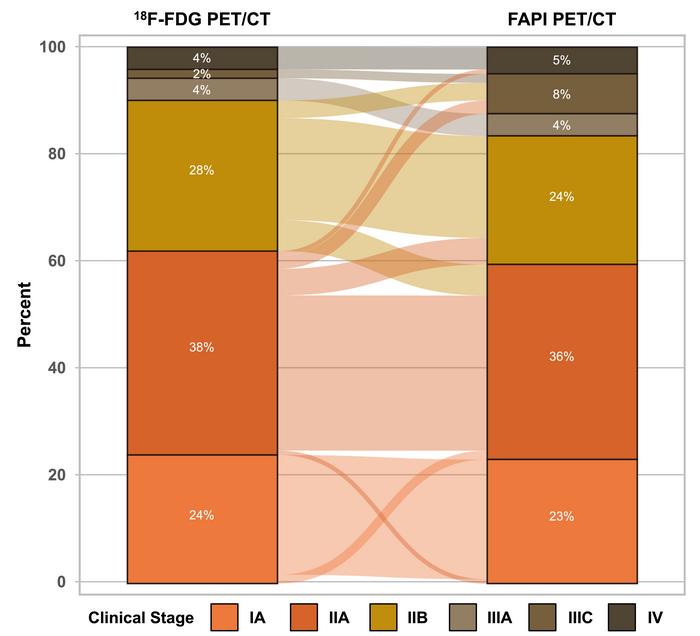
Compared to the clinical TNM stage determined by 18F-FDG PET/CT, FAPI re-staged 19.8 percent of patients. Management plans were optimized in six patients due to the additional detection of bone lesions and internal mammary lymph nodes.
Of note, FAPI PET/CT upstaged 21.7 percent of stage IIA patients by 18F-FDG PET/CT. According to Hao, patients with stage IIA BC should be considered for systemic staging with FAPI PET/CT at the time of initial diagnosis.
“This study is significant as it has the potential to advance personalized treatment strategies for breast cancer patients,” noted Hao. “FAPI PET/CT for the initial staging of breast cancer has the potential to reduce unnecessary treatments and improve patient outcomes.”
Abstract 242411. “FAPI Versus 18F-FDG PET/CT for Systemic Staging of Newly Diagnosed Breast Cancer,” Zhixin Hao, Bo Pan, Ru Yao, Yidong Zhou, Qiang Sun, Li Huo, Peking Union Medical College Hospital, Beijing, China.
###
All 2024 SNMMI Annual Meeting abstracts can be found online.
About the Society of Nuclear Medicine and Molecular Imaging
The Society of Nuclear Medicine and Molecular Imaging (SNMMI) is an international scientific and medical organization dedicated to advancing nuclear medicine and molecular imaging—vital elements of precision medicine that allow diagnosis and treatment to be tailored to individual patients in order to achieve the best possible outcomes.
SNMMI’s members set the standard for molecular imaging and nuclear medicine practice by creating guidelines, sharing information through journals and meetings and leading advocacy on key issues that affect molecular imaging and therapy research and practice. For more information, visit www.snmmi.org.

Credit: Image created by Hao Z et al., Peking Union Medical College Hospital, Chinese Academy of Medical Sciences and Peking Union Medical College, Beijing, China.
Toronto, Ontario—A comparative analysis between FAPI and 18F-FDG PET/CT for the systemic staging of newly diagnosed breast cancer shows that FAPI PET/CT is more accurate in staging patients. Nearly 20 percent of patients were restaged by FAPI PET/CT, indicating the radiotracer’s efficacies and benefits for clinical practice. This research was presented at the 2024 Society of Nuclear Medicine and Molecular Imaging Annual Meeting.
18F-FDG PET/CT, while commonly used in breast cancer staging, has limitations, such as false positives in inflammatory breast lesions and reduced sensitivity in specific breast cancer subtypes. Previous small-sample retrospective studies suggest that 68Ga-FAPI might outperform 18F-FDG PET/CT with its high sensitivity in the detection of primary tumors and metastases among breast cancer patients.
“There is currently a lack of evidence on the efficacy of FAPI PET/CT, especially in large sample cohorts,” said Zhixin Hao, MD, a nuclear medicine physician at Peking Union Medical College Hospital in Beijing, China. “Our study sought to add to the literature by assessing FAPI PET/CT for the systemic staging of newly diagnosed breast cancer compared with 18F-FDG PET/CT.”
A total of 121 patients newly diagnosed with breast cancer were included in the study. All patients underwent 18F-FDG imaging. In addition, 53 patients were imaged with 68Ga-FAPI-04 PET/CT and 68 patients were imaged with A118F-FAPI-04 PET/CT. Data was analyzed and lesions were recorded as positive if their uptake exceeded that of the adjacent background tissue. The TNM clinical stage was determined from 18F-FDG and FAPI PET/CT, according to the American Joint Committee on Cancer Staging Manual.
Compared to the clinical TNM stage determined by 18F-FDG PET/CT, FAPI re-staged 19.8 percent of patients. Management plans were optimized in six patients due to the additional detection of bone lesions and internal mammary lymph nodes.
Of note, FAPI PET/CT upstaged 21.7 percent of stage IIA patients by 18F-FDG PET/CT. According to Hao, patients with stage IIA BC should be considered for systemic staging with FAPI PET/CT at the time of initial diagnosis.
“This study is significant as it has the potential to advance personalized treatment strategies for breast cancer patients,” noted Hao. “FAPI PET/CT for the initial staging of breast cancer has the potential to reduce unnecessary treatments and improve patient outcomes.”
Abstract 242411. “FAPI Versus 18F-FDG PET/CT for Systemic Staging of Newly Diagnosed Breast Cancer,” Zhixin Hao, Bo Pan, Ru Yao, Yidong Zhou, Qiang Sun, Li Huo, Peking Union Medical College Hospital, Beijing, China.
###
All 2024 SNMMI Annual Meeting abstracts can be found online.
About the Society of Nuclear Medicine and Molecular Imaging
The Society of Nuclear Medicine and Molecular Imaging (SNMMI) is an international scientific and medical organization dedicated to advancing nuclear medicine and molecular imaging—vital elements of precision medicine that allow diagnosis and treatment to be tailored to individual patients in order to achieve the best possible outcomes.
SNMMI’s members set the standard for molecular imaging and nuclear medicine practice by creating guidelines, sharing information through journals and meetings and leading advocacy on key issues that affect molecular imaging and therapy research and practice. For more information, visit www.snmmi.org.
Journal
Journal of Nuclear Medicine
Article Title
FAPI Versus 18F-FDG PET/CT for Systemic Staging of Newly Diagnosed Breast Cancer
Article Publication Date
11-Jun-2024
Cite Scienmag News
Nathaniel Bowman. (June 11, 2024). FAPI PET/CT improves staging of newly diagnosed breast cancer. Scienmag. https://scienmag.com/fapi-pet-ct-improves-staging-of-newly-diagnosed-breast-cancer/
Nathaniel Bowman. "FAPI PET/CT improves staging of newly diagnosed breast cancer." Scienmag, 11 June 2024, https://scienmag.com/fapi-pet-ct-improves-staging-of-newly-diagnosed-breast-cancer/. Accessed 4 September 2026.
Nathaniel Bowman. "FAPI PET/CT improves staging of newly diagnosed breast cancer." Scienmag. June 11, 2024. https://scienmag.com/fapi-pet-ct-improves-staging-of-newly-diagnosed-breast-cancer/

