


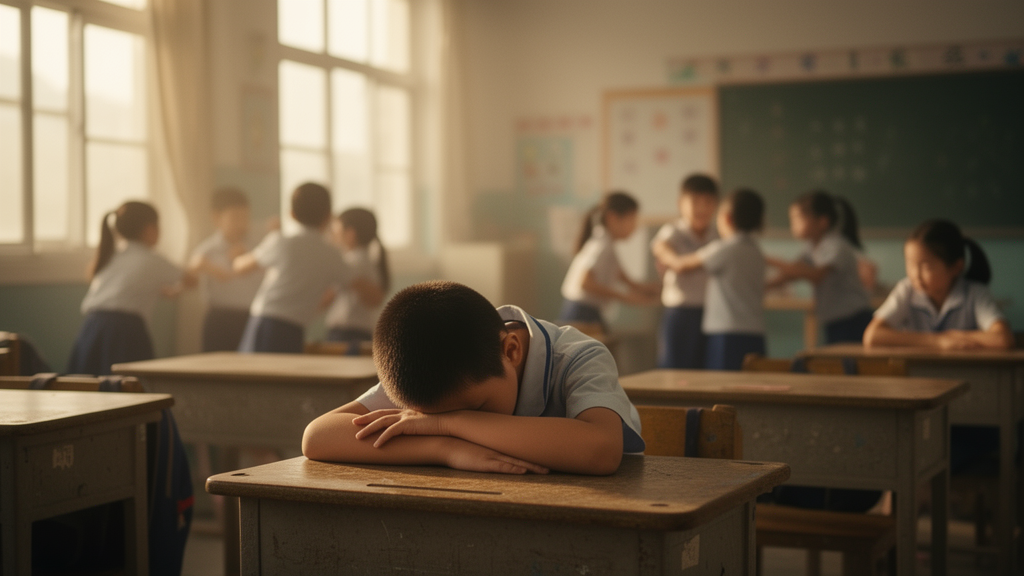
Children in primary school who grow up surrounded by multiple family adversities report markedly lower levels of flourishing, and much of that deficit appears to travel through the quality of their relationships at school, according to a new survey-based study of 1,673 fourth- and fifth-graders in Shaanxi province, Northwest China. The research, published in Frontiers in Psychology, found that the more family risk factors a child carried, the lower their flourishing score tended to be, and that peer relationships accounted for a larger share of this association than relationships with teachers.
Flourishing, in the framework of contemporary positive psychology, is not simply the absence of distress. It describes a high-level, balanced state that combines emotional well-being, developed psychological functions, and successful integration into social systems. For children aged ten to eleven, it reflects the capacity to sustain well-being while coping with environmental pressure, encompassing emotional balance, life satisfaction, and positive social functioning. The researchers measured it with the Chinese version of the eight-item Flourishing Scale, a 7-point self-report instrument that showed strong reliability in this sample, with a Cronbach’s alpha of 0.912 and confirmatory factor analysis supporting a unidimensional structure.
The study’s central predictor was cumulative family risk, an approach that departs from the older tradition of examining single adversities in isolation. Because risks in real families tend to co-occur, low socioeconomic status often travels with parental conflict, and conflict often cascades into negative parenting, the researchers built an additive index from six binary indicators: not living with both biological parents, both parents educated below high school, family financial hardship, low family intimacy, high parental rejection, and parental phubbing, the habit of parents absorbing themselves in smartphones during interactions with their children. Continuous measures were dichotomized at percentile thresholds, and the total score ranged from zero to six, with a sample mean of 1.672. Notably, parental phubbing was included to improve the ecological validity of the risk model for contemporary families, since it repeatedly interrupts parents’ responsive engagement with the child.
The results were unambiguous on the shape of the association. Cumulative family risk was negatively correlated with flourishing, with a zero-order correlation of −0.413, and in the covariate-adjusted model the standardized coefficient was −0.416. Crucially, when a quadratic term was added to test whether the decline accelerates at higher levels of risk, it was not significant, with a confidence interval that included zero. Within the observed range of zero to six risks, the decrement was approximately linear and additive: each additional risk factor was associated with a further step down in flourishing, and no threshold beyond which functioning collapsed disproportionately could be identified. For prevention, the authors argue, this means the count of co-occurring risks matters at every level, and deferring action until some presumed tipping point would leave accumulated harm unaddressed.
To understand how family adversity reaches children’s well-being, the study turned to the school microsystem and modeled two relational resources as parallel mediators: the teacher–student relationship and the peer relationship. This specification was deliberate. Prior longitudinal evidence in the same grade range suggests that peer acceptance and rejection predict later teacher–student relationships rather than the reverse, while meta-analytic work shows that teachers influence a child’s standing among classmates mainly through negative behavior, a weaker channel for the positive relationship quality measured here. A parallel model, in which both mediators are entered simultaneously, estimates each specific indirect effect net of the other and permits a formal contrast of their magnitudes, without assuming that either relationship comes first in time.
Both pathways proved significant. Higher cumulative family risk was associated with poorer teacher–student relationships (β = −0.332) and poorer peer relationships (β = −0.410), and both relational variables remained significant predictors of flourishing after mutual adjustment, with standardized coefficients of 0.211 for the teacher pathway and 0.380 for the peer pathway. The total indirect effect through the two school relationships was −0.226, accounting for 54.3 percent of the total association between family risk and flourishing. Decomposed, the peer pathway carried −0.156, or 37.5 percent of the total effect, while the teacher–student pathway carried −0.070, or 16.9 percent. A formal pairwise contrast confirmed the asymmetry: the peer channel carried roughly 2.22 times the indirect effect of the teacher channel. Expressed in unique explained variance, removing peer relationship from the model reduced explained variance in flourishing by 9.8 percentage points, versus 3.2 points for the teacher–student relationship.
The theoretical reading is that family dysfunction spills across system boundaries. According to the family stress model, financial difficulties and deteriorating parent–child interaction generate negative spillover effects that weaken children’s social and emotional capacities, producing detachment or conflict with teachers and hostility or withdrawal with peers. Parental rejection undermines core self-evaluation and buffers against external pressure; parental conflict reduces satisfaction of basic psychological needs; and phubbing deprives children of synchronous social support, lowering their security and motivation to form positive connections at school. By Grades 4 and 5, the peer group has become the consolidated context in which children spend most of their school day and from which they draw most daily social validation, which the authors consider consistent with the peer channel carrying the heavier load.
The authors are careful about what the design can and cannot establish. Because the data are cross-sectional, the mediation model is interpreted as a theory-driven decomposition of covariance, not a demonstrated causal chain; cross-sectional estimates of longitudinal mediation can be biased even when mediation is complete. The ordering of the two mediators is not identified by these data, and sensitivity analyses of both serial orderings yielded identical total indirect and direct effects. All data were children’s self-reports, checked with a Harman single-factor test in which the first unrotated factor explained 24.443 percent of variance, below the conventional 40 percent cutoff. The unweighted additive index cannot speak to the differential severity of specific risks, the sample came solely from Northwest China, and class identifiers were not retained, so multilevel standard errors could not be computed, a limitation that would affect precision rather than point estimates.
Notably, the two school relationships did not explain everything. The direct association between cumulative family risk and flourishing remained significant after both mediators were entered, leaving 45.7 percent of the total effect unaccounted for by the channels assessed, which points to additional routes such as emotion regulation, academic self-concept, and material resources. The authors also stress that the asymmetry should not be read as evidence that teacher–student relationships are dispensable. Their contribution persisted after peer relationships were controlled, and teachers occupy a distinctive structural position as often the first adults to detect that a child is carrying family adversity.
The practical implications follow directly from the numbers. Educators, the authors suggest, should focus on the cumulative count of family risks rather than any single factor when identifying vulnerable children, and where school resources are constrained, intervention should give precedence to restoring and consolidating peer relationships, through structured cooperative learning, peer-pairing arrangements, and systematic antibullying practices. Teacher–student relationship work should be retained rather than displaced, and because teachers most strongly shape a child’s classroom standing through negative behavior, a low-cost recommendation is to avoid public criticism or expressions of dislike toward an at-risk child, correcting behavior privately instead. Future work, the team proposes, should employ multi-wave longitudinal designs, multi-source assessment including teacher and parent reports, and broader samples to test whether these pathways hold across cultural and socioeconomic contexts.
Subject of Research: Cumulative family risk and flourishing in Chinese primary school children, mediated by teacher–student and peer relationships
Article Title: Impact of cumulative family risk on Chinese primary school children’s flourishing: parallel mediating roles of teacher–student and peer relationships
Article References: Bin, L., Chenghai, Y., & Yinbo, L. (2026). Impact of cumulative family risk on Chinese primary school children’s flourishing: parallel mediating roles of teacher–student and peer relationships. Frontiers in Psychology, 17, Article 1922081. https://doi.org/10.3389/fpsyg.2026.1922081
Image Credits: AI Generated
DOI: 10.3389/fpsyg.2026.1922081
Keywords: cumulative family risk, flourishing, primary school children, peer relationships, teacher–student relationship, positive psychology, mediation analysis, parental phubbing, family stress model, ecological systems theory, China, child well-being
Cite Scienmag News
Glenn Wilkins. (October 27, 2026). Family Risks Pile Up, Peer Bonds Carry the Heaviest Toll for Chinese Schoolchildren’s Well-Being. Scienmag. https://scienmag.com/family-risks-pile-up-peer-bonds-carry-the-heaviest-toll-for-chinese-schoolchildrens-well-being/
Glenn Wilkins. "Family Risks Pile Up, Peer Bonds Carry the Heaviest Toll for Chinese Schoolchildren’s Well-Being." Scienmag, 27 October 2026, https://scienmag.com/family-risks-pile-up-peer-bonds-carry-the-heaviest-toll-for-chinese-schoolchildrens-well-being/. Accessed 27 October 2026.
Glenn Wilkins. "Family Risks Pile Up, Peer Bonds Carry the Heaviest Toll for Chinese Schoolchildren’s Well-Being." Scienmag. October 27, 2026. https://scienmag.com/family-risks-pile-up-peer-bonds-carry-the-heaviest-toll-for-chinese-schoolchildrens-well-being/


