


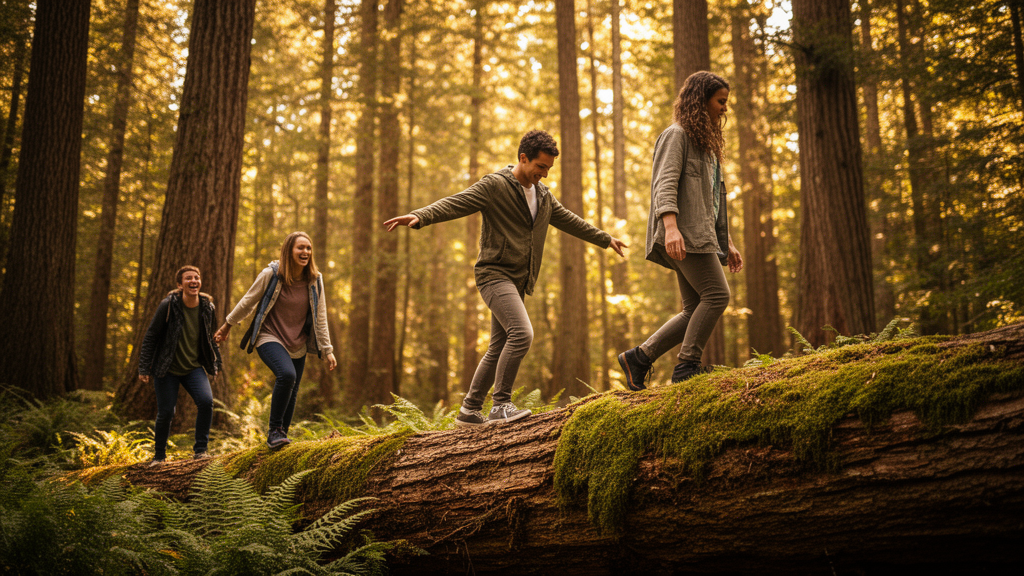
When a class of college students was told to simply go play in a patch of grass behind a residence hall, the first reaction was hesitation. Then one student tagged another, and chaos broke loose. Within minutes, fallen tree trunks had become balancing beams, a low-hanging vine was tested as a swing, and a barren tree was decorated with scavenged berries, twigs, and sweetgum balls. That moment of unstructured play, described by two undergraduate researchers at the College of William and Mary in a new Perspective article published in Frontiers in Conservation Science, is now at the center of an argument that adult play in nature could be a powerful tool for rebuilding the relationship between young people and the natural world.
The article, written by Julia Peavey and Alexandra Hill, both third-year students at William and Mary, focuses on what psychologists call emerging adults, people between the ages of 18 and 25. In Western societies, the authors argue, the lives of this age group are increasingly structured and digital, producing a growing dissociation from nature. College students today experience an urbanized, technological world that limits direct exposure to natural spaces while heightening awareness of ecological degradation. The result, they write, is a dual burden: a feeling of separation from global ecological systems and anxiety about the future.
That dissociation matters for health as well as for identity. Spending time in natural spaces has been extensively linked to improvements in mental and physical health, and even brief periods of exposure to campus green spaces have been shown to alleviate stress and promote well-being in college students. Students actively seek out green spaces to reduce stress and report wishing they had more time outdoors and in study spaces with natural elements. But the authors point to a technical distinction that shapes how much benefit students actually receive: conscious feelings of connection with nature enhance the well-being effects of green-space exposure. Nature relatedness, a measure of the strength of one’s personal connection to the natural world, significantly moderates affective, behavioral, and even electrophysiological markers of nature exposure. In other words, the top-down attribution of meaning and selfhood to nature shapes the bottom-up sensory responses of students in green spaces.
To explain why this matters, the authors draw on the deep ecology theory of philosopher Arne Naess, which moves away from a shallow, anthropocentric worldview toward a relational view in which humans are one with nature. Naess described the realization of the ecological self, a sense of identification with planetary ecosystems, as a process particularly relevant for emerging adults. Nisbet and colleagues, who developed the nature relatedness scale, describe ecological selfhood as our sense of identification with planetary ecosystems, and the authors argue it may be the basis of cultivating non-material, community-based sources of well-being. Identifying with ecological systems also contributes to pro-environmental behavior, meaning that personal health derived from time in nature is symbiotic with planetary health. To neglect the environment, the authors write, is to neglect ourselves.
The technical question is what kinds of experiences can build this identification. The authors note that environmental education alone does not significantly increase nature connectedness, but interventions involving contact with nature and mindfulness practices do. Deep ecology theorists posit that identification with nature necessitates an experiential component that natural sciences often exclude. Learning about ecological systems through Western pedagogical frameworks, which often impart the illusion of an isolated self rather than cultivating relational connectedness, is not enough. Passive exposure to green spaces is also insufficient. Emotional, embodied, in-nature experiences, the authors argue, are necessary for students to truly see themselves as nature.
Their proposed mechanism is play. Van Vleet and Feeney define play as an activity carried out for amusement and fun, approached with an enthusiastic and in-the-moment attitude, and highly interactive. Nature play refers to the embodied experience of unstructured play in natural settings, in which nature itself can act as a play partner. The evidence base for play in children is strong: outdoor play improves physical health, attention, self-control, and cognitive development, encourages symbolic play that promotes abstract thinking, and green spaces enhance these benefits by facilitating more creative and cooperative play. In college-aged adults, playfulness is linked to lower levels of perceived stress and heightened resilience. Yet studies of adult play, particularly in natural settings, remain limited.
The barriers to adult play are both social and structural. Unstructured play can be perceived as embarrassing and contrary to adults’ traditional social roles, reducing its commonality. Play designers largely overlook the needs and interests of adults, catering outdoor recreation spaces to children. Structured activities like sports leagues are often the most accessible and least stigmatized play options for adults, despite the superior health benefits derived from unstructured play. Even so, a survey by Rhea and colleagues found that adults prefer unstructured, outdoor play activities. Concerningly, outdoor unstructured play is also becoming less common for children with the rise of structured schedules and electronic time, meaning today’s college students often have stunted experiences of childhood play and must learn to reap the benefits of play as they transition into adulthood.
The theoretical grounding for why play in nature specifically builds identity comes from phenomenology. Skår and colleagues connect Merleau-Ponty’s The Phenomenology of Perception, which argues that humans make meaning through concrete sensory experiences with their surroundings, to nature play. They posit that nature play, as an embodied experience, is a powerful means to integrate oneself in nature and integrate nature into one’s self. Through tactile play experiences in natural settings, children can identify with local places and avoid dissociation from nature, and outdoor play develops a sense of environmental competency contributing to environmental identity development. Outdoor recreation may also increase pro-environmental behaviors and attitudes in adults, particularly when it involves reflection on relationships between humans and non-human nature. Identifying with natural spaces through play may therefore encourage care and a sense of responsibility for these spaces.
The authors’ argument is informed by their own experience in an ecotherapy course at William and Mary, in which class time included experientials, opportunities for nature immersion in which students abandoned the usual classroom to explore a different theme each week. During the nature play experiential, the class met in an unassuming grassy area behind a residence hall, next to a vegetable garden and opening onto a stretch of woods. A student facilitator emphasized that the assignment to express themselves through play was open-ended and judgment-free. After the instruction to go, the class hesitated and shuffled awkwardly until one student tagged a classmate. The games invented were easy to join and start conversations about, offering opportunities to connect with new people, and the elevated mood lasted for the rest of the day. Most significantly, the experience grounded future interactions with non-human nature in curiosity, appreciation, and attention to detail, forcing the adoption of a perspective of childlike wonder.
College campuses, the authors argue, are particularly formative spaces for shaping perspective, identity, and belonging in emerging adults, and belonging plays an essential role in fostering well-being in college students. They conclude with three practical recommendations aligned with Campus Nature Rx, a nationwide network of over 100 member institutions that promotes engagement with campus environments as a low-cost, high-return mode of improving student well-being. First, they propose time-based challenge activities modeled on Canada’s 30×30 Nature Challenge, in which adults spend 30 minutes outside per day during May, along with scavenger hunts, nature bingo, and group volunteer activities such as litter pick-ups and tree planting. Second, they call for curricula that incorporate nature exposure and nature play activities during and outside of class time, guided by existing Nature Rx and ecotherapy-based courses. Third, they recommend integrating nature play into existing park prescription models, adding loose play objects such as balls, frisbees, and stepping stones to green spaces, and labeling places as ideal for play on campus maps, thus recognizing the possibility of play for emerging adults and alleviating societal expectations that typically associate unstructured play with childhood. The authors acknowledge challenges, including the need for coordinated staff and volunteers, reliable access to green spaces on dense urban campuses, and considerations of safety, though they note that some risk of injury constitutes healthy risk-taking with developmental value. While the practice of nature play only begins to address the structural changes necessary to remedy the othering of nature in anthropocentric societies, they write, it offers meaningful experiences for individuals seeking to reintegrate themselves in nature. With a mindset of spontaneity, enjoyment, and gratitude, nature becomes an expansive playground that students may interact with, care for, and identify as.
Subject of Research: Conservation Science
Article Title: Fallen tree trunks became balancing beams: nature play as a means for emerging adults to identify with ecological systems
Article References: Fallen tree trunks became balancing beams: nature play as a means for emerging adults to identify with ecological systems. (n.d.). https://doi.org/10.3389/fcosc.2026.1907735
Image Credits: AI Generated
DOI: 10.3389/fcosc.2026.1907735
Keywords: nature play, emerging adults, college students, ecological self, Campus Nature Rx, biophilia, nature connectedness, student well-being, deep ecology, green spaces, environmental identity, pro-environmental behavior
Cite Scienmag News
Glenn Wilkins. (October 16, 2026). Fallen tree trunks became balancing beams: nature play as a means for emerging adults to identify with ecological systems. Scienmag. https://scienmag.com/fallen-tree-trunks-became-balancing-beams-nature-play-as-a-means-for-emerging-adults-to-identify-with-ecological-systems/
Glenn Wilkins. "Fallen tree trunks became balancing beams: nature play as a means for emerging adults to identify with ecological systems." Scienmag, 16 October 2026, https://scienmag.com/fallen-tree-trunks-became-balancing-beams-nature-play-as-a-means-for-emerging-adults-to-identify-with-ecological-systems/. Accessed 16 October 2026.
Glenn Wilkins. "Fallen tree trunks became balancing beams: nature play as a means for emerging adults to identify with ecological systems." Scienmag. October 16, 2026. https://scienmag.com/fallen-tree-trunks-became-balancing-beams-nature-play-as-a-means-for-emerging-adults-to-identify-with-ecological-systems/


