


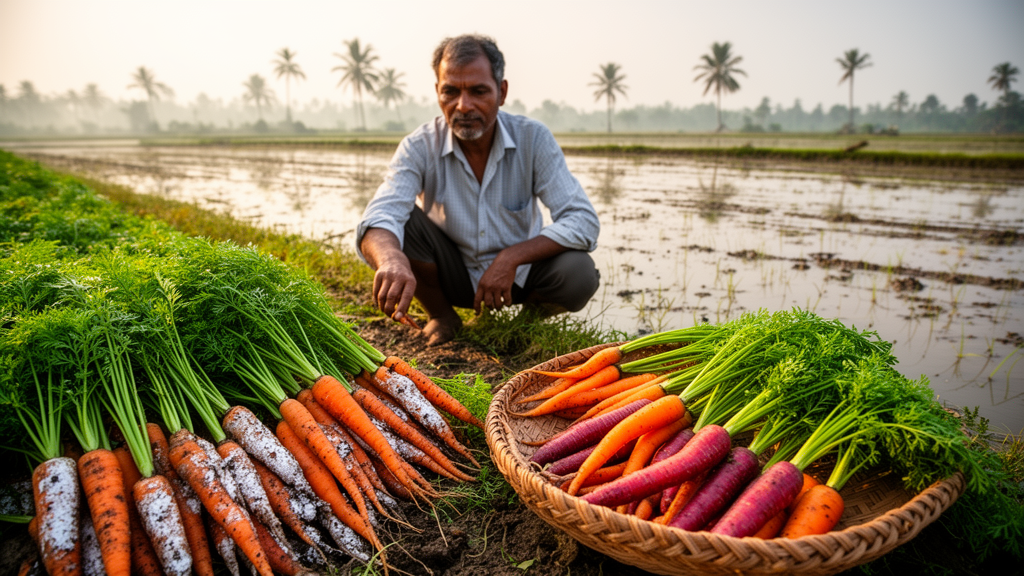
Carrots are not the first crop that comes to mind when thinking about climate resilience, but new research from Bangladesh suggests they may deserve a place in that conversation. A study conducted at Bangladesh Agricultural University has revealed striking differences in how four carrot varieties cope with salt stress, offering a potential lifeline for farmers in one of the world’s most salinity-vulnerable agricultural regions. The findings, published in Innovations in Agriculture, could reshape how carrots are grown across Bangladesh’s coastal and floodplain zones, where rising sea levels and poor irrigation practices have left vast tracts of land too salty for conventional cultivation.
The research team, led by scientists at the Department of Horticulture, set out to answer a deceptively simple question: which carrot varieties can survive and thrive when the soil becomes increasingly salty? To find out, they grew four varieties—Prima Agroflora, Brasilia Agroflora, Indian Acoo 75, and a local variety called Sidur—under six different salinity levels ranging from zero to 6 dS/m sodium chloride. The experiment ran from October 2022 to May 2023 on cemented plots lined with polythene sheets, a design that allowed the researchers to precisely control salt concentrations while simulating the conditions of the Old Brahmaputra Floodplain agro-ecological zone.
The results were dramatic. When salinity reached 6 dS/m, average root yield plummeted from 85.22 grams per plant under control conditions to just 55.79 grams per plant—a decline of roughly 35 percent. But the story was far more nuanced than a simple downward slope. The interaction between variety and salinity was statistically significant across every parameter measured, meaning that each carrot variety responded to salt stress in its own distinctive way. Some varieties barely flinched. Others collapsed.
Sidur, the local Bangladeshi variety, emerged as the clear champion for root production. Under control conditions, it produced the heaviest roots of any variety—119.33 grams per plant—with the longest roots at 13.10 centimeters and the widest at 2.67 centimeters. Remarkably, even at the highest salinity level, Sidur maintained a root weight of 93.09 grams per plant, a decline of only about 22 percent from its control performance. By contrast, Prima Agroflora suffered a devastating 67 percent yield reduction under the same conditions, dropping from 71.13 grams per plant to just 39.40 grams per plant. The difference between these two varieties represents one of the most striking examples of varietal salt tolerance documented in carrot research.
The physiological mechanisms behind Sidur’s resilience are revealing. As salinity increased, the dry matter content of Sidur’s roots rose from 5.85 percent under control conditions to 9.56 percent at 6 dS/m—a 125 percent increase. This pattern reflects a critical osmotic adjustment strategy, where plants accumulate solutes within their cells to maintain water uptake despite the salty external environment. Meanwhile, root water content declined from 94.15 percent to 90.44 percent, indicating that Sidur was actively concentrating its biomass rather than simply losing water. The researchers suggest this efficient dry matter accumulation, combined with minimal yield loss, points to effective sodium exclusion mechanisms that prevent toxic ion buildup within the plant’s tissues.
Indian Acoo 75, a germplasm line designated PI652410, told a different story. This variety excelled in vegetative traits, producing the tallest plants at 76.61 centimeters and the most leaves at nearly 11 per plant under control conditions. It also retained the highest leaf water content at 91.27 percent, suggesting superior water retention capabilities. However, its reproductive performance was vulnerable—seed production dropped to just 4.44 grams per plot at the highest salinity level, the lowest of any variety. This variety appears to prioritize survival of its foliage over reproduction when stressed, a strategy that works well for root harvest but poorly for seed multiplication.
Brasilia Agroflora carved out its own niche as the seed production specialist. Under control conditions, it produced the highest seed yield at 11.31 grams per plot, and crucially, it maintained the best germination rate of any variety at 6 dS/m—50 percent, compared to Prima Agroflora’s collapse to just 40.67 percent. This reproductive tolerance is particularly valuable for a crop like carrot, where seed production is a separate and often more delicate enterprise than root cultivation. The researchers suggest that Brasilia Agroflora’s ability to maintain seed viability under stress may involve stress-induced dormancy modulation, a mechanism that warrants further investigation.
The implications for Bangladesh’s agricultural future are significant. The country’s carrot cultivation has grown rapidly in recent years, with 2,625 hectares producing approximately 35,270 tons in the 2022–2023 season. Yet national average yields of around 35 tons per hectare remain well below the 50-plus tons per hectare achieved in leading producers like China and the United States. Soil salinity is a major culprit, particularly in coastal districts like Satkhira and Khulna, where sea level rise and intensified irrigation practices have rendered large areas fallow. The study’s findings offer a concrete path forward: farmers in moderately saline areas could deploy Sidur for root production and Brasilia Agroflora for seed multiplication, potentially unlocking productivity on land currently considered marginal.
The research also highlights the broader biology of salt stress in crops. Salinity imposes osmotic stress that makes it harder for plants to extract water from soil, disrupts ion homeostasis by allowing toxic sodium and chloride to accumulate, and impairs the uptake of essential nutrients like potassium. Plants respond through a suite of adaptive mechanisms, including the accumulation of compatible solutes like proline and glycine betaine, selective ion compartmentalization, activation of antioxidant enzymes, and changes in gene expression related to stress signaling pathways. Carrot is generally considered moderately sensitive to salinity, but the dramatic varietal differences observed in this study demonstrate that tolerance is not a fixed property of the species—it varies enormously depending on genetic background.
The researchers acknowledge important limitations. The experiment was conducted on cemented plots with controlled salt applications, which allowed precise treatment but may not fully replicate the fluctuating salinity, soil heterogeneity, and multiple interacting stresses of real field conditions. Tolerance was also assessed only up to 6 dS/m, leaving responses at higher salinity levels—relevant to severely affected coastal zones—unknown. Future research, the team suggests, should quantify sodium and potassium flux within tolerant varieties, explore the contributions of rhizosphere microbiomes, and validate economic thresholds across different agro-ecological zones. Field trials across diverse saline environments are recommended to establish comprehensive guidelines for variety selection. For now, the message is clear: in the battle against salt, not all carrots are created equal, and choosing the right variety could make the difference between a thriving crop and a failed harvest in Bangladesh’s increasingly saline floodplains.
Subject of Research: Agricultural Science
Article Title: Adaptive performance of carrot varieties to salinity stress: Growth, yield, and seed potential in Bangladesh’s floodplain ecosystem
Article References: Mia, S., Harun-Or-Rashid, M., Ahmed, M. R., & Rahim, M. A. (2025). Adaptive performance of carrot varieties to salinity stress: Growth, yield, and seed potential in Bangladesh’s floodplain ecosystem. Innovations in Agriculture, 8, 1-8. https://doi.org/10.3897/ia.2025.147493
Image Credits: AI Generated
Keywords: carrot, salinity stress, Bangladesh, crop tolerance, food security, agriculture, plant physiology, floodplain ecosystem, Adaptive, performance, varieties, salinity
Cite Scienmag News
Sloane Callahan. (October 16, 2026). Carrot Varieties Reveal Surprising Salt Tolerance in Bangladesh’s Salinity-Stressed Floodplains. Scienmag. https://scienmag.com/carrot-varieties-reveal-surprising-salt-tolerance-in-bangladeshs-salinity-stressed-floodplains/
Sloane Callahan. "Carrot Varieties Reveal Surprising Salt Tolerance in Bangladesh’s Salinity-Stressed Floodplains." Scienmag, 16 October 2026, https://scienmag.com/carrot-varieties-reveal-surprising-salt-tolerance-in-bangladeshs-salinity-stressed-floodplains/. Accessed 16 October 2026.
Sloane Callahan. "Carrot Varieties Reveal Surprising Salt Tolerance in Bangladesh’s Salinity-Stressed Floodplains." Scienmag. October 16, 2026. https://scienmag.com/carrot-varieties-reveal-surprising-salt-tolerance-in-bangladeshs-salinity-stressed-floodplains/


