

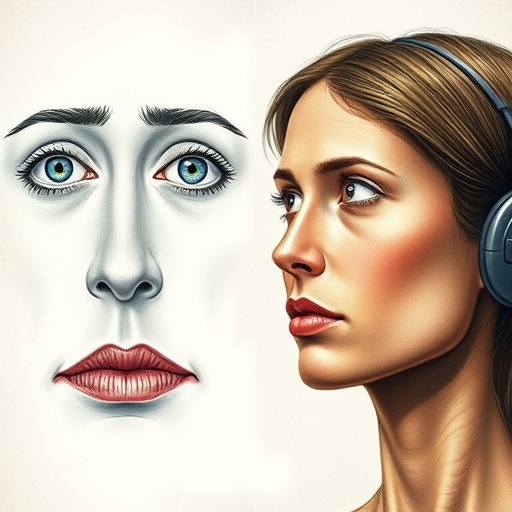
In a groundbreaking study set to publish in BMC Psychology in 2026, researchers Utanğaç and Lander embark on a comprehensive analysis of the complex interplay between facial emotion recognition, empathy, and psychopathic traits. Their work unveils nuanced differential effects of the various measures used to assess these psychological constructs, offering fresh insights into human social cognition and personality pathology. As one of the most intricate aspects of social functioning, understanding how these components interrelate promises to advance both theoretical frameworks and clinical interventions.
Facial emotion recognition, the ability to accurately interpret others’ emotional expressions, has long been deemed critical for successful social interactions. This capability allows individuals to respond appropriately to the emotional states of others, facilitating empathy, cooperation, and social bonding. The study highlights how variability in facial emotion recognition may not only influence empathetic capacities but also modulate the expression of psychopathic traits, which are characteristically marked by deficits in affective processing and social emotions.
Empathy itself is a multifaceted phenomenon encompassing affective resonance, cognitive perspective-taking, and prosocial motivation. The researchers delve into its intricate subcomponents, emphasizing that different empathy measures tap into distinct dimensions, each bearing unique relations to psychopathic features and emotion recognition abilities. By refining the assessment methods, the study sheds light on why previous findings on the subject have been inconsistent or contradictory.
Psychopathic traits, often associated with antisocial behaviors and emotional detachment, manifest through diverse affective and interpersonal deficits. This investigation importantly distinguishes between primary and secondary psychopathy and demonstrates how these variants relate differentially to emotion recognition and empathetic responses. The nuanced differentiation challenges the traditional monolithic view of psychopathy, reinforcing the need for precision in both research and diagnosis.
Central to this research is the methodological focus on the variety of instruments deployed to measure the psychological constructs. Utanğaç and Lander critically evaluate the sensitivity and specificity of facial emotion recognition tasks, self-report empathy scales, and psychopathy inventories. Their comparative analysis provides a roadmap for selecting appropriate measures, highlighting the impact of methodological choices on the interpretation of results.
Utilizing advanced psychometric techniques, the researchers dissect the psychometric properties of widely used tools, unveiling potential measurement biases. For example, some facial emotion recognition tests may conflate cognitive and affective components, while some empathy scales blend trait empathy with situational responses. Such insights underscore the imperative of methodological rigor in psychological science.
The investigation also leverages neurocognitive and behavioral data to augment self-report methods, addressing limitations inherent in subjective measures. By integrating multimodal data sources, the study advances a more holistic model of emotional and interpersonal functioning, illuminating mechanisms underlying observed behavioral patterns in psychopathy.
One particularly notable finding reveals that individuals with elevated psychopathic traits can perform competently on certain facial emotion recognition tasks yet show profound deficits in empathic concern. This dissociation underscores the complexity of emotional processing in psychopathy and suggests that recognizing emotion is not tantamount to experiencing empathy. Such dissociations may explain paradoxes observed in forensic and clinical populations.
Further, the work contemplates the developmental trajectory of these traits and abilities, suggesting that early disruptions in emotion recognition could impair the cultivation of empathy, subsequently reinforcing maladaptive psychopathic tendencies. This developmental perspective opens avenues for early identification and targeted intervention strategies aimed at mitigating antisocial behaviors.
The research also addresses the broader social and evolutionary significance of understanding these constructs. By elucidating how facial emotion recognition and empathy intersect with psychopathic traits, the study contributes to theories on social cohesion, cooperation, and moral behavior. It posits that differential emotion processing may have adaptive roots, shaped by ecological and interpersonal demands.
Importantly, the authors discuss the implications of their findings for clinical practice and forensic assessment. Improved measurement strategies can enhance diagnostic accuracy and inform personalized treatment approaches. For example, interventions could be tailored to specifically target deficits in cognitive empathy or emotional processing depending on individual profiles revealed through refined assessment methods.
Additionally, the study’s findings resonate beyond psychology, touching upon fields such as neuroscience, artificial intelligence, and social robotics. Understanding the subtleties of facial emotion recognition and empathetic processing informs the development of more socially attuned AI systems and robots capable of interacting sensitively with humans, while recognizing psychopathic-like deficits emphasizes the necessity of ethical vigilance.
Utanğaç and Lander’s work has the potential to catalyze paradigm shifts in how researchers conceptualize and measure social and affective traits. Their meticulous dissection of measurement tools stands to harmonize disparate findings across studies, providing clarity in a field often muddled by methodological ambiguities. Consequently, this research is poised to become a seminal reference in social and personality psychology.
Furthermore, their integrative approach, combining psychological theory, empirical rigor, and applied perspectives, paves the way for a new generation of studies examining the intricacies of human emotion in social contexts. By addressing foundational questions about how we perceive and respond to others’ emotions, this research taps into the very essence of human social life.
As the scientific community anticipates the full publication of this article, it is clear that the implications extend into educational, clinical, and technological domains. Enhancements in emotion recognition and empathy measurement promise to not only improve our scientific understanding but also enrich human interactions broadly, potentially transforming practices from mental health treatment to conflict resolution.
In sum, Utanğaç and Lander’s investigation represents a pioneering effort to dissect the intertwined relationships between facial emotion recognition, empathy, and psychopathy through the critical lens of measurement. The study’s depth and methodological sophistication mark a milestone that may ultimately redefine approaches to assessing and intervening in complex social and personality phenomena.
Subject of Research: The study investigates the relationship between facial emotion recognition, empathy, and psychopathic traits, with a specific focus on the differential effects of measurement methods on these constructs.
Article Title: Facial emotion recognition, empathy & psychopathic traits: understanding differential effects of measures.
Article References:
Utanğaç, M., Lander, K. Facial emotion recognition, empathy & psychopathic traits: understanding differential effects of measures. BMC Psychol (2026). https://doi.org/10.1186/s40359-026-04084-6
Image Credits: AI Generated


