


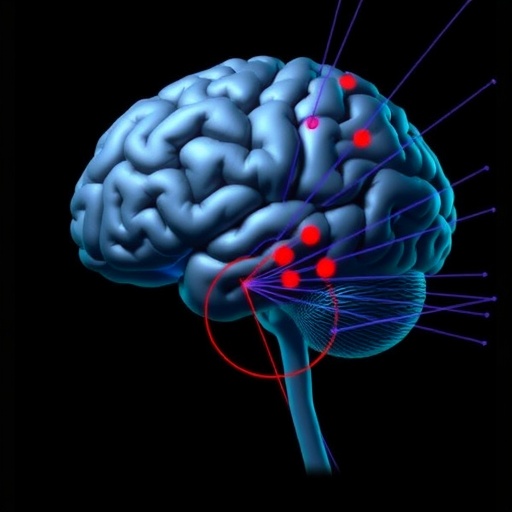
In the ever-evolving landscape of neuroscience, a groundbreaking study has emerged, shedding new light on how the brain processes feedback and adapts to cognitive tasks. Published recently by Debnath, R., Lenz, E., Tobelander, J., and their colleagues, this pioneering research explores the modulation of neural activity through transcranial alternating current stimulation (tACS) over the left dorsolateral prefrontal cortex (DLPFC), while simultaneously employing functional magnetic resonance imaging (fMRI) to track real-time brain activity. This dual-modality approach offers an unprecedented window into the dynamic communication of brain networks during feedback processing, a fundamental cognitive function underpinning learning and decision-making.
Transcranial alternating current stimulation (tACS) has gained prominence as a non-invasive neurostimulation technique capable of entraining brain oscillations by delivering weak electrical currents at specific frequencies. While past studies predominately relied on behavioral assessments or EEG recordings to infer tACS effects, this study’s integration with fMRI advances the precision of mapping how these oscillatory perturbations influence localized brain regions and interconnected networks. The left DLPFC, a key node in executive function and feedback integration, was the focal stimulation site, underscoring its critical role in adapting behavior based on evaluative information.
The feedback processing examined here refers to the cognitive mechanisms by which the brain interprets outcomes, evaluates the efficacy of actions, and updates future responses accordingly. These processes are vital for goal-directed behavior and are commonly disrupted in neuropsychiatric disorders such as depression, schizophrenia, and ADHD. By targeting the left DLPFC, the researchers aimed to modulate neurophysiological substrates that govern these evaluative functions, potentially paving the way for therapeutic interventions.
A distinctive feature of this study lies in its simultaneous application of tACS and fMRI—an approach fraught with technical challenges due to the electromagnetic interference typically generated by electrical stimulation hardware within the MRI environment. Overcoming these challenges required innovative engineering solutions and protocol optimization to ensure artifact-free neuroimaging data during stimulation. This methodological advancement not only strengthens the validity of their findings but also sets a new standard for future research integrating neuromodulation and brain imaging.
The experimental design involved applying tACS at frequencies targeting known neural oscillations linked to cognitive control, including theta (4-7 Hz) and alpha (8-12 Hz) bands, hypothesized to play distinct roles in feedback processing. Participants engaged in tasks requiring real-time adaptation and evaluation of stimuli, enabling direct assessment of how cortical excitability and network connectivity altered due to induced oscillatory entrainment. These dynamic changes were captured by fMRI, providing spatially resolved maps of hemodynamic responses within and beyond the stimulated DLPFC.
Data revealed that tACS over the left DLPFC significantly modulated activity in brain regions implicated in feedback monitoring and cognitive control, including the anterior cingulate cortex and the striatum. Beyond local effects, the stimulation enhanced functional connectivity within frontostriatal circuits, which are essential for integrating reward signals and guiding decision-making. Notably, the frequency-specific stimulation produced differential modulation patterns, suggesting that targeted oscillatory entrainment can selectively influence neural circuits underpinning distinct components of feedback processing.
These findings hold profound implications for understanding the physiological bases of adaptive behavior. By delineating how rhythmic brain stimulation can influence cortical and subcortical networks simultaneously, the study opens new avenues for refining neuromodulation protocols aimed at restoring dysfunctional cognitive processes in clinical populations. For example, disorders characterized by impaired feedback evaluation, such as obsessive-compulsive disorder or addiction, may benefit from tailored tACS paradigms designed to recalibrate disrupted oscillatory dynamics and network connectivity.
Beyond clinical applications, the insights gained here advance basic neuroscience by illustrating the causal role of specific oscillatory activities in shaping cognitive computations. Traditional correlational methods often struggle to dissociate whether neural rhythms are epiphenomenal or functionally relevant; however, the power of tACS lies in its ability to actively perturb these rhythms and observe consequential changes in behavior and brain function. This approach enhances our mechanistic understanding of neural oscillations as integral components in coordinating distributed brain processing.
Moreover, the simultaneous tACS-fMRI technique pioneered by this research affords a versatile platform for investigating other cognitive domains where oscillatory mechanisms are suspected to play critical roles. Memory consolidation, attention, and social cognition are among the processes that could benefit from such integrative neurostimulation paradigms. Future studies might extend this methodology to multi-site stimulation or closed-loop systems, further refining the temporal and spatial specificity of brain modulation.
The sophisticated data analysis combined conventional fMRI metrics with network-level computational modeling to unravel how oscillatory entrainment propagated through neural circuits. The complex interplay between excitation and inhibition, phase synchrony, and amplitude modulation collectively shaped the observed alterations in feedback-related BOLD signals. This multi-faceted approach underscores the non-linear dynamics of brain networks and highlights the necessity of interdisciplinary techniques integrating neurophysiology, engineering, and computational neuroscience.
In summary, the work of Debnath and colleagues represents a paradigm shift in neurostimulation research, successfully demonstrating that targeted tACS over the left DLPFC can modulate the intricate neural substrates of feedback processing. By marrying electrical brain stimulation with cutting-edge neuroimaging, this study transcends prior limitations and offers a blueprint for harnessing rhythmic brain activity to enhance cognition and potentially remediate neuropsychiatric dysfunction.
As this innovative research disseminates through the scientific community, it is poised to ignite broader interest in exploring brain oscillations as therapeutic targets and prognostic biomarkers. The marriage of tACS and fMRI is not merely a technological milestone but a conceptual leap forward that underscores the brain’s rhythmic nature as fundamental to its function and plasticity. Clinicians, neuroscientists, and engineers alike will look to build upon these findings, exploring new frontiers in brain health and human performance optimization.
The capacity to non-invasively sculpt brain network dynamics with exquisite temporal precision heralds a new era in personalized medicine. We are moving closer to a future where maladaptive brain states can be recalibrated through precisely tuned electrical rhythms, tailoring interventions to individual neural profiles. The research by Debnath et al. catalyzes this exciting transformation, inspiring optimism and innovation toward understanding and enhancing the human mind.
Cite Scienmag News
Cassandra Pierce. (March 18, 2026). tACS over Left DLPFC Alters Feedback Processing. Scienmag. https://scienmag.com/tacs-over-left-dlpfc-alters-feedback-processing/
Cassandra Pierce. "tACS over Left DLPFC Alters Feedback Processing." Scienmag, 18 March 2026, https://scienmag.com/tacs-over-left-dlpfc-alters-feedback-processing/. Accessed 4 September 2026.
Cassandra Pierce. "tACS over Left DLPFC Alters Feedback Processing." Scienmag. March 18, 2026. https://scienmag.com/tacs-over-left-dlpfc-alters-feedback-processing/


