


Researchers evaluating wideband receiver components for the planned Next Generation Very Large Array have completed a controlled experimental comparison demonstrating that fabrication methods directly dictate millimeter-wave radiation performance in corrugated feed horns while leaving impedance matching largely resilient. Investigating three feed horns produced from a single electromagnetic design, the study revealed that conventional computer numerical control machining in aluminum and tellurium copper achieved the closest agreement with theoretical predictions, whereas metal additive manufacturing produced measurable geometric deviations that primarily elevated cross-polarization levels. Despite those manufacturing-induced imperfections, all three prototype horns met the rigorous threshold requirements established for the telescope front-end subsystems, maintaining return loss better than twenty-three decibels and cross-polarization suppression below minus twenty decibels across the entire thirty to fifty gigahertz operational band. The investigation directly links coordinate measuring machine data to high-frequency electromagnetic radiation patterns, providing concrete engineering criteria for selecting production techniques across next-generation radio astronomy infrastructure.
The Next Generation Very Large Array represents an ambitious radio interferometer conceived to operate across centimeter and millimeter wavelengths, targeting unprecedented sensitivity and angular resolution to advance astronomical observation. To realize these scientific objectives, the observatory imposes demanding performance benchmarks on its front-end receiver optics and feed subsystems, mandating highly stable radiation patterns, consistent phase-center positioning, minimal insertion loss, and elevated aperture efficiency across broad operating bandwidths. In response to these technical constraints, the Radio Instrumentation Team at the National Research Council Canada Herzberg Astronomy and Astrophysics Research Centre has been developing a dual-linear polarization, single-feed cryogenic Q-band receiver prototype configured for Band-5 coverage between 30.5 and 50.5 gigahertz. This development initiative provided the operational platform and testing framework needed to assess candidate feed designs under realistic operating conditions, establishing whether alternative manufacturing routes can satisfy the exacting mechanical and radio frequency criteria demanded by modern astronomical instrumentation.
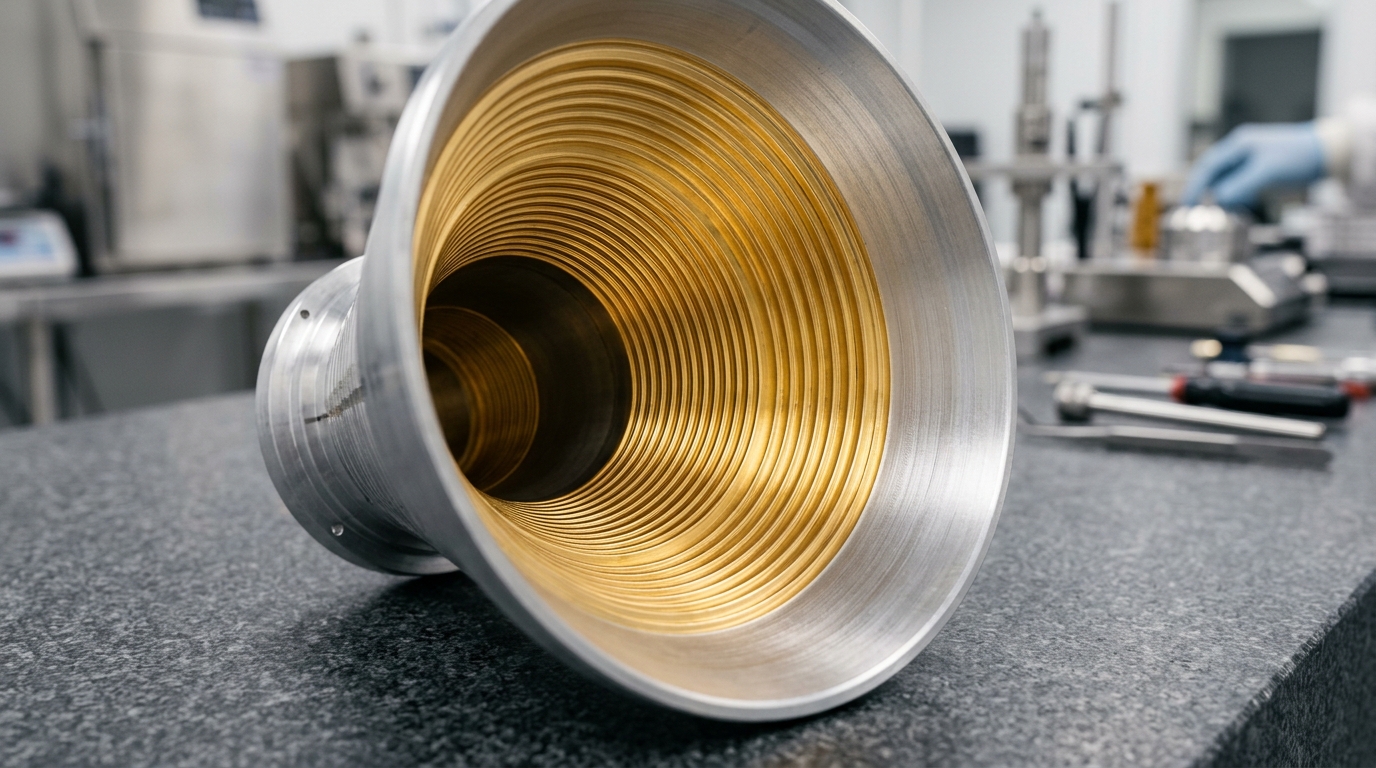
Corrugated feed horns serve as standard optical components throughout radio astronomy because their corrugations establish hybrid mode conditions that yield symmetric radiation patterns, low cross-polarization levels, and exceptionally high aperture efficiency. Axially corrugated architectures are particularly attractive for the Next Generation Very Large Array because of their broad bandwidth capability and direct optical compatibility with shaped dual-offset Gregorian reflectors. The specific Band-5 horn architecture examined in this experimental investigation incorporates a circular waveguide input diameter of 6.7 millimeters, a flared throat section, a logarithmic spiral aperture profile, and a tapered internal groove geometry. This configuration was numerically optimized using full two-dimensional field integration techniques to maximize overall aperture efficiency while simultaneously balancing phase distribution, amplitude taper, and cross-polarization characteristics. In theoretical modeling, this unified electromagnetic design achieved a return loss superior to twenty-three decibels, an average aperture efficiency exceeding 95.5 percent, and cross-polarization levels below minus twenty decibels across the full thirty to fifty gigahertz spectrum.
To rigorously isolate the consequences of manufacturing processes from electromagnetic geometry, the research team fabricated three feed horn prototypes utilizing identical nominal interior dimensions across three distinct material and processing combinations. The first feed horn was manufactured from tellurium copper, designated Cu14500, employing conventional precision computer numerical control machining. The second feed horn was machined from Al6063-T6 aluminum alloy using the exact same two-step mechanical sequence of turning followed by milling, ensuring that differences between the metal components reflected material-dependent attributes such as mass, raw material cost, and thermal properties rather than machining discrepancies. The third prototype was fabricated from tellurium copper through a collaborative effort with the Multi-Scale Additive Manufacturing Laboratory at the University of Waterloo, employing laser powder bed fusion technology on an EOS M290 system. This additive approach utilized a scanning laser to selectively melt fine metal powder layer by layer, enabling the formation of complex geometries that present substantial challenges for traditional mechanical cutting tools.
Because additive manufacturing inherently generates rougher external and internal surfaces than subtractive tooling, the investigators evaluated multiple post-processing surface-finishing techniques to prepare the printed tellurium copper horn for radio frequency testing. The experimental finishing trials encompassed abrasive sandblasting, chemical electropolishing, and polishing utilizing printed conformal electrodes, with each post-processing technique initially appraised through qualitative visual inspections and dimensional verifications conducted with mechanical calipers and coordinate measuring instrumentation. Following these preliminary assessments, electropolishing was determined to provide the superior overall compromise between dimensional fidelity and surface quality, leading to its formal selection for finishing the additively manufactured component characterized in the experimental radio frequency campaigns. Even after completing the electropolishing procedure, the printed prototype retained an average surface roughness measuring approximately twenty to twenty-five micrometers. While tolerable over compact feed dimensions, the authors noted that this degree of surface roughness could potentially degrade millimeter-wave performance if present across extended waveguide transmission paths.
To establish an empirical baseline for mechanical accuracy, the researchers conducted detailed dimensional characterizations of representative geometrical features across all three prototypes using a high-precision Coordinate Measuring Machine. The coordinate measurements scrutinized critical physical parameters, including input bore diameters along orthogonal X and Y orientations, axial groove locations, individual groove depths, and outer component diameters. The computer numerical control machined aluminum horn demonstrated the highest manufacturing precision, maintaining groove and step axial placements within approximately two micrometers of nominal positions and restricting outer diameter deviations below eight micrometers. The machined tellurium copper feed horn similarly exhibited rigorous dimensional control, restricting groove-position errors generally within ten micrometers. Conversely, the additively manufactured copper horn displayed substantially larger geometric inaccuracies, including an undersized input bore measuring 6.494 millimeters against the nominal 6.700-millimeter specification, axial groove-position errors exceeding 0.3 millimeters, and degraded groove surface flatness that exceeded conventional millimeter-wave tolerance thresholds of sixty to one hundred twenty micrometers.
Radio frequency validation was conducted across specialized experimental facilities to verify impedance matching and radiation characteristics under controlled laboratory conditions. The return loss of each prototype was characterized at the Herzberg Astronomy and Astrophysics millimeter-wave laboratory situated in Victoria, British Columbia, while radiation pattern measurements were executed within the compact antenna test range anechoic chamber at the Communications Research Centre in Ottawa, Ontario. To maintain consistent excitation across all testing procedures, the engineers utilized a custom-designed waveguide transition connecting standard WR-22 rectangular waveguide to circular waveguide. Experimental return loss measurements revealed that all three feed horns maintained reflection coefficients better than approximately twenty-three decibels throughout the thirty to fifty gigahertz frequency spectrum, fully satisfying the baseline design impedance requirement. Minor discrepancies between measured curves and numerical simulations were attributed to manufacturing and assembly tolerances, mechanical flange alignment, residual surface roughness, and baseline measurement uncertainty, proving that impedance matching remained remarkably tolerant of localized manufacturing imperfections.
Far-field radiation patterns were gathered across the entire thirty to fifty gigahertz operational bandwidth at discrete one-gigahertz intervals across the fundamental E-, H-, and D-planes, with comprehensive comparative evaluations focusing on thirty, forty, and fifty gigahertz. To quantify beam behavior, the investigators extracted the co-polarization edge taper at the designated nominal telescope illumination angle of fifty-five degrees from both simulated predictions and physical measurements. The computer numerical control machined copper and aluminum horns tracked full-wave electromagnetic simulations with remarkable fidelity, with measured edge taper values remaining within approximately 1.0 to 1.5 decibels of predicted figures across the majority of interrogation planes. The additively manufactured tellurium copper feed horn exhibited somewhat wider deviations from simulation, most notably at the higher frequencies of forty and fifty gigahertz. Nevertheless, despite these localized numerical offsets, all three prototypes maintained the expected overall beam symmetry, stable pattern shape, and requisite edge taper needed to illuminate shaped dual-offset Gregorian optics effectively.
The experimental radiation measurements revealed that cross-polarization behavior was the performance metric most acutely susceptible to fabrication method and geometric imperfections. While all three prototype feed horns successfully adhered to the project specification of maintaining cross-polarization levels below minus twenty decibels across the operational spectrum, their relative margins differed significantly. The additively manufactured horn exhibited cross-polarization levels typically two to six decibels higher than theoretical simulations, with the greatest performance degradation occurring near the lower thirty-gigahertz operational boundary. This degradation directly corroborated the coordinate measuring machine findings, demonstrating that physical anomalies like the constricted input bore and millimeter-scale groove-position offsets disturbed the delicate synthesis of the balanced hybrid HE11 mode and introduced structural asymmetry into the horn cavity. In contrast, the machined aluminum and copper horns preserved dimensional tolerances within tens of micrometers, maintaining pure mode excitation and preventing unwanted mode conversions from eroding cross-polarization suppression margins.
Evaluating the holistic trade-offs across electromagnetic performance, material weight, and production expense, the authors identified the computer numerical control machined aluminum horn as delivering the optimal operational compromise for the Band-5 receiver subsystem. At the same time, the research validated metal additive manufacturing as a viable and practical methodology for rapid prototyping and structurally complex microwave components, confirming that modern laser powder bed fusion can achieve compliance with rigorous radio astronomy specifications despite elevated cross-polarization. A central finding of the investigation is that fabrication accuracy exerts a far more decisive influence over radiation beam purity than over input impedance matching at millimeter-wave frequencies. Looking ahead toward potential industrial scaling, the researchers emphasized that future evaluations must investigate manufacturing throughput, component-to-component reproducibility, long-term dimensional stability, and production economics to determine the feasibility of deploying additively manufactured feeds within large-scale astronomical observatories such as the Next Generation Very Large Array.
Subject of Research: Fabrication methods and millimeter-wave performance of corrugated feed horns for radio astronomy
Article Title: Experimental comparison of fabrication-driven performance in corrugated feed horns for the ngVLA
Article References: Salem Hesari, S., Lemay, E., Nuspel, G., & Densmore, A. (2026). Experimental comparison of fabrication-driven performance in corrugated feed horns for the ngVLA. Experimental Astronomy, 62(3), Article 26. https://doi.org/10.1007/s10686-026-10083-7
Image Credits: AI Generated
DOI: 10.1007/s10686-026-10083-7
Keywords: radio astronomy, ngVLA, corrugated feed horn, additive manufacturing, CNC machining, millimeter-wave optics, antenna measurements, coordinate measuring machine, Experimental, comparison, fabrication-driven, performance
Cite Scienmag News
Grant Pearson. (November 6, 2026). Fabrication Methods Compared for Next Generation Very Large Array Feed Horns. Scienmag. https://scienmag.com/fabrication-methods-compared-for-next-generation-very-large-array-feed-horns/
Grant Pearson. "Fabrication Methods Compared for Next Generation Very Large Array Feed Horns." Scienmag, 6 November 2026, https://scienmag.com/fabrication-methods-compared-for-next-generation-very-large-array-feed-horns/. Accessed 8 November 2026.
Grant Pearson. "Fabrication Methods Compared for Next Generation Very Large Array Feed Horns." Scienmag. November 6, 2026. https://scienmag.com/fabrication-methods-compared-for-next-generation-very-large-array-feed-horns/




