Friday, October 30, 2026
Science
No Result
View All Result
  • Login
  • HOME
  • SCIENCE NEWS
  • CONTACT US
  • HOME
  • SCIENCE NEWS
  • CONTACT US
No Result
View All Result
Scienmag
No Result
View All Result
Home Science News Mathematics

Extra Food Could Let Predators and Prey Coexist in Cubic Herds

October 29, 2026
in Mathematics
Reid Dalton
By Reid Dalton Scienmag Editorial Profile - Applied Mathematics
Reading Time: 2 mins read
0
Extra Food Could Let Predators and Prey Coexist in Cubic Herds

Extra Food Could Let Predators and Prey Coexist in Cubic Herds

65
SHARES
587
VIEWS
Share on FacebookShare on Twitter
ADVERTISEMENT

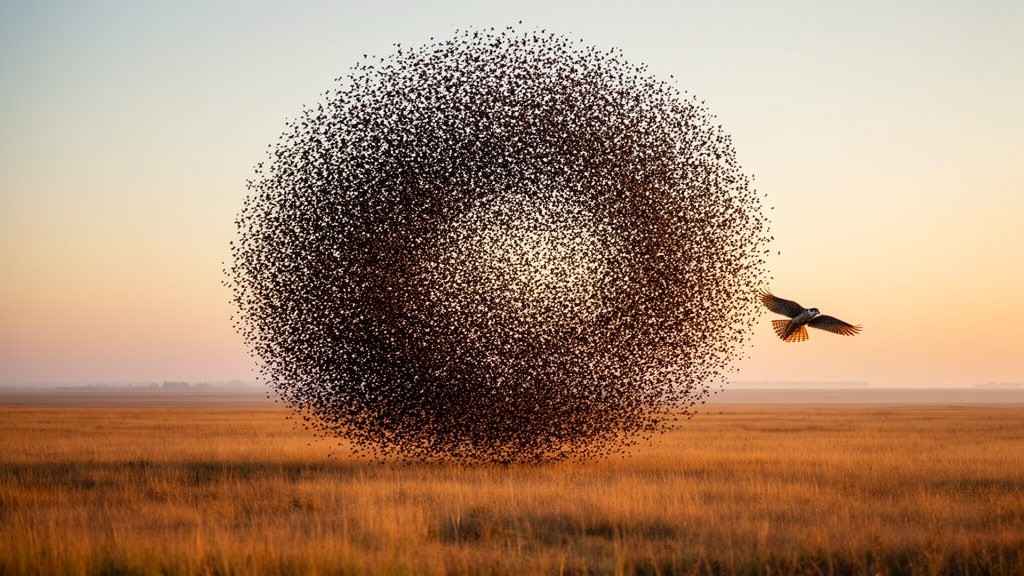
When fish school, krill swarm, or birds flock, the animals often assemble into three-dimensional aggregations that can be idealized as a cubic herd.

The study, published in Advances in Continuous and Discrete Models, proposes and analyzes a prey-predator model in which prey form a cubic herd while predators have access to additional food sources.

The authors, Priyanka Basak, Aniket Banerjee, and Debaldev Jana, first establish the mathematical foundations of the system.

Central to the analysis is the parameter A, which measures the amount of additional food available to predators. The team performs a bifurcation analysis with respect to this parameter, showing how the qualitative behavior of the system changes as food supply varies. Numerical simulations support the analytical findings throughout.

The study also extends the analysis into space. The researchers derive conditions for Turing instability, the mechanism by which a stable uniform state can spontaneously give rise to spatial patterns, and verify these conditions both analytically and numerically.

One of the most striking results concerns bistability. According to the model, increasing the amount of additional food can induce bistability, allowing two different equilibria to coexist simultaneously.

The same increase in additional food also promotes the formation of spatial spot patterns in the model. These patterns, arising through Turing-type mechanisms, illustrate how localized clustering can emerge in prey-predator systems when prey exhibit cubic herd behavior and predators are supplementally fed.

The authors conclude that additional food is crucial for supporting predator persistence and maintaining ecological balance in prey-predator systems exhibiting cubic herd behavior. As a theoretical contribution, the work offers a framework for understanding how herd geometry and food supplementation jointly shape coexistence, though the findings rest on model analysis and simulation rather than direct field observations.

Subject of Research: A mathematical prey-predator model with cubic herd behavior of prey and additional food for predators

Article Title: Significance of additional food in a prey-predator model with cubic shape herd behavior of prey

Article References: Basak, P., Banerjee, A., & Jana, D. (2026). Significance of additional food in a prey-predator model with cubic shape herd behavior of prey. Advances in Continuous and Discrete Models. https://doi.org/10.1186/s13662-026-04138-4

Image Credits: AI Generated

DOI: 10.1186/s13662-026-04138-4

Keywords: prey-predator model, additional food, cubic herd behavior, Beddington-DeAngelis, bifurcation, Turing instability, bistability, spatial patterns, ecological balance, mathematical biology, Significance, additional

Cite Scienmag News

Reid Dalton. (October 29, 2026). Extra Food Could Let Predators and Prey Coexist in Cubic Herds. Scienmag. https://scienmag.com/extra-food-could-let-predators-and-prey-coexist-in-cubic-herds/

Reid Dalton. "Extra Food Could Let Predators and Prey Coexist in Cubic Herds." Scienmag, 29 October 2026, https://scienmag.com/extra-food-could-let-predators-and-prey-coexist-in-cubic-herds/. Accessed 30 October 2026.

Reid Dalton. "Extra Food Could Let Predators and Prey Coexist in Cubic Herds." Scienmag. October 29, 2026. https://scienmag.com/extra-food-could-let-predators-and-prey-coexist-in-cubic-herds/


Tags: additionaladditional foodBeddington-DeAngelisbifurcationbifurcation analysis in ecological systemsbistabilitybistability in predator-prey populationscubic herd behaviorecological balanceeffects of supplemental food on predator-prey coexistenceimpact of additional food on predator-prey dynamicsinfluence of resource availability on spatial patternsmathematical biologymathematical modeling of animal aggregationsnumerical simulation of ecological bifurcationsPrey-predator cubic herd modelingprey-predator modelsignificancespatial pattern formation in ecological modelsspatial patternsstability analysis of prey-predator systemsthree-dimensional animal flocking behaviorTuring instabilityTuring instability in spatial pattern formation
Share26Tweet16
Previous Post

Gut bacteria and sarcopenia link questioned in Iranian aging study

Next Post

Gel Electrolytes Face Water Loss, CO2 and Cracking on the Road to Flexible Zinc-Air Batteries

Related Posts

Mathematicians Map When a Coupled p,q-Laplacian System Has Weak Solutions
Mathematics

Mathematicians Map When a Coupled p,q-Laplacian System Has Weak Solutions

October 30, 2026
New inverse Chris Jerry distribution improves fits for flood and repair data
Mathematics

New inverse Chris Jerry distribution improves fits for flood and repair data

October 30, 2026
New IMEX Scheme Shows Second-Order Convergence for Option Pricing Equations
Mathematics

New IMEX Scheme Shows Second-Order Convergence for Option Pricing Equations

October 30, 2026
Open-Access Platform Maps Brazil’s Lowest-Cost Routes to Carbon Neutrality
Mathematics

Open-Access Platform Maps Brazil’s Lowest-Cost Routes to Carbon Neutrality

October 30, 2026
Mathematicians Prove Uniqueness of Positive Solutions in (p,q)-Laplacian Problem
Mathematics

Mathematicians Prove Uniqueness of Positive Solutions in (p,q)-Laplacian Problem

October 29, 2026
Harvesting Herbivores Can Backfire: Model Reveals Hydra Effect and Vegetation Collapse Risks
Mathematics

Harvesting Herbivores Can Backfire: Model Reveals Hydra Effect and Vegetation Collapse Risks

October 29, 2026
Next Post
Gel Electrolytes Face Water Loss, CO2 and Cracking on the Road to Flexible Zinc-Air Batteries

Gel Electrolytes Face Water Loss, CO2 and Cracking on the Road to Flexible Zinc-Air Batteries

  • Mothers who receive childcare support from maternal grandparents show more optimized

    Mothers who receive childcare support from maternal grandparents show more parental warmth, finds NTU Singapore study

    27656 shares
    Share 11059 Tweet 6912
  • University of Seville Breaks 120-Year-Old Mystery, Revises a Key Einstein Concept

    1061 shares
    Share 424 Tweet 265
  • Bee body mass, pathogens and local climate influence heat tolerance

    682 shares
    Share 273 Tweet 171
  • Researchers record first-ever images and data of a shark experiencing a boat strike

    546 shares
    Share 218 Tweet 137
  • Groundbreaking Clinical Trial Reveals Lubiprostone Enhances Kidney Function

    531 shares
    Share 212 Tweet 133
Science

Embark on a thrilling journey of discovery with Scienmag.com—your ultimate source for cutting-edge breakthroughs. Immerse yourself in a world where curiosity knows no limits and tomorrow’s possibilities become today’s reality!

RECENT NEWS

  • What People Know About Gambling May Cut Both Ways, Review Finds
  • Children’s migration leaves Nigerian elders carrying care burdens and quiet loss
  • Gene-Silencing Vector Shows Strong Protection Against Rabies in Mice
  • Blood Flow Restriction Training Builds Leg Strength in Older Adults at Low Loads

Categories

  • Agriculture
  • Anthropology
  • Archaeology
  • Athmospheric
  • Biology
  • Biotechnology
  • Blog
  • Bussines
  • Cancer
  • Chemistry
  • Climate
  • Earth Science
  • Editorial Policy
  • Marine
  • Mathematics
  • Medicine
  • Pediatry
  • Policy
  • Psychology & Psychiatry
  • Science Education
  • Science News
  • Social Science
  • Space
  • Technology and Engineering

Subscribe to Blog via Email

Enter your email address to subscribe to this blog and receive notifications of new posts by email.

Join 5,151 other subscribers

© 2025 Scienmag - Science Magazine

Welcome Back!

Login to your account below

Forgotten Password?

Retrieve your password

Please enter your username or email address to reset your password.

Log In
No Result
View All Result
  • HOME
  • SCIENCE NEWS
  • CONTACT US

© 2025 Scienmag - Science Magazine

Discover more from Science

Subscribe now to keep reading and get access to the full archive.

Continue reading