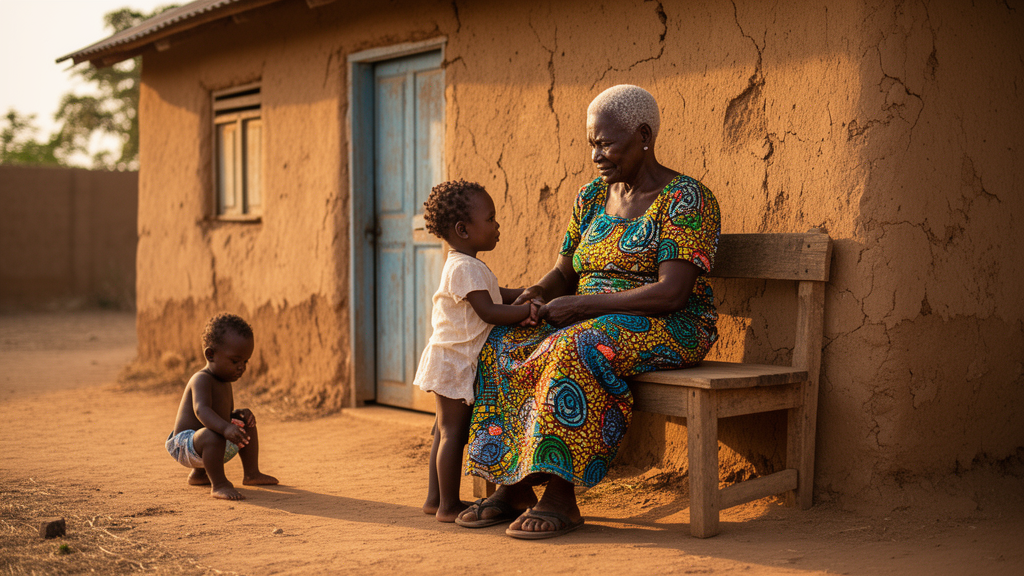
When adult children migrate abroad from Edo State in southern Nigeria, the parents they leave behind do not simply lose company. They lose hands that fetch water, accompany them to clinics, and sit beside them in the evenings. A qualitative study of 20 older adults in Edo State, published in Frontiers in Sociology, documents how international migration reorganizes family care from a distance, and shows that the consequences are sharply uneven, falling hardest on older women who are widowed and living with illness.
The researchers, Judith Ifunanya Ani of Walter Sisulu University and Kezia Batisai of the University of Johannesburg, conducted in-depth interviews with the older adults and analyzed the accounts through the transnational social field perspective, a framework that treats migrant families as connected across borders rather than divided by them. From those interviews, three interrelated themes emerged: migration acting as a social determinant that reshapes care, well-being, and identity; migration as a socially constructed experience that older adults interpret and give meaning to; and migration as a gendered phenomenon that redistributes roles, identities, and vulnerabilities within families.
The most immediate finding concerns care. The departure of children disrupts established care networks, removing the proximate, day-to-day support that older parents had relied upon. Participants described the emotional distress that accompanies this loss of closeness, a burden the authors note is disproportionately carried by those left behind and unevenly distributed by gender. Because the study is qualitative and focused on a single state in Nigeria, it documents these experiences in depth rather than measuring how widespread they are across the region.
Yet the picture the interviews reveal is not one of pure loss. Remittances, the money migrants send home, paradoxically raised some older adults’ standing in their communities. Participants with access to remittances, regular transnational contact, and supportive institutions reimagined themselves as transnational parents and community benefactors, actively reconstructing their identities rather than passively absorbing decline. The authors conceptualize this pattern as left-behind transnational parenthood: parenthood, care, and social standing reorganized from the origin side of the transnational field.
That reconstruction, however, was real but unevenly available. Older adults without such resources, particularly widowed women living with illness, carried the burden of migration without its compensations. The study’s abstract identifies this group as bearing the costs of their children’s absence while lacking the money, contact, and institutional support that allow others to reframe the experience positively. This asymmetry is central to the paper’s argument that the social burdens of migration are gendered.
How older adults made sense of migration also mattered. Participants constructed it as an economic necessity, navigating a duality of pride and loss, engaging in cultural negotiation, and drawing on spiritual meaning-making. Religious and community institutions emerged as critical surrogate support systems, stepping into roles that migrating children could no longer perform from abroad. In the absence of proximate family care, churches and community networks became the structures through which many elders sustained their daily lives and social identity.
The study situates these findings within a broader transformation. As international migration reshapes family structures across sub-Saharan Africa, older adults left behind bear social, emotional, and caregiving burdens that the authors describe as underexplored in migration scholarship. Much research on the region’s migration focuses on those who move; this study turns the analytical lens toward those who stay, examining how the departure of children triggers identity renegotiation and reshapes the social construction of aging itself.
Methodologically, the paper rests on 20 in-depth qualitative interviews, a design suited to capturing how participants interpret their own circumstances but limited in scope. The findings speak to the experiences of older adults in Edo State, a region with well-documented international migration, and cannot be generalized statistically to older populations elsewhere in Nigeria or sub-Saharan Africa. The authors also note that all claims expressed in the article are solely those of the authors and do not necessarily represent those of their affiliated organizations or the publisher.
What the study offers, within those limits, is a structured account of a hidden side of global migration. The movement of young adults abroad simultaneously strips older parents of proximate care and generates emotional distress, while for some it delivers remittances that elevate community standing and enable a new self-understanding as transnational parents and benefactors. For others, above all widowed women living with illness, migration delivers only its burdens. The paper’s contribution is to name that divided experience, and to argue that aging in origin communities must be understood as part of the transnational family system rather than as a separate, local story.
Subject of Research: How the international migration of adult children reshapes care, identity, and gendered burdens among older adults left behind in Edo State, Nigeria.
Article Title: Left behind and reimagined: identity reconstruction and the social burden of children’s migration on older adults
Article References: Ani, J. I., & Batisai, K. (2026). Left Behind and Reimagined: Identity Reconstruction and the Social Burden of Children's Migration on Older Adults. Frontiers in Sociology, 11, 1896525. https://doi.org/10.3389/fsoc.2026.1896525
Image Credits: AI Generated
DOI: 10.3389/fsoc.2026.1896525
Keywords: international migration, older adults, Nigeria, Edo State, care networks, remittances, transnationalism, identity reconstruction, gender, qualitative research, left-behind parents, social burden
Cite Scienmag News
Courtney Benton. (October 30, 2026). Children’s migration leaves Nigerian elders carrying care burdens and quiet loss. Scienmag. https://scienmag.com/childrens-migration-leaves-nigerian-elders-carrying-care-burdens-and-quiet-loss/
Courtney Benton. "Children’s migration leaves Nigerian elders carrying care burdens and quiet loss." Scienmag, 30 October 2026, https://scienmag.com/childrens-migration-leaves-nigerian-elders-carrying-care-burdens-and-quiet-loss/. Accessed 4 November 2026.
Courtney Benton. "Children’s migration leaves Nigerian elders carrying care burdens and quiet loss." Scienmag. October 30, 2026. https://scienmag.com/childrens-migration-leaves-nigerian-elders-carrying-care-burdens-and-quiet-loss/