


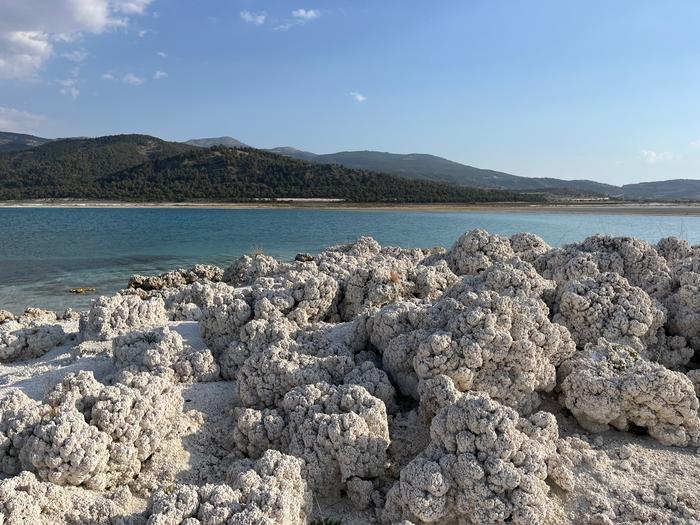
Despite decades of research, there’s still much scholars don’t understand about life’s beginnings and early evolution. A UC Riverside paper has opened the door to understanding more and to framing future studies that could help predict climate change and search for life beyond Earth.

Credit: Tim Lyons/UCR
Despite decades of research, there’s still much scholars don’t understand about life’s beginnings and early evolution. A UC Riverside paper has opened the door to understanding more and to framing future studies that could help predict climate change and search for life beyond Earth.
“This paper strives to inform the Earth sciences community where the research needs to go next,” said Christopher Tino, a UCR PhD candidate during the time of research and a first author.
Many studies have explored signs of early life preserved in ancient rocks, but this paper, recently published in the journal Nature Reviews Microbiology, weaves together this data with genomic studies of modern organisms and recent breakthroughs about the evolving chemistry of the early oceans, atmosphere, and continents.
The paper shows how Earth’s earliest life forms — microbes such as O2-producing bacteria and methane-producing archaea — shaped, and were shaped by, changes in the oceans, continents, and atmosphere.
“The central message in all of this is that you can’t view any part of the record in isolation,” said Timothy Lyons, a UCR distinguished professor of biogeochemistry and co-first author. “This is one of the first times that research across these fields has been stitched together this comprehensively to uncover an overarching narrative.”
Bringing together experts in biology, geology, geochemistry, and genomics, the paper details the journey of Earth’s early life forms from their first appearances to their rise to ecological prominence. As their numbers increased, microbes began to affect the world around them, for instance by starting to produce oxygen via photosynthesis.
The findings across each field often “agree in remarkable ways,” according to Tino, who is now a postdoctoral associate at the University of Calgary.
Specifically, the study tracks how microbial life consumed, transformed, and dispersed key nutrients containing nitrogen, iron, manganese, sulfur, and methane across Earth. These biological pathways evolved as Earth’s surface changed dramatically along with, and sometimes because of, new life. Continents emerged, the sun became brighter, and the world became rich in oxygen.
Because the evolution of new biological pathways affected these element cycles, their trajectories tell us when early life forms appeared, how they affected and responded to the environment, and when they developed global-scale ecological footprints.
Rocks billions of years old often lack the visible fossils needed to tell the whole story, but this study incorporated the chemistry of these rocks and the genomes of living relatives to form a comprehensive view of ancient life.
“In essence, we are describing Earth’s first flirtations with microbes capable of changing the global environment,” said Lyons, who is also the director of the Alternative Earths Astrobiology Center in the Department of Earth and Planetary Sciences. “You need to understand the whole picture to fully grasp the who, what, when, and where as microbes graduated from mere existence to having a significant effect on the environment.”
Many scholars have assumed that once a life form appeared on Earth, it quickly became prolific. Only by bringing together decades of research across disciplines, as Lyons, Tino, and their colleagues did in this paper, can scientists see the difference between the mere presence, versus the dominance, of certain microbes. Often, the rise from existence to prominence took hundreds of millions of years.
“Microbes that at first eked out an existence in narrow niches would later have their turn to be the big kids on the block,” said Lyons.
All this distills down to the basic question that keeps the UCR team awake at night: Where did we come from?
But the answers gleaned from this research also have more practical applications, including insights into how life and environments might respond to climate change, both in the short term and far future.
The study could also aid the search for life on other planets. “If we are ever going to find evidence for life beyond Earth, it will very likely be based on the processes and products of microorganisms, such as methane and O2,” said Tino.
“We are motivated by serving NASA in its mission,” Lyons noted, “specifically to help understand how exoplanets could sustain life.”
Lyons and Tino were joined in this effort by Gregory P. Fournier, Massachusetts Institute of Technology; Rika E. Anderson, University of Washington and Carleton College; William D. Leavitt, Dartmouth College; Kurt O. Konhauser, University of Alberta; and Eva E. Stüeken, University of Washington and University of St. Andrews.
Journal
Nature Reviews Microbiology
Article Title
Co‐evolution of early Earth environments and microbial life
Article Publication Date
29-May-2024
Cite Scienmag News
Violet Maxwell. (July 9, 2024). Exponentially increasing understanding of early life on Earth. Scienmag. https://scienmag.com/exponentially-increasing-understanding-of-early-life-on-earth/
Violet Maxwell. "Exponentially increasing understanding of early life on Earth." Scienmag, 9 July 2024, https://scienmag.com/exponentially-increasing-understanding-of-early-life-on-earth/. Accessed 8 September 2026.
Violet Maxwell. "Exponentially increasing understanding of early life on Earth." Scienmag. July 9, 2024. https://scienmag.com/exponentially-increasing-understanding-of-early-life-on-earth/

