

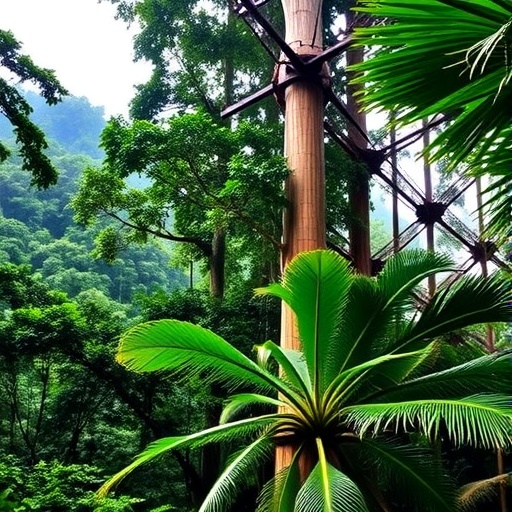
In the heart of the Brazilian Amazon, a pioneering study led by Valle et al. has unveiled intricate details about the vertical structure of one of the world’s most vital ecosystems. This research, poised to reshape our understanding of forest dynamics and their pivotal role in global climate regulation, delves into the complex layers of the Amazon rainforest—a towering testament to nature’s engineering. As scientists grapple with the challenges of climate change, such in-depth analyses offer crucial insights that underscore the Amazon’s significance.
The study taps into advanced methodologies to characterize the vertical profiles of Amazonian forests, recognizing that these layers are not mere physical structures but vital zones where microclimates and biodiversity thrive. Each stratum of a forest plays a unique role: the emergent layer, the canopy, the understory, and the forest floor each harbor distinct species adapted to their environments. Valle and his team are pioneering in using sophisticated remote sensing technology and field measurements to paint a comprehensive portrait of these vertical layers.
One of the remarkable features of Amazonian forests is their biodiversity. Home to millions of species, from towering trees to the smallest insects, the forest’s vertical structure allows for varied niches and habitats. The emergent layer, with its tallest trees reaching heights of over 60 meters, forms a critical habitat for many bird species and provides sunlight for the canopy below. This canopy, composed of a dense layer of leaves, serves as a critical barrier, absorbing sunlight and intercepting rainfall, which regulates the forest’s microclimate.
However, the implications of a changing climate pose an increasing threat to these complex ecosystems. With rising temperatures and shifts in precipitation patterns, the delicate balance within these vertical structures may be disrupted. Valle’s research is crucial in identifying how these changes affect species composition and forest health, aiming to predict the potential long-term impacts of climate fluctuations on the Amazon’s biodiversity.
Moreover, Valle et al. emphasize the importance of understanding forest vertical dynamics in the context of carbon storage. Amazonian forests are among the largest terrestrial carbon sinks, and their ability to sequester carbon is vital for mitigating climate change. The research details how each layer contributes to the overall carbon stock, revealing that disturbances at one level can have cascading effects throughout the forest.
In addressing these vital issues, the study integrates historical data with current field observations, creating a rich tapestry that reflects both the present state of the forest and the historical changes it has undergone. The integration of this extensive dataset signifies a robust scientific approach that aims to offer clarity in the often murky waters of environmental science.
The methodology used in this study is a testament to the advancements in ecological research. The combination of ground-based measurements with cutting-edge aerial surveys, including LiDAR technology, provides unprecedented resolution in mapping the vertical structure of forests. This blending of technology and ecology opens new avenues for understanding forest dynamics, providing a roadmap for future research efforts in similar complex ecosystems worldwide.
As the research circulates within the scientific community, it also raises essential questions about forest conservation strategies. By revealing the intricate workings of Amazonian forests, the findings call for a re-evaluation of how conservation efforts are implemented. Effective policy-making must be informed by the nuanced understanding provided by such research to ensure the Amazon can withstand environmental pressures moving forward.
The forthcoming publication in Commun Earth Environ not only marks a significant achievement for Valle and his team but also serves as a clarion call for further investigation into the vertical dynamics of forests globally. As deforestation and climate change threaten these vital ecosystems, understanding the complexities of forest structures becomes increasingly important for both conservation efforts and climate resilience strategies.
In conclusion, Valle et al.’s comprehensive study of the vertical structure of Amazonian forests sheds light on the intricate relationships within these ecosystems. The insights garnered from such research are invaluable; not only do they contribute to the scientific community’s understanding of biodiversity and carbon dynamics, but they also magnify the urgency of protecting one of our planet’s most critical resources.
Through their innovative approach, Valle and his team have set a new standard in forest research. As the world watches the Amazon face unprecedented challenges, this research represents a beacon of hope and a roadmap for safeguarding future generations of one of earth’s richest ecosystems.
Subject of Research: Vertical structure of forests in the Brazilian Amazon.
Article Title: Characterizing the vertical structure of forests in the Brazilian Amazon.
Article References:
Valle, D., Haneda, L., Brack, I.V. et al. Characterizing the vertical structure of forests in the Brazilian Amazon.
Commun Earth Environ (2025). https://doi.org/10.1038/s43247-025-02976-w
Image Credits: AI Generated
DOI: 10.1038/s43247-025-02976-w
Keywords: Amazon rainforest, vertical structure, biodiversity, carbon storage, climate change, remote sensing, forest dynamics, conservation strategies.


