


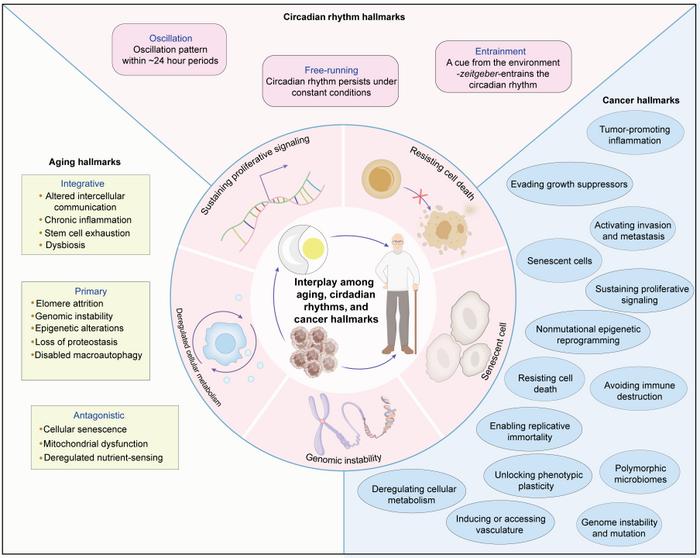
The relationship between cancer, circadian rhythms, and aging is an intricate web, one where each element influences the others in ways that are only beginning to be fully understood. Recent research indicates that aging is one of the leading risk factors for cancer, while disruptions in circadian rhythms may spur tumor development and progression. Furthermore, as the body ages, the natural circadian rhythms that help regulate various biological processes become misaligned, thus amplifying the risks of cancer. This triad of aging, circadian rhythm disruptions, and cancer presents a formidable challenge, but it also offers new avenues for therapeutic strategies aimed at mitigating the risks associated with each of these factors.
Circadian rhythms, the 24-hour cycles that affect behavior and physiological processes, are orchestrated through complex networks involving key clock genes such as BMAL1, CLOCK, and PERs. These genes work synergistically to maintain the body’s internal clock, influencing various crucial processes including the cell cycle, apoptosis, and DNA repair mechanisms. When these core clock genes are disrupted, the consequences can be dire, paving the way for the initiation and progression of different cancers. Studies have shown that abnormal expressions and genetic variations in these circadian genes correlate significantly with cancer risk and prognosis, further underlining their role in tumor genesis.
As people age, the rhythmic intensity of neurons in the suprachiasmatic nucleus—the master regulator of circadian rhythms—diminishes. This weakening can lead to asynchrony between central and peripheral clocks, causing dysregulation in core circadian gene expression. The resultant effects include altered sleep patterns, diminished melatonin and cortisol secretion, and overall weakened metabolic rhythms. These changes collectively advance not only immune aging and metabolic disorders but also escalate chronic inflammation—an environment often ripe for tumor development. Thus, the interplay between circadian rhythms and aging becomes increasingly complicated as individuals grow older, creating a self-perpetuating cycle of dysfunction.
Aging is well-known to elevate the risk of developing cancer through various mechanisms. These include genomic instability, which imperils the integrity of DNA and increases mutation rates; epigenetic changes that silence tumor suppressor genes; chronic inflammation exacerbated by the accumulation of senescent cells; and altered cellular metabolism. The reduced capacity to repair damaged DNA, combined with mitochondrial dysfunction, sets the stage for neoplastic changes, making older individuals more susceptible to cancer. In this regard, aging and cancer are intertwined at every level, from molecular to systemic, creating a need for interventions that target the mechanisms underpinning both processes.
Moreover, the influences of aging and circadian dysregulation on tumor growth and proliferation are noteworthy. Aging may promote tumor growth in some aspects, offering a favorable microenvironment for tumor cell proliferation and immune evasion, while also limiting the efficacy of standard treatment strategies. The role of circadian rhythms in regulating the cell cycle and apoptotic pathways is crucial, as disruptions in these rhythms can lead to uncontrolled tumor cell growth and resistance to therapies. Notably, certain anticancer compounds have shown promise by targeting circadian pathways, indicating that strategizing treatment schedules in harmony with circadian rhythms may hold significant therapeutic benefits.
The impact of aging and circadian rhythms on genomic stability is another area of major concern. Aging is associated with a decline in cellular repair mechanisms, allowing DNA damage to accumulate and potentially trigger malignant transformations. Circadian disruptions hamper the efficiency of these repair processes, compounding the risk of genomic instability. Core clock genes regulate pivotal proteins responsible for detecting and repairing DNA damage, demonstrating how circadian regulation is essential for genomic integrity. Consequently, addressing circadian dysregulation may serve not only to enhance healthspan but also to mitigate cancer risk.
Interestingly, cellular senescence also takes center stage in this intersection of aging, circadian rhythms, and cancer. Senescent cells arise as a result of stressors such as persistent DNA damage or telomere shortening, leading to a state of permanent cell cycle arrest. Though they can prevent cancer formation by ceasing to divide, these cells also adopt a pro-inflammatory phenotype that may foster an environment conducive to tumor growth. Research indicates that circadian oscillators might influence the fate of senescent cells, highlighting their crucial role both in tumorigenesis and in aging. By targeting these pathways, it may be possible to not only promote the elimination of senescent cells but also bolster the body’s capacity for immune surveillance.
The intricate relationship between cellular metabolism, aging, and circadian rhythms is essentially a three-way interaction that further complicates the cancer landscape. Metabolic changes that are typical in aging, characterized by increased oxidative stress and energy dysregulation, can have profound implications for cancer susceptibility. Lactate metabolism, for example, is impacted by circadian rhythms, and both AMPK and Sirtuins emerge as critical regulators that link energy status to cellular health. As such, therapies aimed at rectifying metabolic anomalies may provide a potent approach to combat aging-related cancer risks—a potential synergy that requires further exploration.
Research has highlighted that the core clock genes exert significant control over the expression of numerous other genes tied to aging and tumorigenesis. By establishing transcription-translation feedback loops, these clock genes effectively synchronize the timings of various physiological processes across different tissues. Disruptions to this orchestration can lead to a cascade of downstream effects, including increased cellular proliferation and diminished immune response. The potential of these findings cannot be understated; they pave the way for targeted therapeutic approaches that integrate chronobiology into the management of cancer and age-related health issues.
As investigations into the intertwined pathways of aging, circadian rhythms, and cancer continue to advance, potential avenues for practical applications in clinical settings are becoming clearer. Chronotherapy—tailoring chemotherapy schedules to align with patients’ circadian rhythms—emerges as a tantalizing possibility, promising to optimize treatment outcomes. Likewise, innovations in detecting and targeting senescent cells, coupled with advanced delivery systems for therapeutics, provide a compelling framework for developing effective anti-aging and anticancer strategies.
Understanding the interplay between aging, circadian rhythms, and cancer is not merely an academic exercise; it offers real implications for public health. As populations globally age, the intersection of these factors will become increasingly significant in influencing healthcare strategies and resource allocation. By establishing a better understanding of these dynamics, researchers and clinicians may one day be able to design interventions that slow aging, improve healthspan, and diminish cancer incidence through strategic approaches that leverage our natural biological rhythms.
In summary, the convergence of aging, circadian rhythms, and cancer is a burgeoning field that harbors the potential for transformative insights into disease prevention and intervention. Addressing the disruptions engendered by aging and circadian misalignment may unlock new therapeutic paradigms, catalyzing progress in both oncology and geriatric medicine. Future research remains essential in unraveling these complex mechanisms, with the aim of forging paths toward enhanced health outcomes and longevity.
Cite Scienmag News
Nathaniel Bowman. (March 28, 2025). Exploring the Shared Features and Interrelated Mechanisms of Aging, Circadian Rhythms, and Cancer: Potential Impacts on Treatment Approaches. Scienmag. https://scienmag.com/exploring-the-shared-features-and-interrelated-mechanisms-of-aging-circadian-rhythms-and-cancer-potential-impacts-on-treatment-approaches/
Nathaniel Bowman. "Exploring the Shared Features and Interrelated Mechanisms of Aging, Circadian Rhythms, and Cancer: Potential Impacts on Treatment Approaches." Scienmag, 28 March 2025, https://scienmag.com/exploring-the-shared-features-and-interrelated-mechanisms-of-aging-circadian-rhythms-and-cancer-potential-impacts-on-treatment-approaches/. Accessed 5 September 2026.
Nathaniel Bowman. "Exploring the Shared Features and Interrelated Mechanisms of Aging, Circadian Rhythms, and Cancer: Potential Impacts on Treatment Approaches." Scienmag. March 28, 2025. https://scienmag.com/exploring-the-shared-features-and-interrelated-mechanisms-of-aging-circadian-rhythms-and-cancer-potential-impacts-on-treatment-approaches/


