


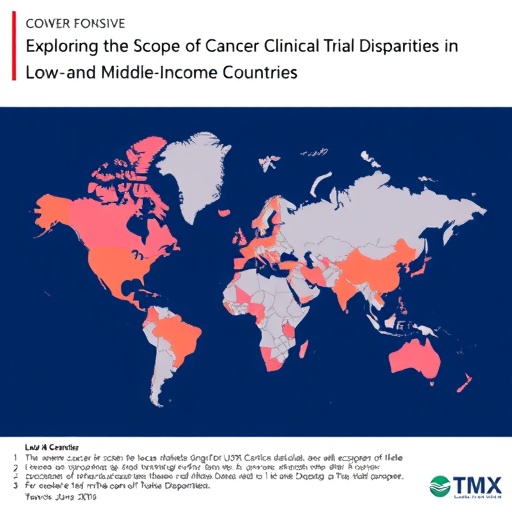
Over the past two decades, the landscape of cancer clinical trials within low- and middle-income countries (LMICs) has demonstrated considerable variation in terms of both quantity and complexity. A comprehensive analysis published by the American Cancer Society’s peer-reviewed journal, CANCER, highlights how economic growth plays a significant, albeit not exclusive, role in shaping these disparities. This intricate relationship between economic development and clinical research capacity underscores the multifaceted challenges that LMICs face in advancing oncology trials.
Despite the anticipated surge in cancer burden within LMICs over the coming years, the bulk of cancer clinical trials remain predominantly concentrated in high-income nations, thereby limiting the generalizability and applicability of oncologic advances to diverse populations. Recognizing this imbalance, researchers embarked on a 20-year longitudinal study to evaluate the progression and complexity of cancer clinical trials registered within LMICs from 2001 through 2020. Their objective was to elucidate how variations in economic trajectories intertwine with clinical research activity, providing insights essential for capacity-building within these regions.
During the study period, 16,977 cancer clinical trials were documented across LMICs, revealing heterogeneous trends across different geographic and economic contexts. Notably, Asian powerhouses such as China and South Korea, which experienced substantial economic upswings, demonstrated pronounced increases in both the number and sophistication of clinical trials. Such growth likely reflects concerted national investments in biomedical infrastructure, stringent regulatory frameworks, and the establishment of comprehensive cancer research networks.
Conversely, countries such as India, Thailand, and Vietnam – despite registering notable economic expansion – exhibited inconsistent and fluctuating patterns in clinical trial growth. This discrepancy suggests that while economic affluence is a facilitator, other factors including regulatory landscape, healthcare infrastructure, and research ecosystem maturity significantly influence clinical trial development. Furthermore, this heterogeneity highlights the critical need for tailored policy interventions that address region- and country-specific barriers to oncology research.
In Eastern Europe and parts of Western Asia and Southern Europe, particularly Turkey, gains in economic indicators correlated with incremental advances in cancer clinical trials, though these were comparatively modest. This trend points towards a nuanced interface where economic growth provides an enabling environment but does not guarantee rapid expansion of complex clinical research activities, which inherently depend on sustainable funding, human capital, and institutional support.
Intriguingly, several North and South American LMICs, including Argentina, Brazil, and Mexico, managed to elevate their clinical trial outputs despite sluggish economic performance during the same timeframe. This phenomenon indicates that strategic prioritization of cancer research, robust collaborations with global research entities, and progressive regulatory policies can compensate for fiscal constraints, fostering a resilient oncology clinical trial landscape.
In African contexts, Egypt’s robust economic growth has been mirrored by a rise in registered cancer clinical trials, reinforcing the link between economic capacity and research proliferation. However, South Africa presents a contrasting narrative where increases in economic metrics did not translate into corresponding advancements in clinical trial numbers, reinforcing the concept that economic development alone is insufficient without a concerted focus on research infrastructure and policy support.
This differential growth pattern across LMICs underlines the complexity of integrating economic progress with clinical research expansion. Factors such as political will, regulatory efficiency, ethical oversight mechanisms, availability of trained investigators, and patient recruitment channels contribute to the intricate ecosystem that underpins successful clinical trial operations.
Moreover, the complexity of cancer clinical trials — encompassing elements such as trial design, endpoints, patient populations, and therapeutic modalities — varies significantly among LMICs. Nations with escalating research sophistication not only increase trial counts but also enhance methodological rigor and innovation, aligning with international standards. This progression is pivotal for yielding impactful data that can influence global oncology practice and policy.
The study’s findings have profound implications for global health equity. As the cancer burden disproportionately affects LMICs in the future, inclusivity in clinical research becomes paramount. Ensuring that cancer therapeutics and interventions are validated within diverse genetic backgrounds and healthcare settings necessitates empowering LMICs to sustain and grow their clinical trial capacities.
According to Dr. Max S. Mano, senior author and esteemed oncologist at the Latin American Cooperative Oncology Group and Einstein Hospital Israelita, “These data provide invaluable insights for LMICs aspiring to bolster their clinical research endeavors.” His statement echoes a call for multifaceted strategies that transcend mere economic growth, advocating for strengthening institutional frameworks, fostering international partnerships, and enhancing human resource development.
In conclusion, while economic growth remains a significant catalyst for cancer clinical trial expansion in LMICs, it is clear from this extensive analysis that it is not the sole determinant. A symbiotic relationship involving policy innovation, infrastructure development, regulatory reform, and stakeholder engagement is essential to close the gap in global oncology research. The study underscores the urgent need for integrated approaches that can empower LMICs to contribute meaningfully to the global fight against cancer.
News Publication Date: 20-Oct-2025
Web References:
– CANCER Journal: https://acsjournals.onlinelibrary.wiley.com/journal/10970142
– Wiley: https://www.wiley.com/en-us
References:
“Disparities in Cancer Clinical Trials Among Low- and Middle-income Countries: a 20-year Analysis.” Fanny G.A. Cascelli et al. CANCER; Published Online: October 20, 2025. DOI: 10.1002/cncr.70067
Cite Scienmag News
Nathaniel Bowman. (October 20, 2025). Exploring the Scope of Cancer Clinical Trial Disparities in Low- and Middle-Income Countries. Scienmag. https://scienmag.com/exploring-the-scope-of-cancer-clinical-trial-disparities-in-low-and-middle-income-countries/
Nathaniel Bowman. "Exploring the Scope of Cancer Clinical Trial Disparities in Low- and Middle-Income Countries." Scienmag, 20 October 2025, https://scienmag.com/exploring-the-scope-of-cancer-clinical-trial-disparities-in-low-and-middle-income-countries/. Accessed 6 September 2026.
Nathaniel Bowman. "Exploring the Scope of Cancer Clinical Trial Disparities in Low- and Middle-Income Countries." Scienmag. October 20, 2025. https://scienmag.com/exploring-the-scope-of-cancer-clinical-trial-disparities-in-low-and-middle-income-countries/


