


Researchers from Japan have unveiled significant findings regarding the environmental impact of nanoplastics, specifically focusing on how soil pH and composition influence the behavior of these microscopic particles in soil ecosystems. As plastic waste continues to accumulate globally, the breakdown of these materials into nanoscale particles poses a potential risk to various environmental and human health systems. The research aims to understand the interactions between nanoplastics and soils, a crucial step toward developing effective environmental policies.
Nanoplastics, defined as plastic particles with diameters ranging between 1 and 100 nanometers, can penetrate ecosystems through multiple pathways. According to the study, these particles can significantly affect soil health, impede plant growth, and potentially carry harmful substances up the food chain, raising health concerns for both flora and fauna, including humans. Researchers emphasized the need for deeper understanding as nanoplastics are increasingly detected in natural environments.
Led by PhD student Kyouhei Tsuchida, the study involved a collaborative effort among fellow researchers from the National Institute of Advanced Industrial Science and Technology (AIST) and Waseda University. This multidisciplinary team aimed to dissect the complex interactions between nanoplastics and soil under varying conditions, with an emphasis on pH variations, which can dramatically alter the behavior of these particles and their interactions with soil components.
The study examined two distinct types of soil—andosol, a fertile volcanic soil, and fine sand. The choice of these two soil types was deliberate; they exhibit markedly different surface characteristics and chemical properties, which are expected to influence nanoplastic behavior. The research highlights how soil type can modulate the adsorption of nanoplastics, thereby affecting their mobility and persistence in terrestrial ecosystems.
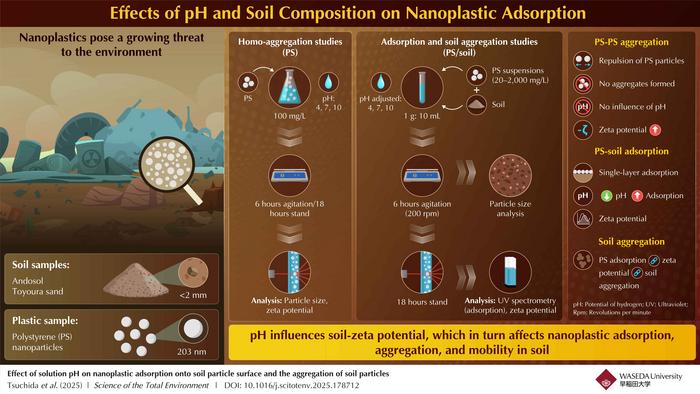
The researchers conducted experiments to analyze the self-aggregation behavior of nanoplastics and their adsorption on soil particles. Understanding the adsorption dynamics is essential, as it governs how nanoplastics travel within the soil matrix. Tsuchida noted that the study identified critical relationships, particularly regarding how nanoplastics aggregate under different pH conditions and how this aggregation influences their migration in soil environments.
In their experimental design, researchers prepared suspensions of polystyrene nanoparticles, systematically varying the pH of the solutions. They evaluated several parameters, including particle size and zeta potential, which is a measure of the electrical charge on the particle’s surface. This assessment is vital in understanding particle stability and potential for aggregation, as well as interactions with soil particles.
Through batch adsorption experiments, the team probed into how polystyrene nanoparticles adhered to the soil matrices. The results indicated that while self-aggregation among the polystyrene particles was minimal, pH changes significantly altered their adsorption behavior to soil particles. Notably, polystyrene nanoparticles exhibited high negative zeta potential, leading to particle repulsion that hindered aggregation, an essential finding that points to the stability of nanoparticles in differing environments.
Contrastingly, the study revealed that the interaction between the nanoparticles and soil particles was markedly influenced by pH fluctuations. As the plastic particles adsorbed onto the soil matrix, they altered the aggregation state of soil particles, indicating complex interrelationships at play that can impact soil structure and health.
The researchers utilized advanced analytical techniques to quantify their findings, including laser diffraction and UV spectroscopy, alongside zeta potential analysis. These methods allowed for a rigorous examination of the characteristics of nanoplastics and their interactions with soil, providing an enhanced understanding of how these materials behave in natural settings.
The implications of this research extend beyond academic curiosity. Understanding the migration patterns of nanoplastics in soil environments is pivotal for policy reform aimed at mitigating plastic pollution. The study advocates for the integration of these insights into environmental management practices aimed at protecting soil health and ecosystems. With increasing plastic presence in soils, policymakers are urged to consider the findings as a basis for developing comprehensive strategies to tackle plastic pollution at its source.
In summary, the research presents critical insights into the behavior of nanoplastics in diverse soil types and how environmental conditions significantly influence their interactions within ecosystems. The findings call for further interdisciplinary collaboration to explore the long-term impacts of nanoplastic pollution and inform future environmental strategies.
These discoveries underscore the urgency with which we must approach the challenges posed by plastic pollution, emphasizing the need to rethink materials we use and how we manage waste. The findings promise to yield fruitful avenues for future research and practical application in environmental sciences, further connecting the dots between human-made materials and their ecological consequences.
The progression from laboratory findings to real-world applications will be crucial as we confront the realities of a plastic-laden environment. Enhanced understanding of nanoplastic behavior can empower researchers and policymakers to devise targeted interventions aimed at reducing plastic footprint, restoring ecosystems, and ensuring a healthier future for subsequent generations.
This exciting research adds to the growing body of literature on the environmental implications of nanoplastics, underpinning the critical need for ongoing scientific inquiry in an era increasingly defined by pollution challenges.
Keywords
Cite Scienmag News
Denise Maddox. (April 9, 2025). Exploring the Impact of Soil Type and pH on Nanoplastic Mobility. Scienmag. https://scienmag.com/exploring-the-impact-of-soil-type-and-ph-on-nanoplastic-mobility/
Denise Maddox. "Exploring the Impact of Soil Type and pH on Nanoplastic Mobility." Scienmag, 9 April 2025, https://scienmag.com/exploring-the-impact-of-soil-type-and-ph-on-nanoplastic-mobility/. Accessed 3 September 2026.
Denise Maddox. "Exploring the Impact of Soil Type and pH on Nanoplastic Mobility." Scienmag. April 9, 2025. https://scienmag.com/exploring-the-impact-of-soil-type-and-ph-on-nanoplastic-mobility/


