


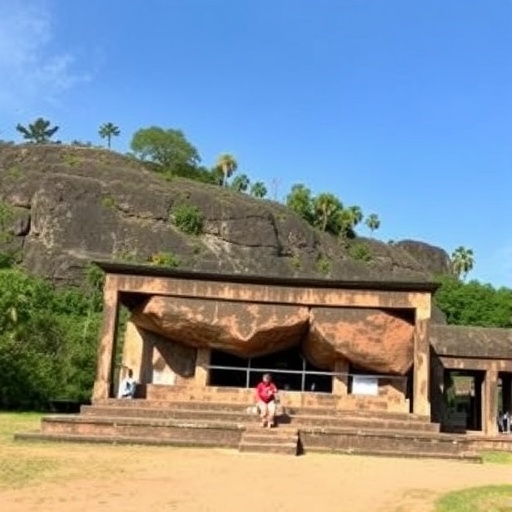
In the heart of Southeast Asia, a remarkable archaeological discovery has emerged from Tham Pha Mue, a rock art site tucked away in Central Laos. This site, with its stunning engravings and paintings, has piqued the interest of researchers and historians alike, shedding light on potential stylistic connections within the region’s rich cultural tapestry. The findings reveal an intricate interplay of artistic expression that resonates across time, offering insights into ancient human activities and beliefs.
The study, led by a team of researchers including Tan, Vila, and Eguilleor-Carmona, seeks to map the art styles found at Tham Pha Mue against other significant rock art sites throughout Mainland Southeast Asia. By examining similarities in technique, motifs, and themes, the research aims to piece together a narrative of cultural exchange that may have taken place among diverse communities in the region. This exploration not only highlights the artistic achievements of these ancient peoples but also their interactions with one another.
Tham Pha Mue stands out as a vital location for understanding the cultural dynamics of prehistoric Southeast Asia. The abundance of rock art at the site varies in complexity, ranging from simple geometric designs to intricate representations of animals and human figures. Each engraving and painting serves as a window into the lives of the people who inhabited this area thousands of years ago, documenting their surroundings, beliefs, and experiences.
The rock art at Tham Pha Mue showcases unique characteristics that invite comparison with other known sites in Laos and beyond. Notably, the sheer variety of imagery found here suggests a flourishing artistic tradition that not only served aesthetic purposes but also played a crucial role in social communication and the transmission of cultural knowledge. The diversity of symbols and styles reflects the rich tapestry of human experience, capturing narratives that may have been vital for community cohesion and identity.
As the research team delves deeper into the implications of their findings, they are considering the geographic and social contexts surrounding Tham Pha Mue. The area’s topography and resources likely contributed to its selection as a meaningful space for artistic expression. Scholars suggest that the site may have been a communal meeting place, where individuals from various backgrounds converged, shared stories, and left their mark on the rock faces, thus forging connections that transcended regional boundaries.
In the analysis of this rock art, archaeologists employ a range of modern techniques, including photogrammetry and digital modeling, which allow for detailed documentation and analysis of these ancient works. Such advancements enable researchers to capture the nuances of the engravings and examine their deterioration over time, ensuring that future generations will have access to this cultural heritage. This technological integration into archaeology not only enhances the study of rock art but also ensures its preservation for posterity.
Additionally, understanding the chronological context of the rock art created at Tham Pha Mue is paramount. The researchers posit that the site has been in use over an extensive timespan, possibly from the late Pleistocene to the Holocene. Such a timeline could hint at shifts in artistic styles and cultural practices corresponding to changes in climate, social structure, and external influences. The layering of images might mirror the evolution of societal complexities in response to environmental and cultural pressures.
Equally significant is the potential for this research to connect local communities with their historical legacy. By unveiling the significance of Tham Pha Mue’s rock art, researchers aim to foster a greater appreciation for southeastern Laos’s cultural heritage. Local stakeholders, including indigenous populations and heritage organizations, may find a renewed sense of identity as they engage with this ancient narrative, which serves as a bridge between the past and present.
The project also delves into the comparisons between Tham Pha Mue and other prominent rock art sites in the region, such as Lak Sao and the UNESCO-listed site of Phong Nha-Kẻ Bàng. These connections offer a wider perspective on how rock art served as a vehicle for cultural dialogue, illustrating the diffusion of styles and themes across different localities. By tracing these connections, researchers can better understand the migration patterns and interactions among various groups who inhabited what is now modern-day Southeast Asia.
Moreover, the aesthetic and symbolic meanings embedded within the rock art provide further avenues for exploration. Each image can be interpreted through various lenses, whether they be spiritual, social, or environmental. The depictions of animals, for instance, may not only reflect the natural world but could also embody deeper significances, potentially serving as totems or representing key milestones in the trajectory of human existence.
Recent interdisciplinary collaborations have also emerged from the study of Tham Pha Mue, bringing together experts in anthropology, art history, and archaeology. This diverse academic approach enriches the analysis, as different perspectives contribute to a more holistic understanding of the rock art’s significance. The incorporation of local oral histories into this research can lead to invaluable insights, as these narratives may hold keys to unlocking the meanings behind specific symbols and motifs.
As the findings from Tham Pha Mue continue to unfold, the implications for understanding Southeast Asia’s prehistoric narratives become increasingly profound. The artwork does not merely tell stories of the past; it serves as a living testament to human resilience, creativity, and adaptability. It reflects the enduring spirit of those who came before, echoing their presence through the ages and reminding us of the shared journey of humanity.
In summary, the research on Tham Pha Mue represents a critical step forward in the exploration of rock art in Southeast Asia. As the team of scholars continues to unearth the rich layers of history encapsulated in the engravings and paintings, they invite the world to witness the artistry, culture, and lives of ancient peoples. The connections they uncover will undoubtedly contribute to a deeper understanding of the complexities and interrelations that characterize this vibrant region.
Tan, N.H., Vila, O.R., Eguilleor-Carmona, X. et al. Tham Pha Mue, a rock art site in Central Laos and potential stylistic connections in Mainland Southeast Asia.
asian archaeol (2026). https://doi.org/10.1007/s41826-025-00121-2
Cite Scienmag News
Courtney Benton. (January 27, 2026). Exploring Tham Pha Mue: Rock Art’s Regional Links. Scienmag. https://scienmag.com/exploring-tham-pha-mue-rock-arts-regional-links/
Courtney Benton. "Exploring Tham Pha Mue: Rock Art’s Regional Links." Scienmag, 27 January 2026, https://scienmag.com/exploring-tham-pha-mue-rock-arts-regional-links/. Accessed 3 September 2026.
Courtney Benton. "Exploring Tham Pha Mue: Rock Art’s Regional Links." Scienmag. January 27, 2026. https://scienmag.com/exploring-tham-pha-mue-rock-arts-regional-links/


