


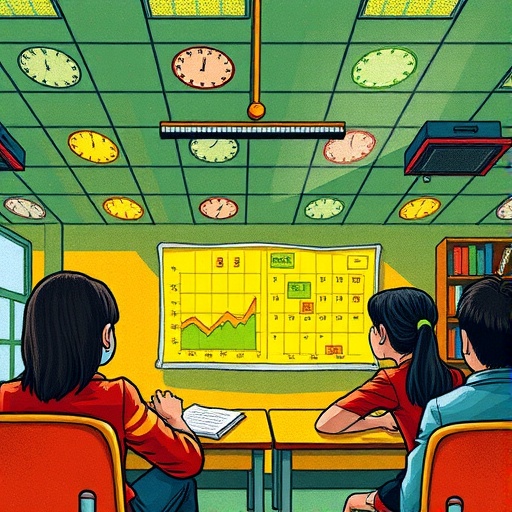
In recent years, the quality of education has garnered fundamental attention, prompting researchers to delve into the intricate relationship between various factors that contribute to effective teaching practices and professional development. A significant publication by Zhang, Ye, and Chen et al. explores these associations within the context of school environments. Their research specifically looks at the interplay between school climate, teachers’ self-efficacy, instructional practices, and perceived needs for professional development. This comprehensive study uses the 2018 TALIS (Teaching and Learning International Survey) data collected in Shanghai, offering a rich resource to analyze the dynamics of educational settings.
At the heart of the study lies the concept of school climate, which encompasses the relationships and interactions between students, teachers, and the school environment. A positive school climate is recognized as a vital component in promoting effective teaching and enhancing student outcomes. The research highlights how elements of school climate can influence not only student behavior but also the efficacy with which teachers approach their instructional practices. This relationship suggests that fostering a supportive and collaborative school atmosphere can significantly improve educational quality.
Self-efficacy, or the belief in one’s ability to execute tasks successfully, emerges as another critical factor in the study. Teachers with high self-efficacy are typically more resilient and are likely to employ innovative instructional strategies in their classrooms. This research argues that a favorable school climate enhances teachers’ self-efficacy, which in turn propels them towards more effective teaching practices. The results indicate that when teachers feel supported by their colleagues and school administration, they exhibit greater confidence in their abilities, leading to more inspired and effective instruction.
Moreover, the study reveals that instructional practices are deeply interwoven with both the school climate and teachers’ self-efficacy. Effective instructional practices are essential in cultivating an environment conducive to learning. The researchers employed structural equation modeling to illustrate how these variables interact and influence one another. The findings suggest that the enhancement of instructional practices relies not only on the individual characteristics of teachers but also on the broader climate of the school, demonstrating that individual teacher performance cannot be fully understood without acknowledging the collective environment they work in.
Professional development, another focal point of the study, refers to training and continuing education opportunities for teachers aimed at improving their skills and practices. Teachers perceive their professional development needs differently based on their experiences in the school environment. The research presents a compelling case that teachers in supportive climates feel more empowered to seek out and engage in professional development activities, indicating that a nurturing school environment nurtures a culture of continuous improvement and learning.
The data analyzed in this study not only emphasizes the need for creating supportive school climates but also informs policymakers about how to allocate resources effectively. By understanding the interconnectedness of school climate, self-efficacy, instructional practice, and professional development, educational leaders can implement strategies that support teacher development comprehensively. The implications for practice are clear: investments in school climate will likely yield dividends in both teacher satisfaction and student achievement.
This research is particularly timely, as educational institutions around the world strive to adapt to changing learning environments and challenges brought forth by the current global landscape. The findings underscore the need for schools to prioritize conditions that foster teacher growth and well-being. Therefore, school leaders are encouraged to cultivate environments that not only support academic achievement but also focus on the holistic development of educators.
Going beyond mere theoretical assertions, the study provides practical recommendations grounded in empirical evidence. By implementing initiatives that promote a positive school climate, educational leaders can strengthen teachers’ self-efficacy. Efforts might include mentorship programs, collaborative teaching models, and professional learning communities that encourage shared experiences and mutual support among educators.
As the study’s conclusions resonate within the educational sector, further longitudinal research could bolster the understanding of these relationships over time. Future studies could explore how changes in school climate influence teacher efficacy and resulting instructional practices in varied cultural contexts. This ongoing inquiry will be critical in refining best practices for enhancing teacher performance and, by extension, student success.
In conclusion, Zhang, Ye, and Chen et al. illuminate the symbiotic relationship between school climate, teachers’ self-efficacy, instructional practices, and professional development. Their findings advocate for a concerted effort in fostering supportive educational environments, which in turn can transform the teaching landscape. The research serves as a clarion call for educators, administrators, and policymakers to recognize the significant impact that a positive school climate can have on professional growth and student outcomes alike.
This comprehensive structural equation analysis provides critical insights into the underpinnings of effective teaching and learning models. The need to invest in educational atmospheres that are enriching and supportive cannot be overstated, as doing so will undoubtedly lead to more empowered teachers and learners in every classroom across the globe.
Cite Scienmag News
Courtney Benton. (November 28, 2025). Exploring School Climate’s Impact on Teacher Effectiveness. Scienmag. https://scienmag.com/exploring-school-climates-impact-on-teacher-effectiveness/
Courtney Benton. "Exploring School Climate’s Impact on Teacher Effectiveness." Scienmag, 28 November 2025, https://scienmag.com/exploring-school-climates-impact-on-teacher-effectiveness/. Accessed 4 September 2026.
Courtney Benton. "Exploring School Climate’s Impact on Teacher Effectiveness." Scienmag. November 28, 2025. https://scienmag.com/exploring-school-climates-impact-on-teacher-effectiveness/


