


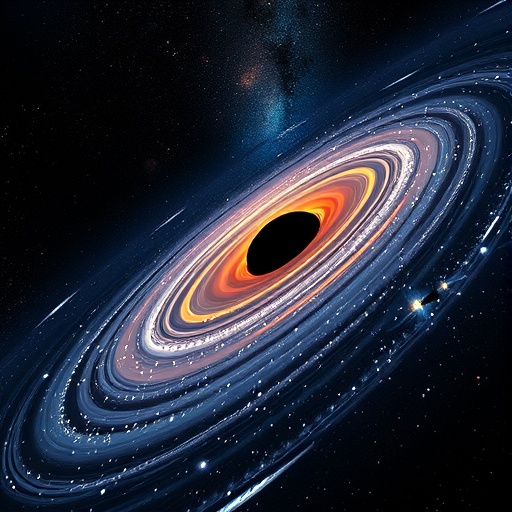
In a groundbreaking study that could redefine our understanding of the cosmos, researchers have delved into the enigmatic nature of primordial black holes (PBHs) and their potential gravitational-wave signatures. This investigation is not just a hunt for cosmic relics but an exploration of the very fabric of space and time itself. The paper authored by Bagui, Clesse, De Luca, and their collaborators promises to provide fresh insights into dark matter, the early universe, and the intricate dynamics of gravitational waves.
Primordial black holes are hypothesized to have formed in the very nascent moments of the universe, shortly after the Big Bang. Unlike their stellar counterparts, which are born at the end of a star’s life cycle, PBHs may have emerged from high-density fluctuations in the early universe. These fluctuations could lead to regions of space where gravity is so strong that it collapses matter into singularities, encapsulated by event horizons. Understanding the formation mechanisms of PBHs is crucial, as it can illuminate the processes that governed the evolution of the universe.
One of the most exciting aspects of primordial black holes is their theorized link to dark matter. Dark matter, which constitutes about 27% of the universe, remains elusive; it neither emits nor absorbs light, making it invisible to traditional observational methods. However, if PBHs make up a portion of dark matter, they could offer a novel pathway to study this mysterious component. Researchers are actively investigating the mass ranges of PBHs that could potentially account for dark matter, with sizes varying from a tiny fraction of a solar mass to several times greater than our Sun.
Gravitational waves represent a revolutionary way to observe astrophysical phenomena. These ripples in spacetime, first detected by LIGO in 2015, provide a means to probe the universe in ways that traditional electromagnetic waves cannot. The collision and merger of black holes can generate significant gravitational waves, which travel across the cosmic ocean unimpeded by the intervening matter. The study of gravitational waves from cosmic events involving primordial black holes could yield crucial data about their existence and characteristics.
One of the intriguing predictions made by the authors relates to the specific signatures left behind by primordial black holes as they interact with normal matter and other black holes. The merger of two PBHs could produce unique gravitational wave signatures distinct from stellar black hole mergers. As researchers strive to identify these signatures, advanced observational techniques and future gravitational-wave detectors will play a pivotal role. This research aims to utilize the advanced capabilities of the Laser Interferometer Gravitational-Wave Observatory (LIGO) and the upcoming space-based observatory, LISA, to capture these elusive waves.
Furthermore, the research takes into account the implications of primordial black holes on the inflationary models of the early universe. Inflation—a rapid expansion phase that occurred microseconds after the Big Bang—has been pivotal in many cosmological models. The dynamics of inflation could directly influence the formation of primordial black holes, presenting an exciting intersection of theories in cosmology. Understanding how fluctuations during inflation led to the creation of PBHs could significantly enhance our grasp of the universe’s evolution.
In addition to the theoretical ramifications, the observational aspects of this research are equally compelling. As technology advances, the sensitivity of gravitational wave observatories is expected to increase, making it possible to detect the minute signals produced by distant primordial black hole mergers. This enhanced observational capability raises intriguing possibilities for the identification and characterization of PBHs, potentially leading to a richer and more complex understanding of our universe.
Moreover, the paper discusses various scenarios under which primordial black holes might influence the formation of large-scale structures in the universe. If PBHs had played a significant role in the clustering of matter, they could have acted as seeds for galaxies and galaxy clusters, shaping the cosmic web we observe today. This notion challenges conventional wisdom about structure formation and encourages further research into how PBHs might be intricately woven into the very fabric of cosmic evolution.
As we stand on the precipice of a new era in astrophysics, the findings presented in this paper will undoubtedly stimulate discussions and investigations across multiple disciplines within cosmology. The journey to unravel the mysteries surrounding primordial black holes is just beginning, and as we explore the implications of their existence, we may be inching closer to answering some of the universe’s most profound questions.
The implications of detecting primordial black holes are vast, potentially altering our understanding not only of dark matter but also of the fundamental laws of physics as we know them. Scientists continue to seek answers, and with each new discovery in gravitational wave astronomy, we are reminded of the fluidity of our knowledge regarding the cosmos. Each gravitational wave detection invites deeper inquiry and encourages a collaborative approach to unravel the delicate threads connecting black holes, dark matter, and the very evolution of the universe itself.
In conclusion, the research led by Bagui, Clesse, and De Luca stands as a testament to the ambitious efforts in cosmology, aiming to bridge gaps in our understanding of primordial black holes and their gravitational wave signatures. Their insights spark excitement and curiosity, driving home the significance of continued exploration in the arena of gravitational physics and the quest to decipher the universe’s fundamental mysteries, thus paving the way for future discoveries in the ever-expanding landscape of astrophysics.
Bagui, E., Clesse, S., De Luca, V. et al. Primordial black holes and their gravitational-wave signatures. Living Rev Relativ 28, 1 (2025). https://doi.org/10.1007/s41114-024-00053-w
Cite Scienmag News
Grant Pearson. (August 9, 2025). Exploring Primordial Black Holes and Gravitational Waves. Scienmag. https://scienmag.com/exploring-primordial-black-holes-and-gravitational-waves/
Grant Pearson. "Exploring Primordial Black Holes and Gravitational Waves." Scienmag, 9 August 2025, https://scienmag.com/exploring-primordial-black-holes-and-gravitational-waves/. Accessed 6 September 2026.
Grant Pearson. "Exploring Primordial Black Holes and Gravitational Waves." Scienmag. August 9, 2025. https://scienmag.com/exploring-primordial-black-holes-and-gravitational-waves/


